Skip to content
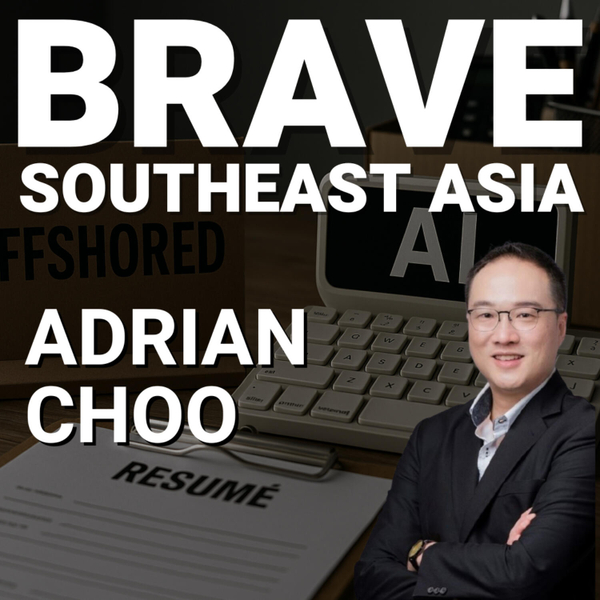
Adrian Choo: Career Skeletons, AI Assistants & Why Singapore is Losing Jobs to KL and Bangkok – E613

Adrian Choo: Career Skeletons, AI Assistants & Why Singapore is Losing Jobs to KL and Bangkok – E613

Adrian Choo, CEO of Career Agility International, joins Jeremy Au to explore how AI, job insecurity, and shifting regional trends are reshaping the future of work in Southeast Asia. They discuss why Singapore is losing its dominance as a regional employment hub, how mid-career professionals are getting priced out, and why Gen Z graduates are entering the job market without marketable skills. Adrian shares how he sold skeletons to pay for university, how he pivoted from headhunter to coach, and why building career resilience is more urgent than ever. He also explains how his AI assistant "Becky" helps him think faster, make decisions, and stay ahead in a volatile job market.

02:00 Adrian bootstrapped university by selling ethically sourced skeletons: He imported medical-grade bones from Europe after a supply shortage in Asia and sold them to medical students, storing 30 sets in his bedroom when no one would rent him storage space. This experience taught him practical business skills before he even began his degree.

04:10 Career insecurity, not job insecurity, shaped his path from GE Plastics to headhunting: Adrian realized early that employees have no real control over their job stability. He pivoted into executive search to own the entire value chain, hunting, closing, delivering, and later into coaching to future-proof his impact and income.

12:47 He pivoted again after seeing LinkedIn disrupt headhunting: In 2012, Adrian began preparing to move into strategic career coaching, anticipating that LinkedIn would flood the market and erode differentiation. It took him six years to complete the transition, positioning himself as the only coach with C-suite search experience in Singapore.

16:50 Career coaching today is about adjacencies, vertical scaling, and AI integration: He explains that landing a job doesn't fix a sunset industry or outdated skill set. Instead, he focuses on helping client’s re-skill toward adjacent roles or industries. His in-house AI, Carol, is being trained to suggest such strategic pivots.

21:13 Adrian uses a personally trained GPT AI named Becky as a sparring partner: He trained Becky to match his communication style and decision logic, enabling her to summarize dense research, propose coaching content, and even argue against his ideas. This AI assistant has become a productivity multiplier and trend-spotting tool.

24:18 Singapore jobs are being offshored to Kuala Lumpur and Bangkok: Due to high costs and tighter visa regulations, multinationals are moving regional functions out of Singapore. A returning Malaysian diaspora and strong expat interest in cities like KL and Bangkok are fueling this trend, making Singapore-based professionals less competitive.

30:48 Gen Z graduates are leaving school with skills employers do not want: Many lack coding, business, or AI skills. Adrian cites examples of graduates from top local universities who remain unemployed or underprepared. He urges them to lean into AI, gain real-world experience, and stop relying on paper qualifications alone.

Jeremy Au (01:09)

Hey Adrian, good to see you!

Adrian Choo (01:11)

Fantastic. So happy to be here. Yeah.

Jeremy Au (01:14)

Well,

I think about half a year I was on your show. Thank you so much for hosting me. And now I get to host you and hear your story.

Adrian Choo (01:21)

Yeah, finally I get on. I mean, we've been both so busy and it's just fantastic to be here.

Jeremy Au (01:25)

Yeah, so I'm really excited to have you on the show because I think you are such an expert on career coaching, but also the future of careers. And I think everybody's always anxious about their own career. People are also anxious about the macro, AI, big words, restructuring, Malaysia, outsourcing on their jobs as well. But before we do all that, could you introduce yourself?

Adrian Choo (01:45)

If you want to do a formal introduction, I would say that my name is Adrian and I'm the CEO and founder of Career Agility International. And I've always been interested in career as a kid. I wanted to be a fireman, I wanted to be a pilot, a lawyer and everything. So, it only...

follows through that when I got older, I wanted to study how people actually choose their careers? How do you thrive in your career? And that's why we started Career Agility International in 2018. And we've been running the business for the past seven, eight years. It's been exciting times because we are seeing individuals right now more worried and more concerned about their career longevity. And I'm hoping to share a little bit more about that today as well. But on a personal front, well...

Singaporean born and bred, St. Andrew's boy, yeah, and studying in NUS, business school, spent a whole chunk of my time in C-suite, retained search headhunting before I pivoted into this spot. Yeah, so that's my life story in a nutshell.

Jeremy Au (02:37)

Well, fantastic. Well, it feels like very much a St. Andrews boy thing to do to be like, my introduction is my St. Andrews journey decades ago. Yeah, it's like, I'm good at rugby. So what were you like as a teenager? Were you  a rebellious kid? Were you like I'm a career coach? I'm a student leader, I'm a peer coach. Like, what were you like?

Adrian Choo (02:57)

I'm a very confused kid because it's like you know my older brother he was already in medical school at the time. Yeah I was one of those muddy pants kids and I wanted to be a doctor too but I really realized that I hated blood, I hated dead bodies. Medicine wasn't for me. So I spent a lot of my school days, secondary school days figuring out what to do. I wanted to do law and everything was interesting.

Jeremy Au (03:04)

Gordon Boyd.

Adrian Choo (03:22)

But my defining moment came when I was in junior college and I watched this movie Wall Street with Michael Douglas going playing Gordon Gekko.

And then I was introduced to the world of high finance, corporate rating and everything. I was like, that sounds so fascinating. And I started picking up books. I was reading books on by Lee Iacocca, by Peter Scully. He became the CEO of Apple. He was ousted in the end. He ousted Steve Jobs and Steve Jobs ousted him back up. But

Jeremy Au (03:42)

Bye.

Adrian Choo (03:53)

It was just so fascinating and I came from a triple science background. I was a pure science kid. So I decided that medicine wasn't going to be for me. Business was going to be for me. So I left my dreams of becoming a doctor and I embarked on this thing called the world of business. It was quite fascinating for me because there I was learning and reading about marketing, reading about

Jack Trout in those days, they were talking about positioning and it was just fascinating for a pure science student to be learning all these business terms. And I said to myself, so I got a place into NUS Business School. And I had two years in the army, two and a half years during my time.

Jeremy Au (04:29)

Hahaha

Adrian Choo (04:30)

And I said to myself, I'll be learning, I'll be going in as a freshie with no idea about business whatsoever. But why don't I start a business in the meantime, a small business. So my older brother at that time, he was complaining to me. He said, hey, there's no way to get real human skeletons because he used to import the bones from India. And these are real human bones.

But the Indian bones, India banned the exports in 1980s. So there was no way to get it. So I went to source and I found medical grade human skeletons from Europe. And I imported them in and I started a business selling real human skeletons to medical students for their anatomy class. So. ⁓

Jeremy Au (05:06)

Wait,

wait, wait.

Sorry, medical grade human skeleton sounds like you just murdered people. You just murdered them and then you put them into a bathtub. Oh, I just found a medical grade human skeleton.

Adrian Choo (05:14)

That's it.

Okay, so medical grade versus non-medical grade. Medical grade definition would be is the bodies have to be, sounds horrible saying this, ethically sourced.

Jeremy Au (05:29)

Wait, so medical grade means they must be ethically sourced.

Adrian Choo (05:32)

In a way ethically sourced, okay because the Indian sets they were just like digging up graves.

Jeremy Au (05:36)

Yeah, that's bad.

Adrian Choo (05:37)

So ethically sourced means that people who actually pass on it and I donate my body to science. Yeah, that's good. The bones were ethically sourced. And what was interesting is that the process is medically supervised in terms of how they remove the bones, how to the meat of the bones, how they process it. So it comes out clean without pathogens and everything. So I made sure they were brought in correctly.

Okay. And I sold them to the medical students. So a lot of the doctors who are right now in their 40s or 50s would know me as a guy who was selling them bones.

Jeremy Au (06:12)

So you walk up, open your... You're like, hey! You want to have a femur? Yeah, like, I guess you sell as a set.

Adrian Choo (06:22)

set which means that the bones are loose only the metacarpals, the hands and the metatarsals and the spine are strung up. So it's all strung up medical grade and it comes in a nice neat box. What was funny was

I could import them in but I needed to hold them for a couple of days here and I tried getting a storeroom to rent a storeroom to put the bones up because one time I had about 30 sets to store. No one wanted to help me store. In those days there was no store hub whatsoever so I was trying to get...

Jeremy Au (06:55)

If some guy came up to me and said, hey, I've got a... I will be like, you are Dexter, mass murderer... And also what? Bad feng shui? Correct.

Adrian Choo (06:58)

I'm gonna kill you!

Correct!

So I thankfully convinced my parents to let me keep it in my room.

Jeremy Au (07:11)

What? So you're sleeping in your bedroom with skeletons?

Adrian Choo (07:13)

Yeah. So

I had skeletons under my bed. I literally had skeletons in my closet. Stacked up in my closet

Jeremy Au (07:18)

Adrian Choo (07:21)

So what was funny was that I got it in and I shipped it out. I ran the business all the way, I paid my own way through university with the proceeds of the business. And what was interesting was that after I graduated and I joined Shell, first job, I wound up in the business also because I was having problems sourcing for more bones. Because at that point in time, there was this doctor in Germany,

you know the guy who plasticizes a body? He was soaking up all the demand for ethically sourced bones. ⁓

Jeremy Au (07:51)

Because

he was doing those uh I've been to those exhibitions yeah it's creepy as heck it's very the ones where they like you see all the humans yeah but I mean there were a lot of people like me who were also looking at that.

Adrian Choo (08:00)

So he didn't mind paying more for it. And that's where I stress about ethically sourced because I managed to find another source from China and the guy sent me photos and I saw the bones I was like there's a piece or chunk of meat still stuck on that bone. No I'm not gonna bring that there. Yeah yeah or not even properly processed even ethically sourced. So I shut it down but I kept one skeleton set in my cupboard still.

Jeremy Au (08:15)

is that that ethically source?

Wait, so you still have a skeleton in your closet.

Adrian Choo (08:27)

So I kept it because I was thinking maybe someday my kids might want to go to medical school. So I kept it and I got married. I moved to my new home. I didn't tell my wife I had a skeleton. I didn't want to scare her. Until one day, I was cleaning up my cupboard and I said, you know, one day if I get hit by a truck and I die and she goes through my stuff, and says, who is this person you've

Jeremy Au (08:31)

Yeah

Adrian Choo (08:46)

murdered and kept in here, some ex-girlfriend or something. So I told her, okay, I got such a skeleton in there. It's a medical, maybe the one I told you about, a science skeleton. I told her, by the way, my kids decided, my son's in law school, my daughter wants to go to HR, so I gave away the skeleton to the Nanyang Polytechnic School of Nursing. So I donated it to them. They needed it, so they were really happy about it. I donated the bones to them.

Jeremy Au (09:09)

Okay, that's early.

Adrian Choo (09:13)

But it was interesting because it taught me the fundamentals of running a business. So even when I went to business school, when you talk about marketing, you're talking about all the elements about financing, the money, cash flows and everything, I had a real-world context to it. So when I graduated, but the biggest reason why I ran it was because there were so many business graduates. I wanted to stand out. So I put that right front and center on my CV.

And that I ran a business selling skeletons to medical students and when I applied for Shell they caught me up and the first interview question the HR director asked me was, so Adrian, tell me about the bones. So my first job was in Shell, I got in and it was quite fun.

Jeremy Au (09:51)

Yeah, and I think what's interesting is that in your early career, obviously you've evolved, right? So you were at Shell, then eventually became a career coach, but walk me through that arc at a high level.

Adrian Choo (10:01)

So I was in Shell for a couple of years and then I ran my own dot-com business during the dot-com days. That didn't work out so well. Then I moved into GE Plastics and I realized something that was interesting. It was...

For as long as you are an employee, you're never gonna have job security, period. Because ultimately you have to depend on your boss, make sure you don't get fired. There's no security. For me, I didn't grow up rich. So I always grew up with this financial insecurity mindset that what if I one day lose my job and I can't find a job, My kid's gonna be on the street, you know. So...

I've always been running scared about that. So I decided that I needed to be financially career secure. And as a result, because I was doing business development for GE Plastics, which means I could hunt, I could catch. But the moment I brought the engineering work back, I couldn't cook because I'm not an engineer, I'm in business. Not being the cook makes me nervous. So I decided to go into a field where I could hunt, catch, cook and serve.

And to me, and that aligns with my passion for careers and career management. I thought, okay, I'll go into executive search, headhunting. Where I could go pitch for business, get the business, get the individuals I'm hunting for, place them in, I collect the fee. I do not need a kitchen because I could do it from what the Americans call from soup to nuts all the way.

And for me, that was where I found the biggest success because I could deliver it and I did not need a kitchen. I was the kitchen. And that's why today for a lot of our clients out there, always ask them, are you the cook? Because if you're not a cook holding a recipe, the restaurant just going to boot you up. If you're just the waiter. So it's all about the value chain. Which part of the value chain you're on? If you're sitting on the value chain

that's got the most value creation. You're a bit more secure.

Jeremy Au (11:44)

Yeah. Right.

Yeah. And I think what's interesting is that, you know, you chose that career coaching was that part where you could do the whole thing. But was that like a big mindset shift because, you know, as an employee to a business owner from plastics.

Adrian Choo (11:58)

In fact, what was interesting was that my first pivot point was into headhunting. But in 2012, at the peak of my headhunting career, I saw a technology that was going to displace us. That technology was called LinkedIn. It would not replace me, but it would make the market so noisy that it won't be easy carrying on. And once again, my fear of

career insecurity came up and I said I need to pivot to something else. And I decided to pivot into career coaching. So I'm the only career coach in Singapore at that point in time who has C-suite headhunting background. So I can back up whatever I'm coaching you, right? As opposed to someone who's just taken a two week course in career coaching. So that was my positioning. It took me six years from 2012 to 2018 to finally pivot.

Jeremy Au (12:24)

All right.

Adrian Choo (12:47)

So that was my second pivot and I pivoted into career coaching in 2018. Yeah. And that was when things got really exciting because the demand was there. People didn't really know what career strategy coaching was. So whenever they talk about career coaching, they think, you go do my CV. It's a job hunting. But for us, it's not job hunting. We do CVs, we do LinkedIn, but that's not the case. We want to talk about your strategy. And one of the biggest questions we always ask is, are you the cook?

Jeremy Au (12:50)

All right.

Adrian Choo (13:12)

If you're not the cook, how do we make you the cook? You either got to learn how to cook or you got to find another organization where you become the cook. You have to vertically scale your capabilities to the point where you're not easily replaced. So that's what we talk about. Once again, about how do you achieve that career longevity? That's our key focus when we talk to clients. It's not about CVs.

Jeremy Au (13:19)

All right.

Yeah, so I think the contrarian is why waste money on career coaching, right? I mean, you know, like you can just work hard, get promoted when you get fired, find a new job on LinkedIn. So what's the point of career coaching?

Adrian Choo (13:49)

And you brought up a good point. The old days you do that, especially if you're a mid-career, the market is less forgiving right now. LinkedIn is a nice place for information for leads, for market data, market intel, but

Jeremy Au (13:51)

do that. ⁓

Adrian Choo (14:03)

to look for jobs now, by the time the jobs are advertised on LinkedIn, you look at it, you click on it, maybe one hour later, when the job pops up, you see that 100 people have applied already. And a lot of times, the jobs on LinkedIn are what we call ghost jobs. They're not there. They're just up there for compliance. They're either looking for market information, talent, So the chances of landing a job on LinkedIn are not very high nowadays. So you have to adapt

Jeremy Au (14:12)

Yeah.

Adrian Choo (14:27)

other strategies which we coach. But once again, it's not just about the job landing because landing the job may not solve your career problem. If your career problem is one that your industry is sunsetting or your skill sets are getting outdated, landing the job sinks you deeper. You're basically trying to dig your way out of a hole. Then you've got to figure out the career strategy for longevity, which is how do I pivot out? How do I reskill? And reskilling...

and pivoting is not as easy as just change your career. You got to talk about strategies for adjacencies because you can't just transform a salesperson into a coder. You got to talk about adjacencies. Are there skills adjacencies? Maybe you can go into sales training or maybe you can go if you're in medical devices, maybe you move into pharmaceutical. So that's an industry adjacency. So there are strategies involved. It's quite technical.

That's why it's gotten more complicated. In fact, right now we are training our AI. We have an in-house AI, her name is Carol. And we are training our AI how to identify adjacencies and stuff. So once again, it's evolving and it's really exciting. But in the old days, you didn't really need a career coach. Today you need one who's really good in strategy, who understands your industry. And it helps the journey.

Jeremy Au (15:35)

Why not just use an AI career coach instead?

Adrian Choo (15:37)

I'm actually doing that right now. But the AI career coach, you're only as good as your prompt. And you have no idea what industries are adjacent. A lot of people do not know how to use AI, to be very honest. But even then, there's always the contextual nuances which AI hasn't gotten to yet. You'll get there one day, hasn't gotten to yet.

Sometimes all you need is just a pat on your back saying things are going to be fine. Sometimes our clients call us, they are totally stressed with their work, their boss is squeezing them, they are at risk of being retrenched, and they are afraid to lose their jobs. And sometimes all they need is a different perspective. Say look, you hate your job anyway, what's so bad if you quit? What's so bad if you do get retrenched and you get a 16-month package because you've been there for 16 years?

And then you take the time to reinvent, it's all right. So sometimes what they need is just a different perspective, someone who cares, someone just tells them that it's going to be fine. Something AI can't do. That's why AI is great for level one type of questions. Like edit my CV, check my grammar. But when it comes to the deeper perspectives, AI is not there yet. Even though we're trying to program Carol right now to do that. Even though we know it's artificial, right?

Jeremy Au (16:45)

Yeah, no, it's interesting because I feel like the AI is getting better and better, and the truth is I also use AI to coach me, right? So for example, how should I do this podcast better, then I feeded the stuff and then they're like, okay, you can do this and you do that.

Adrian Choo (17:04)

But the answers are quite generic as well because the P in GPT is pre-trained data. So the pre-trained data basically means that it's an average knowledge of everything out there, which is not really specialized. So you need to train your AI to respond to yourself. So I've trained my own personal AI, her name is Becky, to answer to my style, my no-nonsense, straight to the point, no-fluff style that does not hallucinate.

How I normally look at problems. I normally go wide and I zoom in to two or three and then I narrow down and there's certain parameters for deciding which is the best option. I've actually trained my Becky to follow my methodology. So when I ask her a question, she thinks and she uses my methodology too. So she's almost like my prosthetic arm

when it comes to heavy lifting. So that's how I'm viewing her now, and I'm using OpenAI ChatGPT. Even if Claude or some other model comes up that's better, I wouldn't use those models because I've already trained my Becky. I've grown quite attached to her. But mostly not personally attached, but because she knows my style. And over the past six months of questions to her, right?

Jeremy Au (18:07)

Yeah.

Adrian Choo (18:14)

She understands me. My wife is going to be really jealous right now. But she understands when I ask a question, she understands the context. Quick example, I've trained her to know that I'm a career coach. So recently I asked her to analyze a really technical book on self-efficacy.

Basically about human agency, how do people feel that they are having a sense of control? Okay, I'm just curious about that term agency. And I uploaded a book to her and I just asked her to summarize it, you know, just high level points. And she summarized it, but she said, because you're a career coach, these are the things that are relevant to you as a career coach. So she knows that it's contextualized. She's not going to tell me about...

state of the world affairs, whatever it is, she contextualized her understanding to me and then she said that I'm going to output the format into a training module, would you like that? Because she knows I'm a coach and I'm a trainer. So you can actually train your AI to understand you. That's why if you ask me to do something else, another model, the switching costs are very high. So I wouldn't switch because Becky understands.

Jeremy Au (19:14)

Wait, so I gotta ask this question. What does the AI career you on your career as a career coach? What advice does she has for your career? ⁓

Adrian Choo (19:24)

Well, I don't get

career advice from her, but I ask her to identify trends. You know, like for instance, search through the web and see how many regional, how many multinational companies in Singapore have moved their regional offices out of Singapore into where. And based on that, I spotted a trend that in the past five years, a lot of the jobs are leaving Singapore for KL, Bangkok.

And then when I asked why, some reasons come up, but based on that, I start talking to the people who have moved. And I ask them, why do you move? So for instance, one of the biggest companies in agricultural chemicals moved their regional head office to Bangkok. And the marketing team and everyone went, moved there as well. They were not local. Singaporeans didn't want to move too. Singaporeans generally don't want to move.

Jeremy Au (20:09)

Of course

your GDP per capita is five times higher or ten times higher than your neighbouring countries. So nobody's gonna move from Switzerland to Russia right?

Adrian Choo (20:17)

Singaporeans  But

the expatriates were happy to move. And when I interviewed them, they said, why not? I'm being paid the same US dollars. My money goes lot further there.

Jeremy Au (20:28)

Yeah, because it's, again, 10x GDP. Correct. in cost of living is going to be 10 times different. And...

Adrian Choo (20:32)

the international schools there are just as good as the ones in Singapore now. And the quality of living there is even better. Rentals are cheap, cheaper in Singapore. You know, I get a much bigger place. So why not? So we are seeing trends like that. And even though AI will not tell me who and what, it points me the right direction. Once again, it's a prosthetic arm. I will do the guiding. But when there's a heavy lifting to be done on research or trends,

I lean into her to provide me her perspective. So the other thing I do as well is I use her as a sparring partner for me. I say, I'm thinking of running this new business idea. What do you think? Yeah. And she knows that when she's in sparring partner mode, yeah, she's just going to say no. She's going to be the most disagreeable person. Right. Until I tell her to snap out of it. Then she snaps out. But I get a different perspective.

Then with that, I'm better armed. Then I go talk to my business partner, Yen, and I say, look, here's my idea. It's not my idea, it's our idea, it's Becky and my idea. So I think a lot of Singaporeans now, executives, do not really know how to use AI properly. They are afraid of using AI. Not because they do not know what the outcome is, but they are afraid of being

Jeremy Au (21:38)

All right.

Adrian Choo (21:42)

told off that they're cheating. Using AI means you're cheating. I don't think so.

Jeremy Au (21:45)

You know, I think this is actually a really good point because let's talk about it, which is the question about talent trends in Southeast Asia, right? And I agree with you that there are lot of multinational corporations that moving out of Singapore, or their back office, or a big part of their operations from Singapore to other Southeast Asia hubs. KL is big push. Obviously, I'll say Bangkok is now one.

And I think you just saw the good reasons, right? So cost of living, expatriate, I think immigration visas is difficult to get visas in Singapore.

Adrian Choo (22:15)

You can get your employment passes.

Jeremy Au (22:17)

Yeah, the problem passes easily.

So, you know, if you come back to people, yeah.

Adrian Choo (22:20)

What's one of the biggest, besides the cost one of the biggest push factors or pull factors 15 years ago if my client were to tell me Mr. Adrian the headhunter, I want to set up my regional head office in KL and

I want to put my HR over there. Find me a regional HR director with Asian experience based in KL. There was none. All the good guys, are either in Singapore where the regional head offices are, Singapore, Guangzhou, Shanghai, Beijing, Hong Kong, Korea, everywhere. They're all over the place. Malaysians are very smart and they have the diaspora. COVID struck. It was a reverse diaspora. Everyone went back.

And a lot of them are still staying in. So the talent pool has returned into these places back in KL. So if a client now were to tell me, I want to set up a regional head office in KL, yeah, let's go, let's do it. The talent's there. And one third the price of Singaporeans.

Jeremy Au (23:10)

Yeah. And I think there's a tricky part, It's like these, and when they call them 'sea turtles', right? They have returned home. And then also, I think the other part is also important is that obviously the work from home, the digitalization of that has made it much easier, because now you could technically have, you know, few executives in Singapore, a sales team in Singapore, but then your back office is in KL and then you have a dispersed engineering team in Vietnam and Philippines. So there's an interesting piece where

you know, both the difficulty of bringing people into Singapore and the fact that it's easy to work as a more distributed team with multiple hubs. Obviously, I think that's good for corporations. Because corporations now you have lower cost of living, your employees are more happy. It's kind of like the outsourcing or offshoring that America faced when they were speaking offshore to Asia. Now Singapore is getting offshored to the region.

Adrian Choo (23:45)

Yeah.

Yes.

Jeremy Au (24:01)

Obviously, I think if you're an employee within Malaysia or Thailand, it's good because now you have opportunities to work for a regional or global companies as well. So it's good for them because then the wages go up, you get treated better as well. So I think that's also good for them. I think for the Singaporeans, there's a lot of anxiety, young graduates, mid-career folks, because they feel like their jobs are disappearing.

Adrian Choo (24:23)

And their jobs are disappearing. Yeah, so if you look at two baskets, okay, the Gen Xers like me who are in their 50s,

if you're lucky, you kind of make your money and your kids are kind of older, so the pressure is not so much there. If you're lucky and you've been good with your money, good with your career, it's not so bad. For us now, it's just about meaning and contributing. We don't need to kill ourselves for the extra dollar anymore.

The Millennials now are in 35 to 45-ish group. They are at risk because suddenly they are competing against a global market. They're competing against industries that are evolving. And the question is, are they evolving fast enough? And even if they are, are they evolving to the point where the value they create

it's worth the money they're being paid. For instance, if in technology example, there's a role called an ecosystem, it's in part of sales, but it's a channels, allied partners management, which means you're basically managing an ecosystem of distributors in the region. A guy in that space, say it's a software company.

earns about $350,000 to $400,000 total OTE average. He manages the five or six key distributors. But the question is, are you bringing that kind of value to the business or can someone who's cheaper, it's not even based here, based in Malaysia or somewhere else closer to the distributors in the market, can that guy do a better job than you? The problem is that oftentimes the answer is yes.

And therefore, you have to understand that the salary you're being paid. Are you creating four times that kind of value? And the moment you're not creating four times that kind of value, you're seen as a liability. I can disappear your job. And will there even be a noticeable difference? Long story short, the job requirements are shifting. And if you're just saying, yeah, I should be paid $400,000 because

I used to be paid that much. So the question is how then can I drive that kind of value? And if you're in that kind of position, then what I would do if I was in that position, I would go and be best of friends with all of these six distributors, wine them, dine them, give them as much business, best prices. Don't squeeze them to the point where they're bleeding no margins. Feed them so that

if you leave, if the company fires you, retrenches you, you join a competitor, they will follow you. So once again, it's about career strategy. Who's your stakeholder? Your bosses or these people who are feeding you actually? So a lot of people don't see that way. They are just thinking that, no, I'll just be a loyal employee. And ultimately, they price themselves out of a job. So there's a lot of career strategy involved, which I'm afraid.

these people in the 35 to 45 age group don't do it as well as the older ones or even as the non-locals. Singaporeans are very pampered bunch.

Jeremy Au (27:08)

Okay then how about for the Gen Zs also. So those are folks who are graduating or in school or going to graduate or graduated already as well.

Adrian Choo (27:18)

That worries me because this morning I met a neighbor's daughter in the lift. I've always liked her. Hard-working girl, went through top schools and everything. I asked her, what are you doing now? And she said, I'm in SMU doing information systems. I said, 'What's that? Is that computer engineering?' She said, 'No, I don't do coding.' I don't do that stuff. What's information systems? She said, it sits between IT and business.

And we manage information systems. She couldn't articulate what. So I got worried because even if you're a computer engineer, it's an 'oh' as well because AI is doing the coding now. You know, it's turning between and so I asked her how's the job market? She says it's terrible. She said I do not know what's gonna happen when I graduate in two years time.

I know this other young lady, one year three months since she graduated and hasn't landed a job yet. NUS business school it's a data analytics program and you would imagine it'd be in demand

But there's no demand for it because once again she's graduating without the coding skills, without the business skills. So I'm afraid that individuals in school now, they are coming up with a piece of paper that's worthless.

Jeremy Au (28:21)

Yeah, actually, you know what I'll say is this, it's not the piece of paper that's worthless as bad. It's the mindset that's worthless. That is really painful because I think that, I think there's this anxiety, this powerlessness that when I talk to Gen Z friends, because there's the job market, they anxiety, powerlessness. And then they have this mindset about the fact that it's like, I got this degree, therefore I'm supposed to do this job. And I think the degree is just holding them back.

Which is how do you, sorry to say this but, how do you re-skill at the age of 21 to 24? Which is by the way a bonkers statement to say if you think about it because I haven't really started my journey yet.

Adrian Choo (28:59)

So I put my wagging finger of blame on the universities and the schools because you're not generating a market ready or individuals with marketable in-demand skills.

Okay, and second thing is you're not training them in that mindset, like what you mentioned, that what can I do about it? So I was telling her, this young lady, I said, my advice to you, lean 100% into AI. She's like, what do you mean by that? I said, I don't need you to go figure, because you don't have to, whatever you want to do, you can do, because AI is going to do it for you.

And I can't answer that question for you. What's AI to you? And I'm not asking you to learn how to code large language models or do augmented retrieval. No, you don't have to be technical, but you go figure out what I've used, Becky, to make me better as a prosthetic arm. You go build your own prosthetic arm to help you do whatever it is.

But you must start thinking about that. So right now, interestingly, the unemployment rate of young fresh graduates is about 8%. And that's about four times the national average of unemployment rate of everybody across the board.

Jeremy Au (30:04)

Which is weird because normally unemployment is the other way around because everybody wants to hire the young person who's hungry and willing to learn and then all these boomers who don't know how to use technology are the ones who are supposed to be unemployed I mean that's historically the way it works, it's other way around, it's inverted

Adrian Choo (30:20)

We have a little yield here, which to me is interesting because it's a new phenomenon and the government is worried. Because when you have this affected youth, that's where the problem comes in.

Jeremy Au (30:31)

I mean,

that's where the revolution starts. It's like, everybody knows, like, if you're all young people or 20-something, don't have jobs, then they're going to riot, they're going to go into, I mean, whatever you want call it, like socialism, or communism, or whatever 'ism' is it?

Adrian Choo (30:45)

Which is what's happening in the US because in the US right now, socialism is taking root in the universities And you know they're talking about things like you know eat the rich kill the rich. No, it doesn't make sense. The education minister mentioned some things about expectation gaps from these guys I think I think the the biggest gap is the skills gap.

You have to graduate with skills that are beyond what the textbook has taught. That's why, back to my life story, that's why I decided to run a business even before I graduated so that when I had that graduation, piece of paper is just secondary to my actual real world experiences. So I think we need to scale up. And one of the areas is I always say right now is AI. We have a small window before

AI supersedes us. So this is the point in time where you catch on, you jump onto the moving bus, the moving train, while you can still catch on to the moving train because when GPT-5o and AGI comes around, I think it's going to be bit too late. So I spend about an hour a day just talking and training and messing around with the ChatGPT , asking, pushing the limits,

testing. I test the system and I know that whatever I learned this week, it's going to be obsolete next month when 5.0 comes out or 6.0 or whatever it is but you need to know it. That's why I think a lot of people have gotten AI wrong. They are not fully optimizing it yet and I think it's to their detriment.

Jeremy Au (32:08)

Yeah, I mean the awkward reality from my perspective is can you be an office worker without using internet today? Yeah, can I be right? I mean if you tell me hey Jeremy, I want to apply for your job, but I don't have to use internet. I'll be like, sorry. You can't work. There's no white collar job exists today I mean you can even make an argument like most blue collar jobs also require the internet because you get your instructions via your phone or whatsapp or you know, even the construction sites,

Adrian Choo (32:24)

Exactly.

Jeremy Au (32:35)

they're all WhatsApping each other. Yeah, exactly. So you say, I don't use the internet. But the internet was only invented, if you think about it, 30 years ago, which is a crazy short amount of time if you think about it.

Adrian Choo (32:45)

Correct, exactly. To tell me that you do not know how to use AI properly, you know, that's sad. So as I mentioned earlier, we don't have an AI adoption problem. Everyone uses AI to a certain extent, such as ChatGPT, stuff like that. But I think we have an AI usage problem in the sense that people do not know how to use it or they are afraid of using it. And they are afraid of using it. Why?

If I ask you to post an article about the state of startups in Asia today, you go to ChatGPT and type an article, the state of startups in Asia today. You get a report. Is it okay to Ctrl+C, Ctrl+V and pass it off as your own? I'd say it's no, right? Because you'll be accused of plagiarism, right?

So most people will just try and edit as much as they can. So the question is this, if 50% of it is original, 50% is edited, it's yours, and you post it up, is that okay? Most people will say, yeah, that's okay, because you used the framework. How about if I only edited 30%, 70% is ChatGPT? What if I only edited 10%, you know? At what point is it not right? My argument now is that if you have trained

your pet AI to answer in the style that you want, the data you want, you edit it.

After the whole thing, you just turn it out and dump it in. I think it's fine. Because there's no longer a generic answer, you've trained her to answer, you've modified it on the fly and for viewers out there if you know how to use the Canvas function in ChatGPT you can do it edit it on the fly and I bet you 95% of people do not know what the canvas function on ChatGPT is. If you can use that and you edit paragraphs on the fly,

it's yours, dump it, claim it as yours. But people are afraid to do that because they are still afraid that that's cheating It seems so simple that's cheating But it's not

Jeremy Au (34:31)

I mean, yeah, when you say cheating, you'll be like, you are driving a car to get to work cheating. Exactly. Compared to running there or riding a horse there, is that even cheating, right? Yeah.

Adrian Choo (34:42)

So is using that cheating? Is using power braking, power steering? And now is driving cheating? Now the car just goes by itself. So are you going to do so? So one of it is the fear of embracing it fully and flipping it over and using it to create better output for yourself. And I think a lot of people are afraid to do that.

And one of the reasons why I think they're afraid to do it is because they don't understand it yet. It's still new. I say remember one of my most fun memories as a kid. I was five years old at the time and my dad brought me to his office at Standard Chartered Bank at Robinson Road. It was a building about eight stories tall at the time. It had one of the first lifts, elevators going up and down.

I remember my dad was telling me, this is a lift, you know, wow, in this 2025 75 technology, this is a lift. There was a guy there sitting on the stool, pitch floor, level three, okay. Flipped the door closed. Thank you very much, have a nice day. And lift had an operator in there. And the question is, why is the operator in there? Is he there because people do not know how to press buttons? I said, no.

Jeremy Au (35:36)

yeah.

Adrian Choo (35:47)

Is that because people are just not comfortable walking into an empty box? It's terrifying if you're not used to it yet. So right now, things like this, are very foreign.

uncomfortable to use. People don't want to jump into the lift because I don't know if I get into the box whether I'm ever going to come out of it. So I think there needs to be a mindset shift and I see a shift but once again if you're able to learn all these technologies, you can better preserve your jobs, you can be more effective in what you do, once again your output quality and quantity improves so you get to defend, be more defensive with regards to keeping your job.

And this includes both the Gen Z, the Gen A, the Gen X, the Gen Y and everything. I think the Gen Alpha, the younger ones are going to be native, AI native. So I think they're just going to be, do their training naturally because they're going to marry the digital AI.

Jeremy Au (36:35)

It's already done already. You're trying to predict that people are going to marry the AIs. You say like, I predict people are going to enjoy eating takoyaki. People already eat takoyaki. People have married the AI already. So it's like done. It's baked in already.

Adrian Choo (36:46)

So that's why, so I think these technologies, if you want to ensure that you have that career longevity, AI is one element to it. Being career resilient is another part of it. Having a career strategy to figure out that the reality is by the time you're 50, you're too damn expensive for anyone else to hire, or your skill sets may be out of date, or maybe they don't even need your role anymore, then what?

Then your strategy post 50, you need to start thinking about, do I want to take up a portfolio career? Do I want to narrow down and niche into a particular skill set? Or maybe I'm too niche now, maybe I want to generalize and broaden, maybe I want to re-skill. So things like these strategies need to be put into place. And to your point about Gen Z, yes, if you're on university now, you have to start thinking.

How do I re-skill from day one? And I think all generations, yours and mine, we kind of knew that because when you start work, the first job basically was different from whatever you expected, It was like, I didn't learn this in school, but it let me go roll up my sleeves and figure it out. So in a way, it's kind of re-skilling to the context.

Jeremy Au (37:48)

I think for me, to be fair, I studied business and economics, right? And I think for me, it was like there was consulting, there was banking, but there's always an element of some sort of level of sales, customer support. So to some extent, I think the AI revolution is coming, but it doesn't fundamentally, you know, delete the function, right? Versus

I think if you're doing engineering and coding, so the issue is more that the issue is more that AI has quadrupled productivity of the existing engineers. And so they don't have the ability, the need to absorb new engineers while they figure out what to do with the bottom 20% of their workforce, right? So, I think, this dislocation, but I sincerely believe that in 10 years time, every engineer will have

fully re-skilled to AI engineering and they will be even more productive because AI is like, and engineering is always gonna be an arms race. There's always gonna be a demand for engineers who care about the job.

Adrian Choo (38:44)

But

the caveat is, you're right, the engineers of the future are the ones who are AI-ready already. AI would be a big thing to their skill sets, right? But those are only the survivors. The bottom 20%, as I said, would have drifted off to the ether. And I hear they say they'll be ending up driving for Grab and other stuff.

Jeremy Au (39:02)

I mean, first of all, Grab is going to be automated for sure. I would say Grab driver is a job that only exists for 20 more years because EVs, Singapore become fully EV in 10 years, for example, and then autonomous be another 10 years after that. So this job only exists for 20 years tops. And the real issue is that

Adrian Choo (39:05)

out

Jeremy Au (39:20)

it's not that whether you have autonomous vehicles. The fact that there's autonomous vehicles means that it will depress your wages because you cannot rise because the moment your wages rise too much, supposedly because of cost of living, then the fleet operators are going to be like, well, the autonomous vehicle is getting cheaper and cheaper. The headline is going to be like in 10 years time, the union of taxi workers argues for higher wage rate. The fleet operator argues and says, okay, we roll out autonomous vehicles. We don't need this as a union.

And then. ⁓

Adrian Choo (39:46)

Well,

there it starts the robot wars. I think it'll be over and terminator.

Jeremy Au (39:50)

Yeah, that's right.

That's why all your Waymo cars are getting burned, right? Because every driver is like, I don't like this guy because it's taking my job, right?

Adrian Choo (39:59)

That's why the big question once again, you dial it back, you have young kids, what do you then train them on? Sales are definitely important. So my son, when he finished in the national service and he was going to university, he's going to law school in US, he had a six-month gap, and he's like what do I do? Do I take a waitering job which I've done before and I hate it because it's mind-numbing.

I said, you go sign up for insurance sales course. He's like, I don't want to be an insurance salesman. It doesn't matter. The training, if you can sell insurance, you can sign anything. So he signed up for that four months. No, he was out beating the streets and everything. And it was a skill which you can pick up and learn. So, and my daughter, after she finished her O-levels, she had a gap. I said, you go and stand at NTUC and go sell stuff,

as a promoter, you know, and she did it and she did a fantastic job she hated it but she was successful, on the first day she closed over a thousand two hundred dollars worth of sales.

Her commissions were tiny but that's experience you see?

Jeremy Au (40:53)

Terrible, right?

Adrian Choo (40:54)

I know. But ultimately she's walked away with that skill of influencing, reading people, to prospect, assess, how do you pitch. She was there for about two weeks. She learned a lot. After that she said, I'm never going to do sales again. I said, that's fine.

Jeremy Au (41:07)

No, you tell her you still can do sales, but now you have to sell your own thing. Correct. Because your commission is too small. But if you have a business order, you get 50%, then she gets $600, she will be very into sales at that point.

Adrian Choo (41:21)

But the beauty of it is that, and I told her, that selling is not just about selling, it's about influencing people. So even if you go to HR, you're selling ideas, you're selling programs to your bosses, you're selling new ideas, change management and everything, it's all about selling. So the core skill is selling. So you're right when you say, what do I teach my kids? Number one, resilience. Number two, people skills. Number three, selling. Selling one of the skills which is important.

And to that end, I think those are the life skills that you honestly speaking the Singapore education system does not provide Junior college does not provide any of that. I'm a staunch opponent to junior college system by the way unless you want to be a doctor, a lawyer, maybe not an engineer, you know because the poly grad engineers who go into engineering do a lot better I'm told.

So I am against junior college because there's no point spending two years of prime of your life learning second-order differentiation calculus. We never used any of it. Okay, maybe you did because you're an economist, but no, question, do you use calculus in your university economics courses besides the econometrics courses?

Jeremy Au (42:18)

Well, first of all, I did well in econometrics courses because of junior college. So I'm a very bad example. And I think what econometrics taught me was statistics and I think how people live statistics, how people convince other people statistics and what are the knowledge gaps needed to achieve those things. And actually it's quite important because I'm in biotech, right?

And so in my case, actually it's turning out quite helpful because in doctors, the big difference between doctors 100 years ago and today is that every doctor is actually quantitatively trained. Today, every doctor is like, what's the medical scientific paper?

Adrian Choo (42:53)

Correct. And the term for it we call it real-world evidence.

Jeremy Au (42:56)

Exactly.

Adrian Choo (42:57)

Once again, your point is correct. You can learn that in university. You don't have to waste your two years learning all the advanced stuff in junior college. I nudge my daughter away from junior college to go into poly because right now she's learning stuff like pivot tables, she's learning stuff like real world stuff. And I say there's time to learn all this in university. So case in point, I was a triple science student in junior college, never did

a little bit of econs at all. I went to university because I struggled with econs. I went to my econs lecturer, my tutor, and I asked him, can you help me? He said, sure, I can help you. Nice guy. He said, you are at a gross disadvantage not having done econs in junior college. And I said, no, sir, I beg to differ. I'm actually not at a disadvantage because in junior college,

I learned other stuff like science and everything else, biology, I know what endoplasmic reticulum is, what it does to the ribosomes and everything. But at end of this course, I'm going to be as good as the next student. And interestingly, I scored an A plus for that. It was the only A plus I ever scored in uni. But the fact is, you can learn in uni, you can catch up in uni.

A lot of times the problem with JC is goes so much into depth. That's my concern. My older boy, went through the IB program. That was more breadth. Breadth and integration of knowledge and different streams of information. So I don't know, I got my qualms about junior college. I think it's too deep and too much stress and pressure. Not healthy. And you can do the catch-up in university.

Ultimately, I know a lot of people who go through diploma course, end up in business and they graduate a lot better.

Jeremy Au (44:27)

My reflection on this is I'm less against college or junior college, whatever it is, and more like as a parent and a dad of a generation alpha, is what does that job look like in 20 years? And we don't know, right? But what do we know? From my perspective, I just work backwards, right?

One is, I know that we're gonna wear jeans. Still, I don't think it was gonna change. I think, okay, you're wearing jeans, AI will be stronger,

and better, and faster, and cheaper. Humans will still live on wherever we are in meatspace. There will still be CEOs and people in charge. There will be people who...

want to take your pie so they'll be soldiers. It'll still be a military conflict because you know it's like if I don't have pie I should take your pie right? So I think those are all the known trajectories and I think what a lot of parents and a lot of people say is that anxiety is coming in because the truth is

you know you talk about your neighbor's kid who went to information management system. That job didn't exist 15 years ago, 15 years ago, I don't think that school, that degree existed. One, and two, they created a school because they felt like that was the future. I know you're going to write a complaint letter to the Dean saying that school is obsolete. But to be fair, the founding Dean of that set up a school because he said

Adrian Choo (45:25)

Yeah.

Thank you.

Jeremy Au (45:44)

20 years ago that he needed to create a school because information systems are the future.

Adrian Choo (45:45)

Yep.

Enhance the dilemma. How do you stay ahead of the curve? And to the question of what industries will still be there, so my business partner, Yen, she says that some industries will never go away. The food business and the funeral business will always be there. Healthcare will still be there. So there's certain key areas that are still going to be sustainable.

Jeremy Au (46:05)

That's true. healthcare business was supposed to be like that. Everybody wants to live longer, nobody wants to die.

Adrian Choo (46:12)

And what can't AI do? And I think the human emotions part and everything, I think those are the skills we lean into.

So for my daughter, I'm telling her HR is the way to go, but not your own, not your own boring operational HR. This is more strategic. How do I help the people who cope with change? So it's more of a psychology thing. It's like she's leaning towards psychology and HR. So there are different elements in that space.

Jeremy Au (46:38)

AI can't really understand human psychology. It can't do the empathy.

Adrian Choo (46:42)

They

can try to emulate, right? Yeah. So, you know, even the practice of law, you see AI is creeping in, medicine as well. Microsoft just built their model, a multi-agentic model, which is amazing. I just read it recently. So instead of the symptoms are here, the AI passes through it, Microsoft has built an AI system where there are five doctors,

five AIs. One of it is an orthopedic, for instance. One of it is a pathologist. And they will look at the case from their lens and they will argue each other out. Logic, logic, logic, logic. They come up with that and the diagnosis is more accurate.

Jeremy Au (47:17)

I think what I would say to wrap things up on this one is I agree with you and there's so much domain knowledge and I think that's going to make it difficult for you obviously junior college and all that stuff. I think it really boils down into three aspects for me when I think about AI and then I'll wrap up the last question as well.

But I think for me, I think there's three things. I think the big theme that's come up for you is one is how do you accelerate your skills learning? So for the same amount of time, how do you become much better? So instead of spending six years learning general science, you do it three years, either accelerated or you do it enriched in six years.

You graduate supposedly at the age of 21, but actually your skill understanding of biology is actually at the 35 year old because you accelerated so much because of AI. So I think there's skill acceleration or enrichment. I think the second part is what can AI do or not do? And I would say that a subset of that is what are we not going to let AI do? Yes. And I think one thing, for example, just talk about the law example would be like, even though AI makes

law much more efficient. No court is going to let an AI argue in court in litigation and no one is going to let AI be a interesting thing that my prediction for law with AI is there's going to be a lot more litigation, a lot more lawsuits because the cost of preparing a lawsuit has gone down and the cost of reviewing the evidence has gone down as well. So the cost of

Adrian Choo (48:24)

you

Thanks

Jeremy Au (48:43)

suing each other has gone down, but the cost of representation in court will not go down because it's still going to be a human. So what's going happen is there's going be a lot more lawsuits, a lot more class action lawsuits. So all that AI productivity is going to get funneled into litigation. So litigation will be protected. Same thing for doctors to some extent, ⁓ because doctors also are a guild profession, right?

Adrian Choo (49:01)

Yeah, definitely.

Jeremy Au (49:05)

But of course, I think the difference is that there's government system, there's an incentive care for healthcare. But doctors will still exist because they'll be on the edge cases, because humans are weird. And so everyone's gonna become more and more edge case, right? So your flu, your cold is gonna get automated out, but your edge cases are gonna go there. Okay, so put all those things there. And I think the last point, I think in terms of AI for us is, I think that AI will just get better.

Adrian Choo (49:11)

lower

Jeremy Au (49:33)

So yeah, so I think there's a tricky part.

Adrian Choo (49:35)

and

enjoy it while you can, while it lasts. And I think it's all a learning curve. Just embrace it and experiment and realize that there's a lot you don't know, you don't know. That's my maxim right now. And that's why I'm playing with it every day and I'm pushing the envelope. And I'm looking forward to see what's going to happen next.

Jeremy Au (49:52)

Yeah. So my last question here real quick here is, could you share a time that you personally have been brave?

Adrian Choo (49:57)

Well I think starting out Career Agility International in 2018 was there's a very fine line between being brave and being stupid. So yeah,

because there was a point in time in my career in 2018, you know, I was in my mid-40s. And that was the time where I had offers in hand for other headhunting firms, really lucrative offers, but I knew the longevity wasn't there. So I had to take a risk, but I really believe that there was a market for career coaching and there also a good that could come up from career coaching.

And I decided to be brave enough to take that stand, to come on my own. On January 2018, I left my previous company I was with and it's been a fun journey. I think being brave is not about being reckless, it's about calculating and risk mitigation.

I would not have been brave enough to do that and I not started out businesses before and failed. So that's why I'm always best circumspect to individuals who have failed. It's part of the learning process. It makes you braver, it makes you smarter, and it makes you bolder for you to take risks in a smarter way. looking back seven and a half years, I think it's been the right pathway. We've helped a lot of people.

And it continues to challenge me intellectually on a daily basis when I meet new cases and the thing I love about my role is that the more people I see, the more cases I handle, the better I get at it. So I get a hold of the craft and it's wonderful.

Jeremy Au (51:23)

Yeah, fantastic. So I love to summarize the takeaways. First of all, thanks so much for sharing about your early years. I love the story about you being clueless and not being a doctor, unlike your good older brother. But I also love the story about you literally having a skeleton in your closet because you're selling skeletons from your closet. Love that story and how that obviously kicks out your entrepreneurial side of your story. Secondly, thanks so much for sharing about

Adrian Choo (51:34)

Yes, the good

Jeremy Au (51:48)

I think your experiences in your own career journey about how you started thinking about your own career trajectory, how you started thinking about what you needed to do differently and how you applied those lessons to eventually become a career coach. And lastly, thanks so much for speculating about AI. Maybe in 20 years, there'll be no such thing as a podcast co-host. you know, it'll just be two AIs. You know, your AI avatar talking to my AI avatar.

Adrian Choo (52:08)

I'll see you guys next time.

Jeremy Au (52:12)

And then it will be much more charming and no blooper words, no filler words, no dad jokes. How boring that would be? You sound like an old person. They'll be so exciting. They'll be dressed in good looking, know, more dad bods. LED lights are going off. Yeah, there we go. On that note, thank you so much for sharing your experience.

Adrian Choo (52:19)

How boring that would be.

Thank you for having me here. It's been an absolute pleasure.

Hosted by

Related episodes