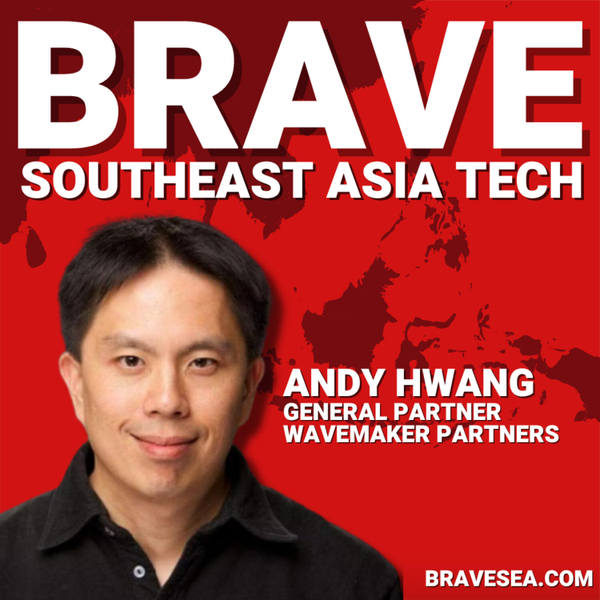

"As a male in Asian society, there is this stigma against asking for help. Mental health oftentimes is brought up as people will look at that and they'll think it’s not real. They think you should just work and that the more you work, the less you'll think about that. But, with everything around us now, all of that noise, I do think it's important for everybody, particularly for those on that startup journey to ask for help. It's well-accepted that if you're a musician who wants to do well in your field, you should have a teacher. It's well-accepted that if you're training for the Olympics you would have a coach. But for some reason, that hasn't translated into all of the fields out there and it hasn't translated as well from the West into this part of the world. So that's something that I want to change." - Andy Hwang
"There's a myth that VC is about a capital business, but I would disagree. VC is very much about the people because good people will always have options. Good founders will always have multiple investors that want to work with them. Good limited partners or people who put money into VC funds will always have options of where they invest their money. I see it very much as part of Wavemaker and what we do, we are in the people business as much as, if not more than, the capital business because if we can build trusted relationships with founders and with limited partners and bring good people who always have alternate options together, that's the only chance that we do well." - Andy Hwang
"I've never been a founder. I've only worked with earlier-stage companies. Both capital and mentorship or coaching are important that's why I think a VC firm needs both. Having a bunch of coaches, but no capital isn't going to work and it's not that sustainable. If you have VC firms that have a ton of capital to pour into founders, that only works for so long because my hypothesis is that, if you're going to be a VC firm that delivers the best returns for your limited partners, you're going to need to find the best founders. So when the capital was free, then you saw the founders taking capital from everywhere. But when that capital is not free, it won’t be just about growing. It’s also thinking about how you run a business, build a sustainable team, and eventually create value as manifested by creating profits. Profits are a great sign that your customers value what you're offering, and they're willing to pay more for it than what it costs you. So in this type of environment, which I would characterize as normal, it's got to be a combination of people that can help you on the capital side, and people that can help you on the business." - Andy Hwang
In this episode, Jeremy Au speaks on early financial curiosity, capital versus coaching in VC, and risk assessment.
Keywords: Andy Hwang, Early Financial Curiosity, Capital vs Coaching, VC Risk Assessment, USA, VC, Founder Story