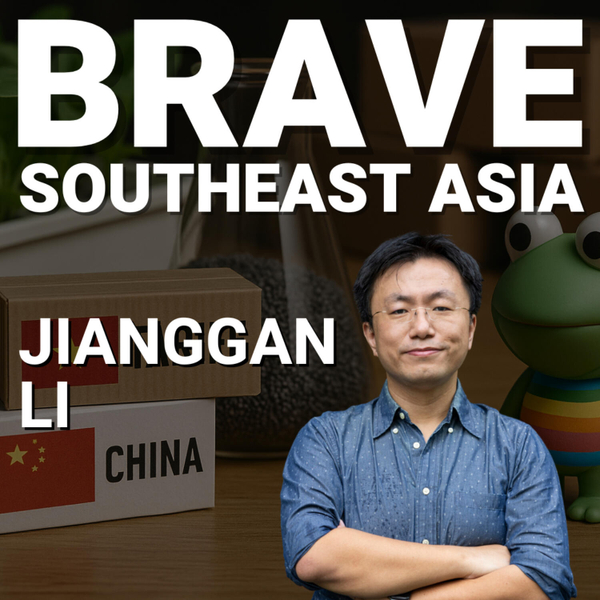
"Chinese companies or Chinese operation teams are much better at doing operations on TikTok because they grew with the rise of Douyin in China. They know short videos much better than brands in other countries that are still figuring out how to deal with TikTok. Throughout their short 15-year history, Chinese brands have always operated in a fast-changing, highly competitive environment, making them more nimble. This advantage comes from the environment that trained them, not from being inherently better. Whether that is sustainable in the long term, I don't know." - Jianggan Li, Founder of Momentum Works
Jianggan Li, Founder of Momentum Works, joins Jeremy Au to unpack the evolving trade dynamics between China, Vietnam, and the United States. They compare Vietnam’s swift concessions with China’s calculated rare earth strategy, discuss the blurred lines of transshipment, and explore how Apple, Pop Mart, and Labubu reflect larger trends in global manufacturing and consumer behavior. The conversation also reveals how Chinese brands are outpacing global competitors in TikTok marketing and why luxury culture in China is undergoing a quiet transformation.
02:28 China used rare earths as a strategic trade weapon: Jianggan references a Deng Xiaoping quote from the 1980s highlighting rare earths as vital. China’s long-term planning turned these materials into a key negotiation tool, influencing American industry pressure and leading to relaxed US restrictions without an official announcement.
04:56 Vietnam offered zero tariffs on US goods to secure a deal: Faced with a sudden 46 percent US tariff, Vietnam’s leadership moved quickly. To Lam personally called Trump and agreed to a deal where Vietnam’s exports would face 20 percent tariffs, suspected transshipped goods 40 percent, and US imports would enter Vietnam tax-free.
08:41 Vietnamese factories feel pressure from China’s scale and efficiency: Mid-sized business owners in Vietnam, even those driving Porsches, admit they can’t compete with China on speed and cost. The concern is especially acute for standardized products without strong local customization needs.
13:20 Transshipment rules are hard to define and even harder to enforce: A Made in Vietnam label can apply if 40 percent of value is added locally but calculating that percentage is difficult. Inputs often come from China, and enforcement depends on both accounting practices and political discretion across borders.
17:25 US criticism of Apple’s China ties expands across party lines: A Daily Show clip highlights Apple training Chinese factories and hollowing out US jobs. This marks a shift in criticism from being Republican led to becoming bipartisan, with concerns about offshoring now voiced by Democrats as well.
29:22 China’s middle class shifts from luxury logos to quiet quality: Before the pandemic, wealth was flaunted through bags and status goods. Post-pandemic, that has changed. Consumers now see luxury as a stupid tax and prefer high-quality domestic brands that offer better value.
34:03 Labubu’s rise shows China’s edge in branding and execution: Pop Mart succeeded by combining designer signings, local manufacturing, and fast restocking strategies that undercut scalpers. The brand also leveraged deep operational know-how from Douyin, giving it a major advantage on TikTok over Western brands reluctant to invest in the platform.
Jianggan Li (01:08)
Hello, half a year has gone.
Jeremy Au (01:10)
Both of us are travelling and working really hard so...
Jianggan Li (01:12)
I got platinum for three hotel groups in the first half year. I mean it's always nice but it shows the intensity. I was telling a joke to a friend that the other day when I went back to my apartment I was trying to swap a car into the...
Jeremy Au (01:17)
What? That's so nice. Was that a nice hotel?
Yeah
So where were you traveling to?
Jianggan Li (01:35)
Mostly China and Vietnam.
Jeremy Au (01:37)
What was the kind of like situation there?
Jianggan Li (01:39)
So a number of things, we mainly look at the whole sort of e-commerce and cross-border trade ecosystem. So to China it's usually to Hangzhou and the surrounding cities and where there are lots of like traders, there are lots of manufacturers, e-commerce platforms. To Vietnam it's largely to Ho Chi Minh City and the surrounding where there's lots of trade going on as you can see. And of course this half year has been coupled with lots of surprises,
Jeremy Au (01:59)
So let's talk about it right because you know, I think the last episode we had it was about kind of like the liberation day all the tariffs and something I'm packing a lot of it and I think there were two big shifts that happened since then one of course is there was the
negotiation between Trump and China on the framework. So I think there's a lot more certainty as of now. And obviously, I think recently just a few days ago, Trump announced a resolution to his negotiation with Vietnam as well. So let's dive deeper into both of these. So let's maybe look at them as a totality instead of looking at them one by one because it's related. They call it big brother, little brother, right?
Jianggan Li (02:34)
It's kind of related, right?
Yeah, it's more nuanced than that. I mean the flags are similar, it's run by the Communist Party, but there are lots of nuances.
Jeremy Au (02:39)
Hahaha
Yeah, so lots of nuances, but I think, you know, from a Southeast Asian angle, there's some similarities. So I think maybe for my summary, at a high level for the China framework, I think it was very much driven by a sensation that there was an initial pause of tariffs, then eventually there was a negotiation. Big component of that was the rare earths materials was a big sticking point. And of course, there continues to be a big push on like Chinese IP and Chinese semiconductor chips. And on the Vietnam deal that was recently announced, a big point was really about transshipment
of Chinese goods and what its country origin, i.e. which are Chinese products. Anyway, I'm just kind of curious how you see both deals from your perspective.
Jianggan Li (03:20)
I think
somebody sort of, I don't know, found a quote of Deng Xiaoping many years ago saying that Rare Earth is strategic, we must control it. Like said in the 1980s or something. So I do think that from strategic planning point of view, I think at least the leadership in China has been looking at all these potential choke points for themselves as well as for the global economy. So I do think that lots of planning has gone into it. So that led to what was happening today, where they have something,
which they can see that okay, in a trade war I have this card which I can use in extreme circumstances, which I think they have used that. I think it shows some results, right? Because you read the news like the auto CEOs went to Trump to say that hey, we can't run our production in America without Rare Earth. So that led to negotiations and...
It's kind of curious, right? I mean, it's been a few weeks after they've concluded negotiations and nobody has announced the results. Yeah. But you see some movements, right? Some of the permits have been granted and some of the sort of restrictions from the US side have been relaxed. I suspect they have reached some kind of agreement. Yeah. But they have probably both concluded that it was not a good idea to announce that agreement at least during that time.
Jeremy Au (04:31)
Yeah, so I think one of the tricky parts is it feels like the Chinese and American negotiating teams kind of want to make a deal, but it does feel like the public optics of it is very much like America has to show that they are strong in terms of negotiating with China and I feel like China doesn't want to lose face. Yeah so
Jianggan Li (04:47)
Likewise, right? that's probably
the reason why they didn't announce the results of the negotiation. I think for Vietnam it's probably a different story. The country is extremely export-led and FDI-led. And I think when that 46 % was announced, it was a shock to everyone. And everyone was just scrambling to say, OK, what can we do about it? Versus if you look at China,
at least the businessman, the manufacturing process, my hometown, they've been going from shock after shock since 2018. I ⁓ think psychologically it's bit different. And the General Secretary Lam of Vietnam was the first to reach out to Trump to have a call. And he offered free, zero tariff for US goods to enter Vietnam. So that's indeed what was agreed, at this time, it was announced by Trump and To Lam.
Jeremy Au (05:13)
you
Jianggan Li (05:31)
So if you look at the current deal that they have concluded, of course, I mean, it's good for Trump. It was like the first deal announced. I'm not sure how many deals will be announced between now and the end of the extension period, which is in a few days. In that deal, exported goods from Vietnam would be paying 20 % tariff to the US. But...
those who are considered trans-settlement from third country, which usually I think means China, will be paying 40%. And the US goods will enter Vietnam tax-free. I think it's always interesting to put a bit of number into perspective, right?
The Vietnamese export to the US last year was about 140 billion USD and the US export to Vietnam is like 12 billion. It doesn't matter much if Vietnam offers it like a tariff free to the US. But of course, if Vietnam loses or has to pay like six entirely for their export to the US and that's hurting the economy a lot more.
Jeremy Au (06:24)
So
I think there are two parts to it. So one of all is I agree that there's a contrast in the China and Vietnam
approach. Yeah. And I think it's a function, like you said, first of all, size, China's bigger, China has rare earths, and China has been dealing with effectively some kind of tariff structure since the first Trump administration. I think in terms of negotiating posture is like totally different, right? So China, whenever Trump raised the tariff, China also raised it, right? hit a hundred plus together, tariffs, and then now they've gone back down together. So I think it was very symmetrical.
And I think it was very clear that it was like a tit for tat. I mean, game theory, right, it's called tit for tat. It's supposed to be like, whatever you do, I do exactly the same just to show you that, you know. And then we've calmed down, we also go down the same way, which is exactly how it's played out.
Jianggan Li (07:12)
But you need bargaining chips to be able to do that.
Jeremy Au (07:15)
Yeah, you need bargaining chips exactly because you can't fold if you don't have it. Whereas Vietnam, I think, played it correctly as well, which is that as a smaller country that's much more export reliant, they just went for the fold, you know, in a sense where they straight away surrendered on the tariff component by being the first and fastest, right? And so they never raised tariffs. They kept everything backdoor, diplomatic, and they offered zero tariffs straight away. Unlike, say, EU or the UK that have some
some longer negotiation and so forth. So very different strategies that I think have worked out for both countries actually. I don't know, I haven't checked my X, Twitter account last night so we may be wrong. Things are gonna change.
Jianggan Li (07:57)
Since January, I started checking Truth Social because you get it first time.
Jeremy Au (08:01)
Yeah, exactly, right? Like why wait for it to be reposted on Twitter? You should get it faster on Truth Social. I think one interesting dynamic is talking actually about was this a good deal for America? I mean, obviously, from Trump's perspective is
this is obviously success for the China side and this is success for the Vietnam side in terms of their trade approach. So I think that's a victory by the US government administration. But I'm just kind of curious, do you feel like...
US got what they wanted or that at the end of the day, these negotiations was beneficial to America.
Jianggan Li (08:38)
I do think that there is some issue with trade for the last few years because honestly looking at, I've been to lots of manufacturing plants in China and I've been to similar facilities in rest of Southeast Asia and in my last trip to Vietnam I spoke with quite a number of...
medium sized business bosses. I Those who drive a Porsche.
And I just feel that I sense a kind of anxiety for lots of manufacturing bosses from Vietnam. They said that, OK, there's no way we can compete against the Chinese in terms of efficiency, in terms of scale, because they have such a large domestic market and whatever they do overseas, especially in areas where not so much sort of localized customization products need to be done, they're just going to be more cost efficient than us. So what should we do about it? So there's this fundamental issue in that.
And the question is that when the US government sees it, there's this narrative that, okay, we should not compete on like low cost manufacturing, et cetera. But I think if you look at manufacturing in China, it's happening like with all the different sectors, advanced manufacturing, they just sell the aircraft carrier in Hong Kong, right? I mean, if you look at the scale of things. obviously you feel that you want to do something about it.
But the question is how and what is the right thing and there's no perfect solution. So how do you rebalance trade or rebalance the dynamics? I think it's tough to say that what is right, what is wrong. I think last time we discussed about, everything's in Trump's head, but
I think one addition to that is that there will be lots of people around him who try to influence him in different ways, which will make it even harder to guess what's going on in his head. So from the US point of view, I do think at least Trump will score a face win. I said, OK, I have struck a deal, and they are paying the tariffs, even though the consumers in the US are paying the tariffs, because most of the exported stuff from Vietnam would be consumer goods.
Jeremy Au (10:12)
No.
Jianggan Li (10:27)
And one component of the deal is that the transshipment will pay 40% tax. I have spoken with some friends in Vietnam. I don't know if they have an idea how to properly identify that. And it's probably less of a technical issue rather than political issue, how to identify what as transshipment. They do have standards of what would be recognized as a met in Vietnam. But the question is that...
so for this 40% tax, who recognises that? Is it the Vietnamese authorities or US authorities or negotiation or whatever? So it's complicated.
Jeremy Au (10:58)
So let's talk about why it's complicated because I think transshipment has something that we've always kind of known at a high level but never really gotten a little bit more into detail. So let's go into that. So from my perspective,
the American perspective is I have a high tariff on China and Vietnam has a lower tariff. So I'm worried that Chinese goods will be moved into Vietnam through logistics and then come to America and basically bypass the higher tariff I have on Chinese goods. And so therefore I want to make sure that there is a higher tariff on Chinese goods that are transship via Vietnam. So, okay, conceptually, I think that makes sense to me.
Because basically what he's saying is, I don't want you to smuggle and get through the territory.
Jianggan Li (11:39)
So
I set some rule and you don't find a loophole to bypass this rule, right?
Jeremy Au (11:43)
Correct.
And this is actually a real problem because I think I was reading an analysis by economists and basically it was saying that the terrorists from Trump administration, the first administration about...
the headline figure of course is X, but because of the very loose enforcement of these transactions, et cetera, the tariff effectively rate was effectively half of the headline tariff rate because everybody's not paying the tariff, right? You know, the taxation. So, okay. So I think the concept really makes sense, but I think the part that's getting tricky and let's talk about it is what is a Chinese good versus a Vietnamese good, right? So obviously if you had a farm and you,
raise a durian tree on a Vietnamese soil and then you send it to America then obviously there's a Vietnamese product and obviously if you have Chinese phone that's 100% example that manufactured in China and then goes through Vietnam to the port only through the logistics and then that's the Chinese good. I think the in-between is tricky, right? We're just let's say you have a factory in Vietnam that is assembling phones but
80% of the components come from Chinese factories. But then obviously there's a labor component that you're also adding on top of that, which is quite significant. So how would you trade ship or how would you label that?
Jianggan Li (12:53)
I have not gone into the details about what is recognized as a Medi Vietnam or sort of official certification, whatever, but I do have two friends who told me that for both their sectors, I'm not sure whether that's across the board or just for their sort of categories of goods specifically, if they have 40% of value at Medi Vietnam, they can consider their products like Medi Vietnam. And then here comes the question, I mean, how do you recognize this, this like 40%, right? So...
if 80% of the value of the components came from China, but what was the value added? I mean, of course, the cost is one thing. And the second is that, I how do you declare your books to customs or whatever. There are lots of different accounting treatments to that. So I think it's a bit hard to, I think it's a bit hard to police.
Second thing, people look at all these Chinese schools, they say that is always because of like, you know, enterprising Chinese small companies who are, selling factories in Vietnam, et cetera. But if you look at the structure of Vietnam's exports to the U.S., I mean, Samsung alone is like 40%. And Samsung is a large actor. And it has the power to direct its suppliers to move their production or move their sort of sourcing, et cetera. So last year I spoke
with the GM for Vietnam of large Chinese electrical appliance company. And he was telling me that he was very grateful for Samsung. I said, why? Samsung forced so many of our suppliers to move their production to Vietnam. It made life easier for us. Because previously they had a source from China either. But the problem is that these are still Chinese manufacturers and we go a little bit upstream, there's still lots of things being produced in China.
So how to decipher this and how to break this apart and how to set policies with so much complexity, I'm not sure how much of that is a technical issue versus a political issue. That's what we discussed about.
Jeremy Au (14:33)
Yeah,
I think I actually like what you just said, identification is that,
there's actually a nexus between obviously Vietnamese labor and Vietnamese kind of like plants, right? But there's also another component of the Chinese components, Chinese factory bosses, or I'll say supply chain suppliers. And then there's actually a big chunk of like Samsung or Japanese, I don't know what you call it, master or anchor kind of like factories or products who are actually coordinating the whole show, right?
I think when we look at the 20% tariff and 40% transshipment tariff on Vietnam, it's not necessarily applying to Vietnamese companies, it's also applying to Samsung products that have been run out of Vietnam as well.
Jianggan Li (15:19)
To be very honest, I'm not sure how much of that is true. Vietnamese companies are funded by the Vietnamese, actually running operations in Vietnam. And of course for large companies, a lobby, right? So I don't know what's really going on behind the scenes.
Jeremy Au (15:31)
I think it was interesting because I was watching the Daily Show by Jon Stewart and there was a journalist called Patrick McGee and he was complaining about Apple. He was basically saying that Apple invested billions of dollars into China's economy.
training up factories, training suppliers. And I think both of them were arguing that this basically destroyed American jobs and, you know, kind of like train a new generation of Chinese electrical engineers and so forth. So I thought it was interesting because I think historically there's a lot of criticism of that, obviously from the Republican side, but this is the first time I've seen that criticism in the mainstream democrat side as well. So I'm just kind of curious how you think about that.
Jianggan Li (16:12)
What do I think about Democrats?
Jeremy Au (16:13)
I don't think you're voting. I think there's this new emerging criticism of Apple because I think previously, you go back like even to one year ago, not everybody liked Apple, right? And everybody was thankful. Like everybody wanted iPhone. And everybody was thankful for everybody to have an iPhone because if iPhone, you could actually, I don't know use apps, use AI apps. You can use your software as a service apps.
Jianggan Li (16:15)
So.
Jeremy Au (16:38)
I don't think anybody's ever complained about a cheaper iPhone. It's not as cheap as Android for sure. I think an Apple iPhone has gotten better value for money over time.
Jianggan Li (16:41)
was not going cheaper but...
This kind of issues get politicized and the truth probably doesn't matter anymore, right? And when things are not going well people find things to blame. It's always easier to find something to blame than try to explain to people what actually it is, so so the perspective of manufacturing jobs from the US I have heard lots of like narratives and lots of podcasts lots of shows and stuff. I think what I liked the most was,
so there's this podcast by the US journalist Barry Wise, I think Honestly or something. once she, mean just a few months ago, she interviewed Nell Ferguson, the British historian. And Nell Ferguson was saying that...
the root cause of the issue in the US is that education has not caught up with post manufacturing. Basically, you are left with a lot of people whose education level can only suit that kind of manufacturing. But as the industry moves on, as the whole economy moves on, they're left behind. That leads to lots of grievances and stuff. And he was drawing parallel to what happened in Scotland.
He talked about like post manufacturing so deindustrialization so the place where I am from somewhere in Scotland and
I saw that since I was born, like many years ago. And he doesn't see anywhere to go back to the sort of glorious old age. And people need to invest in their education to move up to actually tap into new value creation. But the problem is that for the existing generation, it's tough.
Jeremy Au (18:15)
Actually, I think there's a good point because I think I was watching this anecdote and I think there was a debate between I think Obama and the Apple CEO. ⁓
Jianggan Li (18:25)
That was
when Obama was still president.
Jeremy Au (18:27)
Yeah,
I think there's an argument about, I think Obama wanted jobs from Apple to be in America. I think what the anecdote was was that he asked that and then Apple was like, hey, we're looking for hundreds of thousands of engineers. They don't exist in America. And then, you know, And then I think the story of the anecdote
basically goes both ways, right? One is because the American government doesn't have enough electrical engineers, therefore Apple could not do the factories because they have electrical engineers, process engineers, and so forth. So they fly their designers and their folks to China to build those factories. Or the other story is that America...
should have forced Apple to build those factories and by building those factories, it would have forced Apple to train those engineers in America. So I think that's the anecdote kind of goes both ways, right?
Jianggan Li (19:12)
So the question goes, right? I mean, if you want something to take off and you need all the pieces, right? You need all the pieces and who's going to pay for everything? So the narrative, Apple says that China has it, which means the Chinese government has already trained enough engineers or built enough engineering faculties that can train enough engineers. So the government or the society is shortening its cost and Apple is tapping into it. If Apple were to do it in the US, building factories, training engineers, it has to shoulder the cost on its own.
Yeah, so of course I mean for rest of the business decision if there are no sort of rules or regulations and you will naturally gravitate towards the low-cost solution. And
that's natural, right? So if the US government in the very beginning said, hey, you can't go to China, you have to train engineers here, then Apple would be left with no choice. And then there will probably not be such a big debate now.
Jeremy Au (20:00)
Yeah, so I think the trade-off that was happening, right? Which is if America had forced Apple to not build factories in China, then the next question would be Apple probably would have built factories elsewhere in the world. And they could have built it in India or Vietnam as an example, right?
Yeah, so unless
America, kind of like 10 years ago said, Apple can only build factories in America.
Jianggan Li (20:21)
Yeah, but 10 years ago, 15 years ago, the problem is that at that time globalization was remote. So consumers were saying that, yeah, so amazing that they move the factories there and we have cheap goods.
Jeremy Au (20:34)
Yeah, Apple stock value went up like crazy because from a shareholder perspective, which was primarily US asset owners were basically saying, we like the increasing efficiency, the return on investment, consumers get to buy more Apple stuff. And Apple's...
Jianggan Li (20:46)
Consumers like cheap
Jeremy Au (20:50)
revenue stream a big traffic come from services and the services can only happen when there's a lot of people using the devices who are cheap you make money on Apple TV, Apple music, you know Apple iCloud storage, digital services and App Store. so
Jianggan Li (21:04)
So like 15
years ago it was political to talk about globalisation. You would not have such a backlash because now people have seen the consequences and many people have to shoulder these consequences themselves.
Jeremy Au (21:18)
Yeah, I guess
in a multiverse, multiverse, if somebody had forced like American factories can only build in America, I think first of all, Apple would be a smaller company because these phones would be more expensive.
I think, yes, there will be more engineers in America because they will be forced to train engineers and set up the vocational. But I think what will happen is that Android will have won, because Android will continue working with the Chinese and so forth. So in order for that to happen, you can't only say Apple can only build in America. You also have to mandate that Android phones in America, Google, can only be built in America as well. In which case, Google will also be a smaller
company. ⁓
Jianggan Li (22:00)
The whole pie
of the economy will be smaller than we have today.
Jeremy Au (22:03)
Apple and Google stock will both be down because if you only force Apple to build in America, Google go bonkers. And it's also another company, American shareholders and lot of retirees invested in Google stock, right? So, and every Android phone is training their Google AI models today that only exist.
Jianggan Li (22:11)
Google is also American company.
Jeremy Au (22:21)
American AI models all that training data comes from American Apple iPhones and Android phones, right? So I think the tricky part is I think we can make a point of view of Apple but I think I find that one of the tricky part is that people don't think about the the full other scenario, right? Okay, you're telling us that America Apple should only build in American factories, but then what's the full impact of that?
Jianggan Li (22:45)
Well, the problem is that we try to run a narrative with the public. It's hard to teach people the full picture because, I mean, try to explain that. It take like a few hours,
Jeremy Au (22:55)
So.
Jianggan Li (22:56)
I actually learned this from, I read lots of books about how Mao Zedong, the Communist Party leader, led revolution in China. And a lot of that is that, we are the right choice and these landowners are evil. And of course, there are lots of landowners who are benevolent towards the peasants, but it doesn't matter, right? Because your objective is to win the revolution and it's much easier to find someone to blame than trying to explain to people what it actually is.
Jeremy Au (23:19)
So yeah, so I think this journalist is good. It was a quite interesting. I think I suspect be actually quite influential because the subtitle is like how Apple was captured by China.
Jianggan Li (23:31)
Yeah
Jeremy Au (23:32)
So I
was like, this is going to be a viral hook, for both the left and the right. I think what's interesting is that I think we've also seen a lot of Chinese brands learn from Apple and other American consumer brands. So I think there's been a kind of interesting part because I remember like, oh my God, like 20 years ago,
obviously the Chinese brands were always seen as you know...
Jianggan Li (23:53)
There were no Chinese brands, there were Chinese products.
Jeremy Au (23:55)
There's a good attack line, there's no Chinese brands in 2008, only Chinese products. So yeah, I mean, but I think there's a crux of it, right? I was like, and everything was really about cheap, cheap, cheap, cheap, cheap. In fact, there's only just starting to be a crackdown
on Chinese fakes because at the time I don't even remember there was all these counterfeit markets where all the brands were all being cloned like crazy and that got cleaned up right before the Summer Olympics.
Jianggan Li (24:19)
The conflict is still there, but they take different forms and take different audience because I think the urban middle class of Chinese consumers have grown out of that. But there's still a large percentage of society in China as well as in the West who value counterfeit cheap products.
Jeremy Au (24:36)
You can get a Louis Vuitton bag for $1000 or $100.
Jianggan Li (24:42)
I actually went to a market and saw someone was guarding in there and I said, yeah, it's all domestic brands. No, you can still buy the sort of counterfeit international brands. And she went to talk to someone and someone started showing me the things they do. I said, wow, okay. I I wouldn't be able to tell whether it's fake or not.
Jeremy Au (25:00)
Yeah, and I think the problem has been because it's taken a few forms, right? One is that specialized counterfeit factories the counterfeit products secondly I think the factory is a subcontractor or supplier of that good but they just do a production overrun to just you know so they just produce an extra 10% more product and then they sell it on the side.
Jianggan Li (25:19)
And they're much more cautious now, I would imagine, right? Because the brands are taking stricter sort of enforcement and stuff. But when you look at, The thing is, people talk about low quality goods and stuff. I remember when I was in primary school back in China, people around me,
Jeremy Au (25:21)
Exactly.
Jianggan Li (25:34)
the choice is between nothing versus something. And the quality was not a big concern. When the economy was first started to lift off, you don't really have that much means to produce good quality stuff. And anything that works is good for you. But as the economy grew, and there will be certain segments of customers who moved beyond that. And that's like after 2008, after all this, the 4 trillion incentives, whatever the economy was going, then people started buying
sort of branded goods. And post pandemic the whole sort of narrative or the whole sentiment shifted. I was just talking to a friend last week, she works for a large sort of oil company. And she was telling me that, before the pandemic when she goes to a client meeting, every client say, huh.
Mr. Miss so and so and so I can see that your income is not rising because you because you are you're carrying the same bag as you did half a year ago.
Jeremy Au (26:26)
It's horror. Wow, that is so direct.
Jianggan Li (26:29)
That's
brutal.
And but post pandemic and people I think somehow I mean something that the pandemic or the policy around the pandemic shift psychology yeah, so all is a good quality and If you're paying for like no luxury brand you're paying a 'stupid tax'. Because you can get similar quality at a much lower price point. I think that reflects a couple of things to me first is the psychology of the consumers of the sort of middle class and above consumers has shifted and second is I think
the domestic grants have caught up in quality.
Jeremy Au (26:59)
I think
maybe one thing I'll add as well is that I think also the Chinese government philosophy on like ostentatious luxury symbols. Cause I mean, there's a joke back in 2008 is like you could tell who was Chinese if they were wearing Louis Vuitton from head to toe, right? You know, cause that was like the mark on obviously we didn't know whether it was counterfeit or real Louis Vuitton, but that very ostentatious like wearing all
international brands. And then I think after Xi Jinping's kind of like crackdown on like corruption and on like public displays of very large amounts of wealth, or whatever you now call it, then I think the sentiment also shifted away from like wearing very obvious displays of western luxury to, I don't know, what do call it? Like more domestic affordable luxury goods.
Jianggan Li (27:44)
Yeah, I know.
So you see the shift but the shift is it's not uniform across the society just last night I was talking to a friend who's obviously made some money and he's saying that oh I'm considering buying a Rolls-Royce Cullinan, and I said why I mean it's hard to drive it's big and you know why would you want to do that? He said oh because two friends of mine have got it so it's still a bit
If I don't get it.
I mean, every like billionaire or multi-billionaire drives a Toyota Prius. So you see this as utility rather than a symbol. And I do think it's happening in sort of the middle class and the urban sort of educated class and with the factory owners and stuff. you still see people wearing like a full Louis Vuitton and stuff.
Jeremy Au (28:32)
Yeah, I think the key thing is that I think from my perspective, I think when you look at Europe, for the people who are truly rich, they don't show it because they know that if they show it, they'll get taxed by the government and people will hate on them and then they'll get a backlash and everything. So to me, I think my reflection is that I think in Europe as a result, the ultra rich are very invisible.
Jianggan Li (28:55)
Yeah, it happens after like two or three generations. You don't need to show it.
Jeremy Au (28:58)
Exactly.
So we need to show it in terms of the experiences they go on holidays. They have leisure. They're doing art. Yeah. And then a lot of money is being done handled discreetly by their money managers who are investing. I think Jeff Bezos, you know, kind of like booked the whole Venice, right? So, and I was thinking to myself, I don't think any Chinese billionaire would dare to book Venice for
you know, if they booked that number of days of Venice, I think Xi Jinping would probably have something to say about that.
Jianggan Li (29:27)
It's
definitely better to stay low profile. And that's not new, right? Throughout history, you see any rich businessman who became too extravagant and too exposed, it's not going to end well. I mean, you look at the entire history across dynasties, it happens like that.
Jeremy Au (29:43)
What happens is
like, I was reading some Chinese history books, it's like the richest man in China, then he gets summoned by the emperor, and then he gets taxed like 50% or something like that, right?
Jianggan Li (29:54)
If you get taxed, that's already a better outcome.
Jeremy Au (29:56)
Rather than being... Yeah, exactly, exactly.
Jianggan Li (30:00)
But the jokes aside,
I think what would be interesting is to see all these Chinese brands who have now kind of beaten international brands in China. I have a bunch of friends who sell international brands in China and they generally retreat in all the sectors, even in luxury. So people go to traditional Chinese like Laopu. Laobubu. No, Laobu. Yeah, similar to Laobubu. Laopu is...
It's a trader of gold. They design their products and stuff. They just opened out in Singapore. So all these people have become domestic competitive and many of them are trying to be international competitive now. I mean you see Mixue everywhere and Lucky now is going to Brazil and Labubu, I mean it's crazy.
Jeremy Au (30:42)
Yeah, Labubu. So I never understood Labubu, which is this viral, frankly from my perspective, pretty ugly doll.
Jianggan Li (30:50)
Either
and I have three colleagues in office who buy Labubu regularly and I've been talking to them they don't understand I mean they couldn't explain why they said okay just you just the more you stare at it the more you sort of get drawn with it the more you want to buy. and
Jeremy Au (31:03)
No, you know what I'm It's like the Barbie wave. There used to be a Barbie wave, right? People buy a lot of Barbies. Wasn't it other, I forgot, there's American wave of doll buying. I can't remember.
But I think a lot of it is socially driven, is that, you know, it's like, if everybody likes Britney Spears, I must like Britney Spears. Therefore, everybody likes Britney Spears. Because if you don't like Britney Spears, you're a weird person. And now it's like, it's almost like Taylor Swift. Everybody listens to Taylor Swift because everybody else is listening to Taylor Swift. So there's a little bit of you know, kind of like curve.
Jianggan Li (31:20)
Yes.
Jeremy Au (31:32)
it's a good example because I think you need a lot of things to get correct, right? You need the marketing you need to do the endorsements I think there's a lot of stuff to learn.
Jianggan Li (31:40)
I know a couple of investors in Pop Mart before Pop Mart became big and there was lots of narratives and stories. I do think that Labubu is, so they've signed a lot of designers, different kind of designs, different doors and stuff. But what they have built is a system behind it that leverages the manufacturing in China who can produce these things rapidly and at decent cost.
And they've signed all the designers and it's a matter of time or it's a matter of luck that something like Labubu becomes something sensational. But the company has been very profitable for a while. I mean, historically it goes through ups and downs, but they have figured out how to manage this. I would think that the key here is the patience of the founder.
So now if you look at Labubu has become so sensational and you see the methods that they are doing that they are doing a lot of things to try to deflate this because because I mean it's like the economy right and once it can become overheated if it comes crushed down like yeah that's going to cause lots of lots of damage so so so so so a few weeks ago they restocked some of the popular goods they are really fast which basically crushed some of the resellers hoping to like make a quick
profit. So I think it'll be interesting to watch as a business model as for the toy itself i still don't understand.
Jeremy Au (32:58)
Yeah,
so I think this is really interesting, right? Because at the end of the day, what you're saying is, if you look at the whole value creation chain, it's leveraging the Chinese supply chain, you used to make teddy bears, and make Barbie dolls, and now it makes Labubus. But the cost is very low.
Jianggan Li (33:16)
Some of us has paid that cost to build this supply chain.
Jeremy Au (33:18)
Those factories are making lots of different types of dolls and lots of different products they're not only making labubus. So And then the next layer is that this Chinese brand instead of American brand has figured out how to make it, create a portfolio of products, design it, iterate on it and make it go viral.
Jianggan Li (33:34)
And also I think about that, Chinese companies or Chinese operation teams, are much better at doing operations on TikTok. Because these are the guys who grew with the growth of Douyin China. So they know short videos much better than brands in other countries who are trying to figure out how to deal with TikTok.
Jeremy Au (33:50)
And
I think a lot of I'll say a lot of brands in America don't want to do TikTok because they keep thinking that TikTok is gonna get banned, because of that they just don't want to invest into it. They rather invest in YouTube or X or Instagram because they know that it's gonna be around.
Jianggan Li (34:03)
But when we look at all these Chinese brands, throughout their history, short history, 15 years, they've always been in this fast-changing environment, cut through competition. So they're probably much more nimble because of that. Not because they're inherently better in that aspect, but it's the environment which trains them this way. Is that long-term sustainable? I don't know.
If it's a game of how do you adapt in an environment where TikTok dominates people's time, I think these guys have a playbook.
Jeremy Au (34:29)
Well, I think the one thing we can all agree on is that in 10 years, the entire world is going to buy more Chinese brands because the marketing will continue to better, the prices will continue to be good, and so there's going to be that value capture, I think, versus other brands.
Jianggan Li (34:42)
I would think so. I think in absence of extreme regulatory action, I don't see any way this will play out otherwise. See you.
Jeremy Au (34:50)
On that note, thank you so much. See you next time.