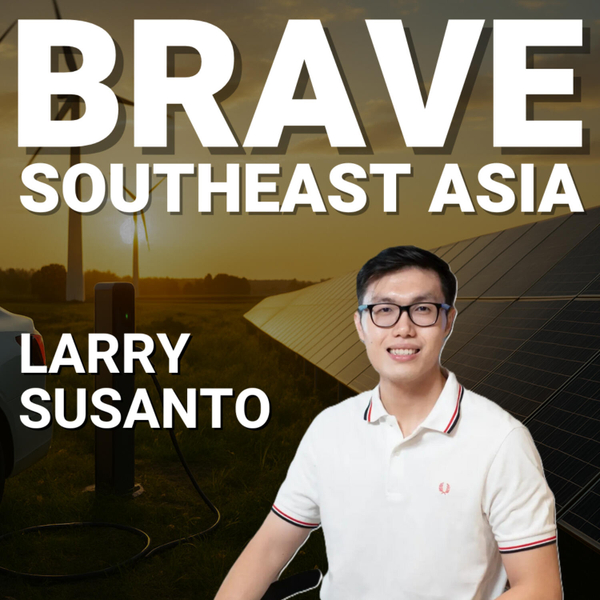
AVP of Investments at ACV Larry Susanto and Jeremy Au discuss Larry’s journey from a Berkeley-trained engineer to a climate-tech investor shaping Indonesia’s sustainability future. They trace how his career evolved across research, product management, and consulting, and how Southeast Asia’s climate ecosystem compares to Silicon Valley’s innovation-driven model. Their conversation explores Indonesia’s renewable potential, capital gaps, and the role of government policy in turning natural resources into long-term value creation. Larry also shares how courage, learning agility, and purpose guided each of his career leaps across industries and continents.
00:00 From lab to venture capital: Larry shares how curiosity for chemistry and sustainability led him from UC Berkeley to the Bay Area’s solar startup scene.
05:32 Choosing home over the U.S.: Larry reflects on returning to Indonesia to give back despite visa hurdles and more advanced R&D ecosystems abroad.
10:42 Strategy at Bain: Larry deepened his business acumen, joining sustainability projects such as EV strategy, plastic recycling, and Bain’s Green Economy Report.
15:12 Climate tech in context: He contrasts the West’s deep-tech innovation with Southeast Asia’s business-model adaptation and localization approach.
19:36 ACV’s five climate pillars: Renewable energy, electric mobility, energy efficiency, climate-smart agriculture, and waste circularity form their investment focus.
25:22 Indonesia’s EV and mineral opportunity: Despite abundant nickel and raw materials, the nation must improve downstream capacity to capture more value.
30:22 Untapped green potential: With 500 gigawatts of solar capacity and 120 million motorbikes ripe for electrification, Indonesia holds a massive opportunity.
Jeremy Au (00:00) Hey, Larry, excited to have you on the show. You are an Indonesian who is a consultant, engineer, and now a VC in climate tech. So lots to unpack there. Larry, could you introduce yourself?
Larry Susanto (00:11) Yeah, thanks so much, Jeremy, for having me here. Hi, everyone. My name is Larry. I'm currently an AVP of investments at ACV. Just a short background about ACV: we are a fund based in Jakarta, Indonesia, investing in Southeast Asia across different stages.
Jeremy Au (00:28) So Larry, one thing we share in common is we both went to UC Berkeley, and you were an engineer. Go Bears! Yeah. And you were a chemical engineer. Why did you want to be a chemical engineer?
Larry Susanto (00:32) Alright, Go Bears! Honestly, growing up, I've been really interested in science. Chemistry to me feels like magic. And I think as a boy, I was super interested in trying to explore that a bit further. Just being realistic at that time, I just Googled "top paying jobs," and chemical engineering was one of them. And I thought it was a perfect fit with what I'm interested in and also what the market pays.
Jeremy Au (01:05) And what was it like being a student at UC Berkeley? I know there's a huge Indonesian community. I was part of the Singapore Malaysia Student Association, which is obviously a different club, but smaller than the Indonesian community. What was it like for you at Berkeley?
Larry Susanto (01:19) It was a very rewarding experience. I really, really enjoyed my time at Berkeley. We do have quite a strong and big Indonesian community. I would say at that time, maybe around 150 students. We are very close with each other. We do have a lot of events. Everyone's very supportive. And even until now, when we go back to Indonesia, we are still quite connected with one another. But as you know, Berkeley is also one of the top schools in the US, so it was not an easy period, I would say. There were a lot of classes, a lot of assignments, but having a lot of friends, a lot of community, really helped me go through Berkeley and also make long-lasting friendships.
Jeremy Au (02:01) Yeah. And I think what's interesting is that you were in Indonesia, studying chemical engineering, and you spent, effectively, three plus years in the U.S., in California, being a research engineer, working with batteries. Could you share more about that? Why you decided to stay in America and work on that?
Larry Susanto (02:17) Yeah, yeah. So I stayed, I think, for a total of seven years in the US, mostly in the Bay Area. After four years in college, after graduating from Berkeley, I took an opportunity to become a research engineer in a solar cell startup, also in the Bay Area. I think at that time, connecting a little bit to my motivation of becoming a chemical engineer, I was very fascinated with chemistry. I'm fascinated about new technology, and climate and sustainability and renewable energy is actually one of the sectors and topics that I'm very interested and passionate in. In fact, throughout college, I've always been participating in different research groups across the campus, developing new technologies such as artificial photosynthesis or new ways to treat wastewater. And when I got the opportunity to actually work as a research engineer in a solar startup, I decided to go for it. I guess it was something that as a child who's very interested in science and chemistry, to be able to actualize it for my first job was definitely very interesting and something that I was very excited to pursue.
Jeremy Au (03:28) What was it like being a research engineer working on all these solar cells and batteries?
Larry Susanto (03:33) I would say research, if you break it down day to day, can be a bit monotonous, because when you run experiments, right, you have to set it up. You do the whole experiment for the whole day, and you'll get one data point by the end of the day. And you do have a lot of hypothesis, a lot of experiments that you have prepared and planned. So just to come up with a conclusion for one parameter, for example, it would take days. But I think it's about the bigger picture when you decided to play around with different parameters. And when you see something starting to work, I think that's when it becomes really rewarding.
Maybe just to share a bit more about the startup that I worked with: after I joined around two, two and a half years, they got acquired by a larger company. So they were able to sell their technology to this parent company. And I think as part of the very small team—there were only five of us at the time —I played quite a big role in terms of developing the product itself , even to the extent of going to China to test the products that we developed at the customer's manufacturing line. And it wasn't easy as well. I cannot speak Mandarin. So every time I flew to China, a lot of sign language needed to be used to be able to interact with our customers. It also wasn't easy moving from the lab to the actual pilot line and actual production. Things might work well in the lab in the US, but when you actually try to bring your technology to an actual manufacturing line in a different country, in a different operating condition, you need to do a lot of iteration. So the whole journey wasn't easy, but I think after one or two years of iteration, it turned out to be quite positively received, and we ended up with a good acquisition by the parent company.
Jeremy Au (05:32) What's interesting is that you're here in California, effectively part of the broader Silicon Valley ecosystem: research, startups, acquisitions, technology transfers. And then you made a decision to travel back to Indonesia and become a product manager at Bukalapak. Could you share about that decision, why you decided to go back to Indonesia? Because there are so many Indonesians who say, "Yeah, moving to California and Berkeley, fantastic." And then moving back to Indonesia, question mark, right? What would you say to that?
Larry Susanto (06:01) So at that time, I did spend a lot of time debating with myself if I wanted to continue my journey in the US or go back to Indonesia, my home country. But I think it boils down to two things. First of all, if you stay in the US, of course you have to have the right visa and you need to get it. For a work visa, it's also a lottery system. So I had to go through a few lotteries to be able to get the work visa. And I think second for me is just the long-term aspiration. I do feel that there is a calling for me to go back to my home country to give back. And at the same time, I feel like there is a large opportunity still untapped in Indonesia. Although it might not be the same ones that I'm pursuing in the US, like doing deep tech research, I would say in the US, the technology and research advancement is much more ahead compared to Indonesia. But there is still a lot of opportunities here in Southeast Asia that can be harnessed.
Jeremy Au (07:07) And what's interesting is that you became a product manager, which is a different kind of field and domain. Product management versus doing research. So what was that transition like? You're moving countries, industries, and roles. So I'm just curious, what was that learning curve for you?
Larry Susanto (07:24) Yeah, so I think for me, the decision to move to product management has a few aspects. I guess the first one is I was just trying. When I moved back to Indonesia, I was actually looking for opportunities in similar fields: looking into renewable energy, battery storage, startups or companies here. But unfortunately, at that time—this was around 2019—it was still very, very nascent, so not a lot of opportunities there.
Second is that when I look at my friends who actually went back to Indonesia, a lot of them moved to tech. And when I was in the Bay Area as well, a lot of my friends that I hung out with were all software engineers. So actually, I got some exposure to the tech world. And I think when I decided to come back, I had to make a decision either to maybe start something on my own in renewable energy or green energy, because the opportunity wasn't there yet, or find a job that's available that, even though it might deviate from my own initial passion or interest, it can still give me something to learn. I thought about it, and I decided that product management is an interesting stepping stone in a way, because you do have the exposure to tech, but at same time, you get a lot of opportunities to interact with customers, trying to understand about business, trying to understand about solving real problems and creating a solution that lasts. So I decided to go for it and transition from being an engineer to a product manager.
Jeremy Au (09:09) What was it like being a product manager?
Larry Susanto (09:11) Because I have friends in the tech world in the US, in the Silicon Valley, so I did have some expectations of product management. And I would say actually the product management in the US is slightly different than what I experienced here. When I was a product manager at one of the e-commerce startups in Indonesia , I initially thought product management—I read books about it—is more about product vision, product strategy, owning a lot of the business aspect also. But I think in reality, at least when I was a product manager here in Indonesia, most of my time day to day was spent more on dealing with operational challenges and problems, trying to make sure that the product that is already out there will function as it's supposed to, as it is designed to. I felt a lot of my time, at least for the first six months to one year, was a lot of firefighting. I think I was only able to start developing after most of the large fires had been settled. It was a challenge, and also for me, because I didn't have any real tech background, right? A lot of it in the first few months was actually learning on the job, trying to understand how product management works, and at the same time tackling all the operational issues that were ongoing.
Jeremy Au (10:42) And then you went to Bain where you were there for three years. So we both shared that same Bain consulting experience, but what was the experience like for you for those three years?
Larry Susanto (10:49) It was amazing. I think Bain was a very rewarding, a very fun experience. And one of the reasons why I decided to transition from product management to Bain was also to get more of that higher level strategy exposure that I wasn't exactly receiving when I was a product manager. Definitely the first few months weren't easy, because I also didn't have any background in finance or business. I was a pure engineer by training. So I had to learn a lot from my peers, learning directly from my mentors on the case. Everyone there was very supportive of each other. There is this phrase that we used to say at Bain, which is, "Bainie never lets another Bainie fail". So I really experienced that, that people were very supportive of the transition, of the learning. Definitely not easy. From my part, I needed to put in a lot of hours as well, a lot of time for preparation and also for ramping up on the job. But I think after a couple of months, I was able to transition quite well with the job.
The first year I was at their Private Equity Group. So I did a lot of commercial due diligence projects, and these projects are very fast-paced, short project duration. So I think it was a good exposure for me to really ramp up quickly. And after that, the next two years, I spent in the general pool where I was exposed to different kinds of projects across strategy, operating model, value creation. And actually, I was lucky enough to be part of projects that I'm very excited about that overlaps with my interest in climate and renewable energy and sustainability. So I helped coming up with EV strategies for automotive clients, developing also the joint venture for plastic recycler. And one of the other projects that I helped with was actually Bain's annual Green Economy Report for Southeast Asia.
Jeremy Au (13:17) And I think Bain is fantastic. And actually, I'll be collaborating with them to also discuss the Southeast Asia internet economy report as well in the coming years. What happened after that, and then you went on to become a VC at ACV. So what happened there?
Larry Susanto (13:25) Yeah, so I think after a couple of years at Bain, just connecting back to my initial story, I've always been passionate and very interested in climate and sustainability. And even at Bain, it's great, but you're exposed to a lot of different sectors, right? Sometimes sectors that you're not so interested and passionate about. And I think around 2024, a couple of my friends who are also ex-Bainies moved to ACV and they reached out. They knew that I was very passionate and interested in the climate sector, and they told me that there is this opportunity that as a fund, ACV wants to focus more on climate investments as well. So they asked me if I was interested to explore this opportunity or not.
And I think for me, it was a very good overlap of what I've been doing and also my interests. Because also at Bain, I was part of their private equity group, so I had good exposure in due diligence, doing due diligence for PE clients. And I think that with that experience, plus my background in chemical engineering and also working in renewable energy startups in the US, would be a good fit to transition into climate investing. So that's why I decided to pursue that opportunity.
Jeremy Au (14:52) I think this is a good segue into the next chapter, which is really talking about climate tech and the Indonesia startup ecosystem. The first question I have to ask you is, now that you've been in the Indonesia ecosystem for many years, but you also part of the California ecosystem, how do you compare those two technology ecosystems?
Larry Susanto (15:12) Yeah, very, very interesting question. So I would say, first of all, when we talk about climate tech, I think the first thing that pops up to someone's mind is a very innovative deep tech solution that someone is trying to develop to solve the earth, to save the earth. But in terms of climate, one of the differences that I noticed is that I would classify there are two types of solutions:
- More of the deep tech physical solution.
- More, I would say, business model innovations. This means you would take an existing technology that is already quite mature, that is developed from maybe a different country, and you would try to adapt it to make it work in a new country that you would bring it in.
I would say in California or the West, as I touched upon earlier as well, the development and the research and the resources dedicated for climate is more advanced compared to Southeast Asia. So the opportunities there are more like, I was developing a new solar-based technology, I was developing a new lithium battery technology. Versus in Indonesia or Southeast Asia, most of the time the opportunities here are more on simply bringing something that's already mature and trying to make it work here in Indonesia or Southeast Asia. For example, one of the companies that we invested in is a solar CNI developer. So they built solar on rooftops of office buildings or industrial clients. The technology itself is something that's already mature and proven in other countries.
Jeremy Au (16:57) And in terms of the kind of talent pool and capital pools, how do you feel like there's a difference between the Silicon Valley and Indonesia ecosystem?
Larry Susanto (17:05) Yeah, the talent pool, I think for sure because I would say climate and sustainability is something that is still more nascent here in Southeast Asia. The talent is not as readily available if you compare it to the US or the West in general. But I would say there's growing interest. So there are more and more people, especially the younger generation, who are very interested in this topic and wanted to build a career in this sector. And also there are people, I would say like me, who had already had an education or experience outside and decided to come back to build something here in Southeast Asia.
In terms of the capital pool itself, I would say, of course, a lot of the public capital is more readily available in the West. You can see there are a lot of grants, a lot of incentives. And also in terms of the private capital pool, there are also a lot of VCs, a lot of investors that have already been focusing in the sector for a couple of years. So that's why there are startups that I was able to work in. But I would say in Southeast Asia, it's still quite nascent and there are still gaps in terms of the capital landscape as well. Maybe the availability of the capital is leaning towards one edge versus the other. So maybe there's still more only in the earlier stage and only on the later stage, but not so much in between. So I think as a fund, ACV, we are also trying to bridge that gap. We actually see a lot of venture builders or investors that are excited about this sector, but more like the very early stages, pre-seed to seed rounds. And there are also the big guys who are more comfortable in investing in larger projects that come at the later stage. So hopefully as a fund, we can help bridge this gap in this wide space to help more companies be able to grow from the very early stage to a size large enough and mature enough for the larger investors to come in down the line.
Jeremy Au (19:13) What's interesting is that you're also building in the climate tech space, right? The problems that you talked about in terms of obviously Indonesia and Southeast Asia having less talent and capital compared to Silicon Valley is stuff that I think we both would agree on, but climate tech is even more nascent as a vertical, right? So could you tell me what the thesis is between climate tech as a vertical thesis for Indonesia?
Larry Susanto (19:36) Yeah, so I think when we talk about climate, I guess most people would only think about solar farms or EVs. But actually, the way we look at climate, we try to divide it into five pillars:
- Renewable energy.
- Electric mobility.
- Energy efficiency and resource management.
- Climate smart agriculture.
- Waste and circularity.
So we think across these five sectors, there are a lot of interesting opportunities that can be solved. And also when we approach these five sectors, it's not just about climate mitigation, which is decarbonization, but there are also opportunities in climate adaptation, which means it's adapting to the results of climate change. For us, we think there are equal opportunities in all these five sectors. Maybe renewable energy or waste or EV would be a little bit more mature compared to the other two. But the thesis is, I think for all of these sectors, we do have a lot of opportunities and a lot of available, readily to be solved problems. So I think it's just about finding the right solutions to these problems and helping the companies to scale.
And maybe another thing that I want to point out is in the West, probably the regulations there would help or accelerate the adoption of certain technologies. But I think here, what's different is beyond giving the proposition of being green or reducing the carbon emissions, the solutions that this company brings need to be financially viable as well. So usually it would give an additional economical benefit on top of the green benefit or the decarbonization benefit that it offers.
Jeremy Au (21:39) I think the sense from the ground is like, climate tech is not popular now, right? I think in 2025, there's very much a sense that there's a pushback against climate tech, ESG, DEI, for example. So how do you react to that?
Larry Susanto (21:58) Yeah, so of course, unfortunately right now globally there is some shift or a shift in perspective in terms of how people see climate, how people see sustainability, DEI, and these topics. But I think my view is if we believe that there is a real problem and the sector actually has solutions that would solve this problem, I think it would definitely be resilient enough to weather through this different cyclical perspectives or challenges that it's currently facing. And for me, I think climate falls under that category. I think there is real value beyond just like people would usually say greenwashing for branding. There is actually a problem that the world is currently facing, and we need these solutions. And once that problem becomes dire enough, I would say people would realize that the climate tech sector is actually a sector that is solving one of the most important problems that the world is currently facing, and it will be here to stay.
Jeremy Au (23:06) One thing that people are changing their minds on is whether we're moving towards more renewable energy as part of the mix, versus, I think, "Let's just get as much energy as possible, whether it's from renewables or carbon energy, because energy is a finite resource and we need as cheap as possible in the context of growing our economies, growing our manufacturing, and powering our AI data centers". So where do you fall between these two camps from your perspective?
Larry Susanto (23:36) Yeah, I think there's always a tension between focusing on economic development—and when you do that, you need to get as much as cheap energy as possible so you can accelerate that growth—versus long-term sustainable growth. I would say it's definitely not an easy topic to decide. I can see the importance of both, but I would want to argue that it's important to think of things in the long-term perspective instead of just the short-term. So it's very important for us as investors and also for innovators in developing these solutions to be able to accelerate the technology or the solutions that we can offer so that it doesn't have to be a compromise to achieve economic growth by sacrificing or by choosing sustainability long term. We want to be able to offer solutions that we can still grow sustainably at a pace that is good enough using these solutions that are available out there.
Jeremy Au (24:44) What's interesting, of course, is that Indonesia obviously has a lot of the nickel, a lot of the minerals needed for electric cars and vehicles. But if you take a step back, it feels like most of the energy is either happening in America, where there's the research and Tesla, a lot of energy seems to be happening in China as well. And even if you look at Southeast Asia, you see that a lot of this electric vehicle manufacturing or building chains seem to be happening in Vietnam or Malaysia instead of Indonesia , which seems to have all the raw materials actually. So I'm just curious how you think or see that playing out.
Larry Susanto (25:22) Yeah, for sure. I think you brought up a very good point about Indonesia having the natural resources but lack the downstreaming infrastructure to actually build the end product itself like batteries or EVs. But I think this is something that the government is trying to improve on. So a lot of the initiatives or the incentives that the government has is to focus on downstreaming. So it's harnessing the availability of the material and also trying to build up the infrastructure and build up the required factories in order to be able to process this raw material and convert it into a higher value material and even the end product itself. So I think we've seen a lot of investment coming into this part as well. This would usually come from the large battery makers, large automakers, investing a lot of their capital and resources to build up a facility here in Indonesia. And I think it's a good direction where this is all going. So I'm hoping to see that this investment will pay out in the near future.
Jeremy Au (26:33) Do you think it will work out? What are the risk factors for this playing out in terms of adding value, right? Another one, like you said, is moving downstream from just the raw materials. What are the risk factors that make or break for the success of this? Because there are many countries that succeed. Obviously, I think Malaysia and Vietnam are doing a good job in increasing the value of the end product that they can manufacture and build as a country. But I'm just curious, are those risk factors that are important to consider in the context of Indonesia?
Larry Susanto (27:06) Yeah, I think first of all is about the regulatory incentives. I think it's very important that the government is aligned with the long-term vision so that the private money or the investments that the corporates make here could be used in the most effective way. And also with the incentives, it will help them lower the cost as well to jumpstart something. I think second is more on the execution itself. Doing business in a new country is obviously going to be challenging. So even if these large MNCs would come in, they need to be able to adapt to how they do business on the ground here in Indonesia. And I think one way to mitigate that is to find local partners who are already experienced and have the knowledge to work with the local people, finding the right talent and also finding the right opportunity set and stakeholders to work with.
Jeremy Au (28:09) What do you think about the engineering issue, in terms of talent as well? I think there's an interesting debate, right? Obviously, we all know that China is full of engineers, and Vietnam also has a huge focus on education. So there are a lot of engineers, and I think that's been one of the pull factors for companies trying to relocate because they need that engineering pool. I think obviously Malaysia and Singapore would be more like one cluster as well because located factory in Malaysia, Malaysia and Singapore, there's actually a lot of shared talent pool as well. Especially with the Johor special economic zone. But I think for Indonesia, it's kind of like I'll say third, that, within Southeast Asia, in terms of the perception that there's a deep enough engineering research pool, talent-wise, etc., to be able to support these. What do you think about that?
Larry Susanto (28:59) Yeah, in terms of talent, like you mentioned, I would say Indonesia is not the top of the list in terms of the other Southeast Asian countries. At least, that's the perspective or the perception that people have. But I would say there is also a good interest and also a good pool of talent that is currently in the pipeline. So I wouldn't say that the education here is bad. It's actually there are a lot of universities that provide decent education, especially in engineering. We do have a couple of top schools here in the country also that has produced a lot of strong engineering talents. So I would say there's still enough engineer talent here locally to support this investment and infrastructure that we are building. But of course, it would be great if there is more push also from the governments to be able to put the right resources, allocate the right investment in education to support the growing economy.
Jeremy Au (30:02) So you've written several research reports obviously on Indonesia and the green economy with Bain as well as with ACV. Can you share some key insights or numbers that you think would be something that people don't really know or should learn more about?
Larry Susanto (30:22) Key insights or numbers? I think maybe one thing I want to highlight is just how big the opportunity is. For example, in Indonesia, just looking at the renewable potential, there is, I think, around 5,000 gigawatts of solar potential that is readily available to be harnessed. In reality, right now in Indonesia, we only have less than 1 gigawatt installed already. So there's still a very big gap right now. Second, also in terms of the electric vehicle penetration, we have around 120 million bikes on the road. And right now, the EV penetration is less than 1%. So there is still very, very huge potential, a very, very huge untapped market that can be transformed with the right solutions and investments. And I think we estimated trillion US dollars for these investments to decarbonize Southeast Asia.
Jeremy Au (31:30) So let's talk about that, which is that penetration is obviously a huge issue. For the startups that are tackling the problem, I've noticed that there are two major patterns. One is it's solved by either themselves, in-housing and building out their own technology stack. The second one is they're doing some kind of partnership where they bring in technology from somewhere else. Or the third is that the problem can be solved by some other international country expanding to Indonesia as well, bringing their products. So what do you think is the right approach from your perspective for this adoption change?
Larry Susanto (32:04) Yeah, I think it would be a mix of both depending on the problems that they are trying to solve. For example, the initial example that I gave about solar, the technology itself, we wouldn't necessarily require to build our solar cell technology or solar module technology. We could take some existing mature technology from China, for example, and then build up the solar on the rooftops in Indonesia, and that would work out fine. But at the same time, for example, for EVs, what we notice is it's not as simple as bringing an electric bike from China and selling it to the customers here, because the design and the specification might not suit the actual driving condition and the road terrain in Indonesia. So there needs to be some kind of product development and product improvements in terms of the specification so that the customers here can have the best experience. So that's why I would say it's a mix of both depending on the challenge itself.
Jeremy Au (33:14) The electric motorbike one is a good example, right? Do you think it's big enough a niche for a startup to be able to build independently? Or do you think it's something that's more like, hey, some Chinese team needs to localize their product and build a new SKU for the Indonesia terrain?
Larry Susanto (33:30) I would say, being able to... if an Indonesian team is the one that builds this solution, they would be definitely more knowledgeable about the current requirements by the customers. I think the opportunity set and the market potential is big enough for a startup to tackle this. In fact, when we look globally, the sector where we see insurgent startups being able to dominate or take a significant share is in the two-wheeler EV sector. Not so much on the four-wheeler because we do have the large car automakers globally already releasing the EV product. But for example, in India, we can see a couple of new names, new startups in the two-wheeler EV space gaining significant traction and having a good enough market.
Jeremy Au (34:20) So could you share a personal story about a time that you've been brave?
Larry Susanto (34:24) Yeah. I wouldn't take myself as a very brave person per se. I think I'm actually a very risk-averse person. But I did jump out of a plane once because my friend forced me to. But I think throughout this conversation, I've actually jumped a lot in terms of my career. I started as an engineer, I did product management, I went into strategy consulting, and now in investments. I feel like for me growing up, I always had this image that I am a science student. That would be something that I would do in the future. I would just develop a new technology in the lab and then release it to the world. Never would a 12-year-old me thought that I would become a consultant or even someone in finance, or even when I was in college, I would never have thought that I would go into investments. But I think what we need to do, at least what I've learned to do, is to be able to just look at the readily available opportunities that are available and make that leap of faith. So that's what I decided to do when I shifted my career. And it wasn't easy, for sure, a lot of time investment, a lot of resource investment, but I would say it has been a very worthwhile jump that I made , I guess similar to skydiving.
Jeremy Au (35:46) Thanks so much for sharing. I'd love to summarize the three big takeaways. First of all, thanks so much for sharing about your experience studying in Berkeley, California, as well as your early job there and weighing that versus going back to Indonesia. That's such an important part because there are so many Indonesians who dream about going to California and Berkeley, and there are so many Indonesians who are also wondering whether they would return back to Indonesia. So thanks so much for sharing about that personal set of trade-offs and positions.
Secondly, thanks for sharing about your perspective on the technology ecosystems between California and Indonesia. Specifically, I think a little bit more about the fact that Indonesia doesn't have as much capital or talent compared to Silicon Valley, but there are opportunities in terms of the market opportunity and potential, as well as the business model innovation, which is a different style of business creation versus America.
And lastly, thanks so much for sharing about climate tech. I thought it was just interesting to hear about that push and pull between whether it's popular or not popular now versus what we think are the market opportunities. And I think some of the risk factors that we need to think about, which is really about the regulatory incentives by the government, whether they are aligned and consistent with that policies, as well as continuing to build out the workforce that is skilled enough to advance this climate tech industry as well in Indonesia. So on that note, thank you so much, Larry, for sharing your experience.
Larry Susanto (37:20) Thank you, Jeremy, for having me. It was a pleasure.