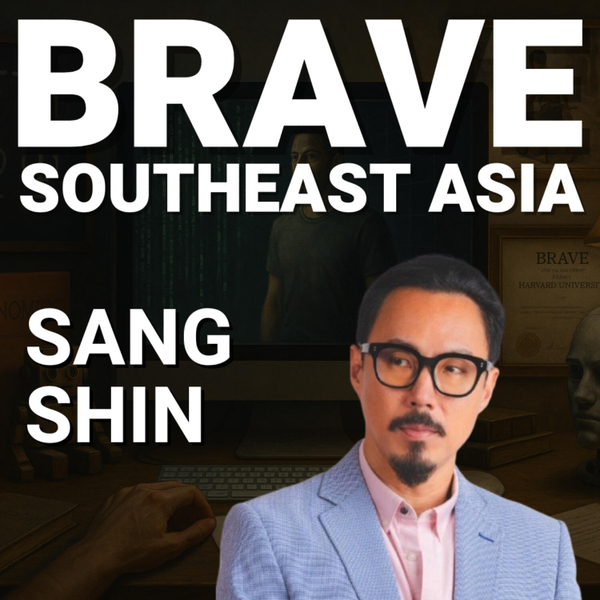
"And if you really start asking the truth about yourself, why are you really doing whatever you're doing? Why are you feeling the way that you're feeling? It all boils down to the self inside of you. He has this idea of the operator and the machine, but for me, it was more about the operator inside of you. Why are you doing what you're doing? Why are you feeling the way that you're feeling? If you really drill down into it, you'll understand that it ultimately boils down to the self, everything." - Sang Shin is an entrepreneur, investor, and philosopher.
"So I thought, going to a startup is retiring from the corporate rat race, but there is another rat race. So then what is actually retirement from the system itself? You are not in the system anymore. In some form or some way you have attained a level of financial freedom, which you should be using. It takes time, you cannot just get there from day one, you have to work your way towards it. But at least you know that is what you are working towards. You are not working towards becoming a CEO, you are working towards the goal of financial freedom, which can be attained in many different ways." - Sang Shin is an entrepreneur, investor, and philosopher.
"Qualia is best explained by asking how you explain what sweet is. You cannot. The best you will do is find a synonym for the word sweet and tell it back to me, but you will never explain the experience of what sweet actually is. That is the hard problem of consciousness, and that is what qualia is — the experience itself." - Sang Shin is an entrepreneur, investor, and philosopher.
Jeremy Au and Sang Shin trace Sang’s journey from a privileged childhood in the Philippines to his evolution as an entrepreneur, investor, and philosopher. They unpack the pivotal moments that shaped his outlook, the hard lessons from building a privacy-first startup that challenged big tech, and his creation of Fafty, a belief system grounded in the idea that life is a simulation and the true goal is to elevate personal existence. Their conversation weaves together stories of youthful awakening, the realities of startups and investing, and reflections on AI, religion, and parenting as forces that guide self-transformation.
02:00 A street encounter in high school sparked gratitude and change: Seeing a boy his age pushing a cart barefoot on hot asphalt made Sang realize his privilege. He cut his hair as a symbolic reset, faced teasing and rumors at school, and used the experience as fuel to work harder, eventually earning straight As and getting into a good college.
08:35 Chose environmental science and economics at Tufts University to understand the conflict between economy and ecology: Realized there was no silver bullet to solving environmental problems and pivoted toward technology during the early internet era. Self-taught web skills allowed him to compete in a new field where there was no entrenched expertise.
16:52 Built a privacy-focused ad tech startup to give users control over their data: The product let people opt out of ad networks or opt in to get paid directly by advertisers. It went viral with millions of downloads but was later banned by Apple, which also revoked Sang’s developer access. This taught him the lesson that money always wins.
21:08 Moved to Singapore in 2016 believing the US had peaked: Saw Southeast Asia as an emerging startup hub and wanted to help founders and grow the entrepreneurial ecosystem from the investor side.
24:35 Realized startups are another kind of rat race: Founders still face systems, funding stages, boards, and oversight similar to corporate hierarchies, challenging the idea of full autonomy.
27:28 Created Fafty, a belief system rejecting centralization and canonization: Based on the belief that reality is a simulation, it encourages people to respawn as a fully conscious player rather than an NPC, gaining control over impulses and actions instead of following programmed behavior.
45:28 Parenthood and training AI shaped his views on intelligence and consciousness: Observed parallels in how his children and AI models learn but emphasized that AI lacks qualia, the subjective experience of sensations like sweetness or pain.
Jeremy Au (01:37)
good to have you on the show. I'm excited.
Sang Shin (01:39)
Glad to be here, man. Good to see you in real life. I know.
Jeremy Au (01:42)
five
years we had a zoom call it was a pandemic for sure
Sang Shin (01:46)
Yes. Thank you Pandemic for connecting us online.
Jeremy Au (01:49)
Yeah, definitely.
And over the years, obviously, you've seen all your LinkedIn posts about your flexures and life. so it's good to have this catch up in person because you're in a new phase of life and I'm just so curious. Yeah, fantastic. let's get that introduction of yours. Who are you?
Sang Shin (01:53)
Yeah.
But I'm glad to be here.
Sure, so I'm Sang I
quite a mixed background. if you start from the beginning, I'm a Korean, but I was born and raised in the Philippines, actually. So Philippines is kind of my home. And I grew up there for the first pretty much until high school. So I graduated high school there. So many people don't know that I can speak a little Tagalog. I'm down with the Pinoy brotherhood.
And then I went to the States to study university. And after graduating, I stayed there for quite a bit before coming to Singapore.
Jeremy Au (02:40)
And I think what's interesting is that you've also had this career as an entrepreneur, as an investor, and now as a philosopher. now I'm very curious about all those different aspects. what would you like as a teenager? Were you
Sang Shin (02:55)
so my dad was a diplomat in the Philippines. Yeah. Yeah. Yeah. Back then. Yeah. Or military kids. I mean, there were too many reasons back then. Right. Especially if you're from Korea, not back in the seventies, pretty much were in Korea. Unless you were one of those reasons. And yeah, so he was working for the Asian development bank in the Philippines. So I grew up with that whole diplomat.
Jeremy Au (02:57)
So that's why I said, Diplomat.
Sang Shin (03:19)
lifestyle, which was actually, it was actually quite not reality, would say. Because when you were growing up under like this diplomatic status, so you have this whole like diplomatic community, we were living in the village where all the really, really rich Filipinos would be living. As a kid, you don't know that, right? So you think you're all you're
Your friends are, you're one of the same. So I grew up thinking we were billionaires. We owned this Island and this boat and blah, blah. So I'm like, you know, growing up like that, you think you're just like them. Obviously we're not right here. My dad was working at the bank and, ⁓ but that's how I kind of grew up. So I grew up as a very, very spoiled kid. I would say I was a brat.
I took everything for granted. know, we're going to, we're chauffeured to school in a Mercedes Benz in a third world country where there's poverty all around. But you never saw that because, I mean, I was a kid, I was just trying to be cool at school and I didn't really and I was also a dork. So I always wanted to be cool, but I was never like part of the cool crowd. Any of you from IS Manila watching this probably know me as the weird kid, but yeah. So I was always trying to fit in
I kind of grew up thinking I was like all the other rich Filipino kids who are our neighbors in the village. And obviously that wasn't the case. So I was kind of not doing what I should have been doing at school and not really doing well and sucking in grades. And there was this moment, like I think it was around the 10th grade where, you I was just coming home. I got picked up in the Mercedes Benz. They call it Chidang in the Philippines. And there was who came home, stopped light and
It was a really hot day and I saw this kid pushing a wooden cart selling coconut husks. They would use them to like scrub, right? So was just saying a bunch of coconut husks. And he was...
barefoot on the
And so it was really hot. And I remember, you know, red light and somehow our eyes locked for whatever reason.
that was, there was that moment right there when all of a it just clicked in my head. was like, hey, you know, this kid's about my age. Like, why am I in here and he's out there? why wouldn't, what's the difference? How come he's not in here and I'm not pushing?
So that kind of just clicked in my head and then on the way home that really affected me and I said, wow,
it could have been just the role reversal. And so what am I doing here? Like if he were me, then what would he be doing? And I was like, wow, this guy would probably try to make the most out of like the opportunity. So I went home and I'm like, I'm wasting an opportunity.
So the part of that, oh, you know, I'm a lucky guy, you know, in terms of having the opportunity sunk in. And that really affected me. I need to do something to make a change. And so was like, what am I going to do? I was like, well, what's the one thing that I value so much that is a waste and let me undo it? And that was my hair. Cause I always thought my hair was something.
You know, look cool, styled, whatever else. Like, look, I'm gonna cut all my hair off.
Jeremy Au (06:18)
Hmm.
Sang Shin (06:19)
that's a very big cost to me. So I took out a pair of scissors and started cutting my hair. And so my hair was all like screwed up. so my dad then comes home, right? he looks at me and and in his head, I know he was thinking like, oh, this kid's finally lost it. He's finally lost, a bad kid and now he's finally gone. Buckwild crazy.
And I try to convince it. I'm like, dad, no, you know, like, this is the reason why I'm doing it. It took a little bit, but I think he finally got convinced. And so was like, all right, let's go to the barber then, you know, because your hair's really scary. So we drive to the barber. It was late already because he had come home. right when we arrived, we got to the door and the guy like was switching to the closed side, like because he shut down. And my dad's like knocking. It's like.
He's like, look at his hair, right? And the barber takes a look. He's like, okay,
Jeremy Au (07:07)
Hahaha!
Sang Shin (07:08)
Yeah, then he shaves my hair off. Excuse me. So then he shaves my hair off and go to school the next day. Everybody's making fun of me. All these rumors swirling around that my mom caught me wanking off in the bathroom and all kinds of rumors. know, kids. ⁓ But you know, the thing was,
It worked like a charm because every time there was the rumors or whatever that came, obviously I knew what was going on. It just gave me more fuel, right? And every, every time I like would touch my head and there's no hair, it just reminded me. And so like from the second semester of 10th grade till when I graduated, I was able to turn things around. So I was kind of like basically barely passing and flunking. And I was able to, at least for the last, you know, one and a half years left in high school.
I was able to get like really good grades. I got like pretty much straight A's. And I'm not like the smartest guy, but it was like a lot of effort I put in and then I was able to get into a pretty decent school. It says low battery there by the way.
Jeremy Au (08:05)
yeah, you can keep going.
Sang Shin (08:06)
And I was able to get into a pretty decent college. And yeah, so that's a long-winded story, but that's kind of like what I was like
Jeremy Au (08:13)
Yeah. And what's interesting is that you're in the Philippines, you're in the US, and then you basically chose to your early career in the US. Can you tell a little bit more about what those decisions were in terms of your choice, in terms of domain, in terms of direction?
Sang Shin (08:30)
Yeah, I specifically went to, so I went to Tufts University and the reason why I chose that university besides it being the backup if you didn't get into Ivy League, which was kind of the point. They did have a very good environmental science, but back then it wasn't called sustainability, was called environmental science. And so I wanted to make, so I did a double in environmental science and economics because I thought those were two things that are and still are at odds with each other.
And I thought that if I could learn those two things, I could figure out the solution between the two. And so that's why I went there. And I thought I I was always into the whole environment thing, even back in high school. So this was like in the eighties. People who knew me back then, I wore this hat and this yellow earth shirt for those who might be watching from back in the day. I thought that...
was something I was going to do, so that's why I chose to study that. But then what happened was...
I became a pragmatic person after learning more about the two disciplines and I realized that there is no silver bullet to this. My realization was it's going to take someone like a Mahatma Gandhi type person to really change this. The more I studied it. I wasn't going to do it because I didn't think I was Mahatma Gandhi.
Jeremy Au (09:40)
Yeah.
Don't worry, I don't think I'm Mahatma Gandhi
Sang Shin (09:46)
Yeah,
so I actually ended up not doing that after
Jeremy Au (09:49)
so what did you choose to do in your early career?
Sang Shin (09:52)
So I was always good with computers as a kid. I used to overclock computers like when that whole thing started back when I was a kid. But there was a purpose to it. was so I could play games. But I never took a computer course or anything, but I was just, happen to be good at it. So after graduating, that's what I did. And that was during when the internet wasn't the internet. was just, had like, it was the beginnings of it.
Pine as email or BBSs with the modems back then, 56K, 288K. And so that's one thing that I find similar back then with today with AI and all this is there just was, it was so new. Like there was no like internet degree. It was still like being formed. so one of the message I would tell people as when I was later on doing entrepreneurial stuff is, look for areas.
or understand areas where the level field is the same, meaning because it's so new, there's no degree or, it hasn't been around long enough for there to be an unlevel playing field, basically. And so when you're in that situation, back then it was the internet, can have, you can make, you can use that to your advantage, and that's what I did, right? So because there was no web degree back then.
I just self-taught myself what the internet and web was and yeah, I became good at it. And I could compete with anybody else because, know, again, it was a level playing field, right? So you're able to use that to your advantage. And I was able to get a pretty good job in that area.
Jeremy Au (11:24)
Yeah. And what was interesting is that you eventually became entrepreneurial as part of experience. So what was that like?
Sang Shin (11:30)
so I worked in tech or in web internet engineering for investment companies. And yeah, so I had, built a career doing that for, for a bunch of investment companies, but basically, the second part of my life. So the first part was 10th grade, right? That was a big change. So the second part of my life, that was a change was actually when I was going through a divorce.
And that made me kind of like another moment in life where you have these moments in life. There's not many. There's probably a handful of them in anybody's life where it's quite a big change. And this is a second one. And the divorce really made me question things. when I was going through that divorce, one of the things that did help that started this whole journey to the entrepreneurial side was I started reading this book.
called The Principles by Ray Dalio. it kind of like opened my eyes about, specifically about the truth. And so I was like, wow, you know, this stuff really resonates with me and helped me like, you know, what is the truth? Why am I, you know, what is really going on with this divorce? And yeah, so I wanted to learn more about it. I ended up working there. Somehow I managed to get a job there and worked under him. And I learned even more about the book through him.
⁓ and then I actually resigned from Bridgewater. I left, they're quite shocked. They're like, nobody resigns from Bridgewater. I'm like, yeah, I am. And I did that because I wanted to take it to the next level, which is to try and become an entrepreneur and build something myself from scratch. So that's kind of why, I did it. was a confluence of personal reasons and then like kind of philosophical with the whole principles thing. then.
with a career that I decided to, there's this idea also that was going on that we wanted to, it was this whole Jeff Bezos thing, Like, they're a great minimization framework. So I came to the point where I was like, I know if I don't try this, I'm gonna like always wonder on my deathbed and like, I don't want that. So that's how I knew like whether it succeeds or fails. Like I know I had to do it. The point was whether or not it succeeded. That wasn't the point anymore. It was whether or not are you gonna do it or not.
And so when I arrived at that point, and I could ask myself, is that what you're going to be asking on your deathbed? are you always going to wonder about it? Just like Jeff Bezos said in his thing. And I was like, yeah, absolutely. was like, So that was the final like switch at the end.
Jeremy Au (13:50)
Yeah.
And I think what I'm curious about, know, let's sit with that moment for a bit longer, is that you sounded like you were very much doing off thinking, Yeah. Divorce, reading Ray Dalio's principles, working there and absorbing. some level of processing. What were some lessons that you learned from that time period? Like, you know,
Do it any, I principles of your own that you came up with or what are specific principles that really resonated with you during that time period.
Sang Shin (14:17)
Yeah, no, and in fact, a lot of what happened in that time, well, in all of these major moments in life, but what I took away from that one was literally the truth. And that factors into what I'm doing today. So what I'm doing today is an amalgamation of all the things I learned. But at that moment in time, it was about the truth, which is what Ray Dalio's principle is all about. And if you really start asking the truth about yourself, like, why are you really doing whatever you're doing?
Why are you feeling the way that you're feeling? Like you will, it'll all boil down to the self inside of you. And, you know, he has this like the operator, the machine, but for me, what it was, it was more about the operator, machine, more than machine, but inside of you, why are you doing what you're doing? Why are you feeling the way that you're feeling? And if you really drill down into it, you'll understand that it boils down to the self ultimately, everything.
Jeremy Au (15:14)
And back then, why were you doing what you were doing?
Sang Shin (15:18)
Well, yeah, so again.
Back then, I was still young. So back then, was like, you know, it was all about trying to, you know, I worked for the world's largest hedge fund. I wanted to be, it was all about that, that part of the life, which I realized after going through that process. And then the flip to the entrepreneurial side, I thought was, oh, I'm going to change the world, change the world. And again, now that we're
Jeremy Au (15:22)
Hahaha
Sang Shin (15:45)
look about it. But back then I thought I was doing something good. I was using my abilities to change the world for something I thought was for the better. And that was why I was doing it back then. Obviously now when I look back then I realized that also really wasn't the truth. I had to go through the whole entrepreneurial thing to get to where I am now.
Jeremy Au (16:03)
Yeah, so, you it was interesting because you transitioned and you said, know, there's pride in working for Bridgewater. Sure. know, professional pride, obviously. I mean, I was a consultant at Bain and at that point I was like, yeah, oh, I it. You know, I was like, yeah, yeah. So I totally get it at that point of time. And what's interesting is that you became an entrepreneur. What did you do and learn during that time?
Sang Shin (16:27)
as an entrepreneur. mean, there's a whole other set of learnings there, but what we did was we, so the good that we're trying to do. wasn't, weren't, so at least we weren't trying to become an entrepreneur because we saw some, well, there wasn't no Netflix movie about entrepreneurs in a series. It was a little before that, but we weren't doing it to also like, at least we weren't doing it to make money and have fame and all that. We were actually trying to, me and my co-
co-founder trying to change the world for the better. And the change that we were trying to make was, this was, you got to understand back in over, it's like 15 years ago, but we didn't like that big tech was taking your data and selling it behind your back. We thought that was wrong. So that's what we wanted to change. So we built, know, one of the first things we did was we built a company that essentially,
allowed you to prevent them from taking your data. if you wanted to opt into, so the default would be you're out of the ad network. But then if you wanted to opt in, we gave you the option to opt in where you would get paid directly by the advertiser and not go through an intro. We're basically taking out the middleman of Facebook and Google. And the advertiser would just pay you directly for your data and show you ads. So that's what we did. That's what we were doing. A little early, I guess.
Jeremy Au (17:41)
Yeah.
Sang Shin (17:44)
for that like before nobody had the idea of that you were the product that was like 10 years later
But you know what was crazy is when, we did all kinds of research, but when we looked into it, you know, we went in with eyes wide open because we, it was amazing what we found out with. wasn't even back then it wasn't. Um, there had, there was a whole litany of other startups and companies that try to do it with the moment Netscape came out as a browser with third party, that failed.
So we were looking down this pathway, a trail of all these skeletons of previous attempts to do right, that have failed. And so there was a moment, I remember me and my co-friend, was like, dude, do you want to look at all the skeletons of dead dinosaurs on this path? It's like, do we want to really go on this? that was, there was a, that was a moment there that we had to, it was like yay or nay. then, yeah, we were like, yeah, the whole point is, yeah, we got to try it, right? Like that's the whole point here.
So there was that moment, yeah.
Jeremy Au (18:46)
and then you tried and what happened after you tried.
Sang Shin (18:49)
Well, we tried and so to our surprise, at one point we went viral, right? Millions of downloads and we were all over the newspaper. And then, so we thought, we're like, oh my God, this is actually gonna work. Right? Yeah, but then Apple, I mean, to make a long story short, they banned us and they specifically banned me as well as from their developer app developer.
Jeremy Au (19:03)
Fantastic.
Sang Shin (19:15)
And basically they killed us. Which was, people asked, well, obviously they're going to kill you, right? If you're trying to subvert their money making machine, which is ads. And what people don't understand is they were with us making our technology. The technology that we made couldn't work without Apple giving us kernel level access to their iOS operating system.
Jeremy Au (19:17)
Nah,
Sang Shin (19:39)
And in order to get access, you had to actually write to them and they would give it to like the Department of Defense or like some university studies. So we wrote to them thinking they weren't going to grant access to us. We were one of the few who had access to kernel level without jailbreaking the phone. So that's why we thought they were really actually practicing what they preach with their whole privacy thing, the ad set they were doing.
Jeremy Au (19:49)
Yeah. But they did, right? Yeah.
Sang Shin (20:05)
But obviously when Push came to show with Money and Facebook, they turned. Money always wins. So that was the lessons I learned. Like, we're going to change the world. Yeah, know, very idealistic. yeah, that was ⁓ the big takeaway there is money always wins.
Jeremy Au (20:11)
No.
And you know when you say that money always wins, know, obviously one interesting part in my reflection is that you also moved from an entrepreneur and all those experiences and eventually became more on an investing side as well. So was that one of the reasons why you transitioned as well?
Sang Shin (20:40)
Yeah, it was because then I thought, well, I'm going to change that. Now I'm going to help all the founders of startups. I thought, yeah. So again, I think good intentions. And it coincided with like, you know, me leaving the US back then. And I left back in 2016, right before Trump version one got elected.
basically because I thought that was peak US, which to this day I believe that was actually peak United States. And I'm very lucky to have left about that. And I said, I was asking the wrong question. was like, what am going to do now? Like, am I going to do another startup, do the whole serial entrepreneur thing, or am I going to go back to corporate America? I've already worked at all these companies. What am I going learn there? Then I realized it was the wrong question. The right question is actually not what I'm going to do, but really where am I going to do what?
And then so that's when I was like, the world is my oyster. I can go anywhere and do whatever I want. So then it became a process of elimination of where and that process led to Singapore. And so once I figured Singapore out, was like, OK, you know, well, you know, I think there's going to be a lot of startup build over there. Again, about 10 years ago, turned out to be true. 10 years. There's a lot of growth in entrepreneurship and startup in Southeast Asia.
So I wanted to be part of that and from the investor side, start helping out and building the entrepreneurial landscape out here. So that's why.
Jeremy Au (22:06)
Yeah, I think it's interesting. why did you choose Singapore? Because you know, you have a thesis of peak America, USA. But of course, you've been like, well, let's coast, you know, one out of 20 years. Yeah. For a peak USA, or you could go to different countries, you know, Korea, Singapore, Europe, Europe. mean, peak Europe has been, I know.
You're still comfortable, right? So was kind curious how you thought about that.
Sang Shin (22:35)
Yeah, no. So my philosophy in life or one of the tenets is that comfort is another word for unliving. One thing you're not really alive if you're comfortable. So, yeah, I mean, that's the simplest answer. So why Singapore was and it was a process of elimination. So I was with my my then.
Jeremy Au (22:43)
Mmm.
So you chose Singapore because you felt
Sang Shin (23:00)
⁓ fiance who's now my wife. So she's American and she had to English. So like, you know, when we're looking around the world, that kind of limited things, you know, like can't go to Korea, for example. Yeah. So Singapore was English speaking is also a good entry. You know, they call it the gateway to Asia. And I also from the, you know, from the entrepreneur and startup site, I also
Jeremy Au (23:10)
Yeah.
Yeah, that's difficult.
Sang Shin (23:24)
believed that it was obviously that was a gateway for funding as well, and that if there was going to be, as an investor in growth of Southeast Asian entrepreneurial and startup ecosystem, Singapore would be a very pivotal place for it to develop through. So there a bunch of those reasons.
Jeremy Au (23:43)
Yeah, fantastic. And what's interesting is that you became this investor mindset. So now you've done a few things, right? You've done the Bridgewater, the engineering and investor set, then the entrepreneurial set, and now the investor and ecosystem builder set. I'm just kind of curious, like, how did your philosophy change during this time period as well, over the past 10 years? What did you learn?
Sang Shin (24:07)
Yeah, one of the things about the entrepreneurial side, so a lot of people I meet, including myself before when I was on the other side, like working at big corporations, was that there was this idea, and I see it around still, and it's the biggest misunderstanding, if you will.
that people think, okay, I'm sick of the corporate nine to five job. I want to be my own boss and have my own schedule and have ultimate freedom. So I'm going to do a startup, sick of the rat race, sick of this system. And so I'm going to break out by doing a startup. that's, yeah, one of the biggest, if not the biggest misunderstanding because, so now that I've been a founder and then now the investor of startups and it's not true. Like it's just a different rat race and system.
And so that was the understanding there that it still is a system. still is. So in the startup world, the difference is, yeah, you're not going from analyst to junior, to assistant vice president, and blah, blah, blah, this department, and my fiefdom, and the corporate. And then hopefully I'll become a chief of something, and then I'll be fulfilled. You aren't, but people believe that. In the startup world, it's...
Okay, I have a founder, kind of get co-founder and now I'm to get seed money and then I'm going to get, you know, pre-series A and A and I'm to get shares and I'm going have a board and I'm going to... It's the same thing that you go through. Ultimately, you know, I guess the equivalent of a C level exec in corporate world is to get a pre IPO or IPO, you believe that everything's going to be, you know, that's a top mountain. But it's just a different rat race. And it's an illusion to think that...
It's, you know, that there isn't one and you're really the master of yourself. You're not. There's a board. So you're not, you're not. But people like to think that and it's what's sold and, you know, just be wary of that. So that's one of the things I've learned and affected into my philosophy as well, that things aren't what they seem. Right.
Jeremy Au (25:54)
Yeah. There's a board. Yeah.
Yeah.
Yeah.
So, you what's interesting is that you've done all of these experiences and now you're talking about the philosophy, right? About what things are versus what they seem to be. What are some, I don't know, principles of your own on this dimension?
Sang Shin (26:31)
Yeah, so I did put up retire on my LinkedIn profile.
Jeremy Au (26:35)
Yeah, and then it links to your YouTube page.
And then on your YouTube page you have a video that went viral. It says, I think the title is something like, I'm lost and I'm not sure.
Sang Shin (26:47)
Yeah, yeah, yeah. Like I quit my job and I'm not sure if that's the right thing I did. Yeah, that one did get some traffic.
Jeremy Au (26:51)
Yeah. And that's the one event viral.
Anyways,
I thought that was a good emotion and
Sang Shin (27:00)
Yeah,
mean what ended up happening was I To make it to make put it bluntly. I realized that Actually, the most important startup isn't a company. It's actually yourself. That was a realization It took me some time to get there
But that's the, so if you, if you're able to expand your mind and understand that a startup isn't just necessarily only companies and that a startup could be anything actually, then if you, accept that truth and then you go around looking at everything and saying, then if it's start can be anything, then what is the most important thing you could start up then, right? If you really think through it. And I arrived at, well,
the answer is obvious, right? It's yourself. There's nothing more important. And so that started the process. And so I was like, okay, what if you actually applied startup principles and all the stuff they teach you?
yourself to restart yourself if you will. Wouldn't that be an interesting thing to look into? So that's how it started. How it ended with is I realized that I'm actually creating a religion, but as I said earlier it's not a religion, it's a belief system because it doesn't do two of things that all religions do, which is have centralization and have canonization.
Jeremy Au (28:19)
⁓ okay. Let's get into this then. you are building religion, but you don't believe in centralization and you don't believe in canonization. So that makes it a belief system. Correct. Which sounds like philosophy. Correct. Which sounds like Redalio to some extent. Okay. Anyway, so, so I'm just kind of curious, like what's this adventure that you're on?
Sang Shin (28:33)
to some extent.
yeah, so it's the final adventure. that's when I put on my profile that I retired. The retired isn't like, I'm not doing work, I'm just playing golf, which is actually another big lie that they sell people of what they believe what retirement to be is. It's actually the, so this is a true retirement from any rat racer system. That's what I'm retiring for. So I thought, okay, going to start up is retiring from the corporate rat, no, there's another rat racer.
Jeremy Au (29:04)
You
Sang Shin (29:05)
So then what is actually retirement from the thing itself, the system? And that's what I've arrived at. So I've retired from the system. And what it is is, yeah, so you're not in the system anymore. Some form or some way you've attained some level of a component of is financial freedom, which you should be using. It takes time to, you can't just get there from day one.
to work your way towards it. But at least you know that's what you're working towards. You're not working towards becoming a CEO. You're working towards this goal of one component being financial freedom. You can attain that many different ways. But ultimately, when you're out the system, and now you're really the true boss of who you are, there's no board or there's no something above you telling you what to do, that's when you realize that
you have time to think about what this is, which is what many people in the past have thought through. And we have multiple examples of enlightened people there. And so I'm not saying I'm one of the enlightened people, but the whole point here is when you think through that, what I've arrived at is that essentially we are, what Fofty represents is that
It's a belief system that we are in a simulation, so this is all a simulation. And that the whole point of existence is to try and elevate yourself because as we were talking about earlier, the rendering of the simulation, a manifestation of reality, is dependent on your ability to render it at higher and higher fidelities.
Jeremy Au (30:42)
Sorry, so let me just jump in here real quick. So you're saying that you believe that right now we live in a simulation. So, okay, so that's a real belief. Okay. Yeah. So let's go there. Yeah. I'll be upfront. I don't believe that right now, but I'm happy to hear what that means from your perspective. So who's rendering the simulation? Like ourselves? Yeah. The nature or an alien race or God? I kind of this very similar.
Sang Shin (30:48)
Absolutely
Rendering
and who created are two different things. But all the simulation is just an update on our vocabulary. It's really, me, no different than the You want to call it the universe? It's also OK. All it is is just a bunch of laws. You want to call it physics, chemistry, biology. It's basically formulas, laws, rules that everything operates under. And when we create a simulation, that's what it is, right? We create the physics engine. We replicate real physics in art.
in our games, but it's really a bunch of formulas and math that govern the simulation that and the simulation itself is nothing right. Like you actually have to do like a player needs to go in or something needs to move through it to to render it right. Otherwise, it's just like a bunch of probabilities of what could happen within the within the construct of this simulation that you coded. But until something goes through, it's just nothing right. Yeah. So that's kind of like this this universe is the same thing. It's just
The whole thing about Fofty this is why the second tenant that nothing's canonized is unlike religion. So if we were trying to explain the internet to like a dog, it would be difficult. We'd have to be like woof woof woof. If you try to explain the internet to an orangutan, you might be able to use some symbols. Do it to a human, you can use words. So humanity, the different levels, right? So if we go back like
Thousands of years ago like hundred thousand years ago if you know, we were like cavemen That's the way we would explain rain and thunder Because that's all we knew that yeah Two thousand years ago when you know, let's say the Bible was created Also, we didn't know as much as we know today. So again, we need some metaphors things and then we find out more and then here we are today the problem with the canonization, which is a group of people who determine what's right and wrong and then who's
snapshot it at that point in time forever and eternity is we learn more and what we learn sometimes doesn't jive with the metaphors that we had created and so then there's this lots of you know explaining backwards you have to do which causes problems right and it's not easy to do that and so that's that's the model right and so you know who's to say like today and then like a thousand years from now they're gonna we're gonna know probably more than
And then whatever, if we snapshot what we do based on our knowledge today, people in the thousand years from now are to be like, no, right? And all we're trying to explain is the same thing, the truth, right? Like what is enlightenment? What happens after life? What is the whole point, right? It's just that the way we can explain it improves over time because we are developing in our understanding as well. And so that's why I don't think it should be canonized. In fact, it should always be updated with
whatever we learn. like, two years ago in physics, the Nobel Prize for physics was given to the scientists who three scientists who determined for a fact that there's no such thing as local reality in the subatomic world. just isn't. Yeah. It needs to be observed for it to become something. And we know that now undeniably as a fact what used to be theory. And so that tells you like, well, nothing's kind of real actually in the subatomic world.
And that has implications to our existence, right? And so, yeah, so that's a component. like, yeah, so in that sense, I do think that we're just updating the vocabulary and the mechanism and fidelity in which we're explaining things based on new knowledge. And so,
You call it the universe. Now I think we can call it simulation because now we know how to build things and we can see how in these rudimentary versions of it, how things operate. And if you go in, you know, it's probabilistic events and nothing really exists until you render it, you know, or experience it. But it's the same thing. It's just a bunch of rules running a thing up ultimately. And we're just in it. The question of who created it and like, okay, who's wearing the VR goggles? I mean, that's a different thing.
But as far as like this, we're just rendering the probabilities of this rule set. And Dodd's doing the same thing. It's just it's rendering it with instead of a GPU like from Nvidia, it's doing it with a cheap laptop. So very low frame rates or maybe like not colorblind.
Different chipset, yeah. But who's to say that this is the peak also, right? That would be very arrogant to believe that there's nothing above us who can render it at a higher fidelity.
Jeremy Au (35:36)
So you're saying humans are wearing the Oculus Quest and some people are wearing...
Sang Shin (35:41)
It's very arrogant to believe that this is it, that there's nothing better than this rendering of the scene.
Jeremy Au (35:48)
Okay, okay, so, you know, I'm studying econometrics, I'm in the biospace. So I'm happy to kind of like go through this. So wouldn't someone just be like, okay, maybe your definition of it is like, it's not a simulation, it's perception reality that one end or the other end is calling it a game, right? Because the game has rules, we have players. A game is a simulation. I guess in some ways implied that a game is
Sang Shin (36:09)
The game is a simulation.
Jeremy Au (36:15)
implied to have fun, guess the purpose of the game is. Whereas the simulation is implied the purpose is to extrapolate reality or.
Sang Shin (36:17)
Yeah, so there's, yeah, so.
Well, the simulation itself, I don't think has a purpose. But if you overlay a purpose into when you create a simulation, then you'll have different things like a game. You can have a simulation to discover things, like with drug discovery and AI. mean, there's the, know, but so the, the simulate the, concept of simulation is that there's no real purpose, just a framework of things. You know, put things together and it's like, why you put it together than now that's a different story, right?
Jeremy Au (36:51)
Okay, my, okay, so maybe I was using a terminology here is Jeremy simulation is different from Jonathan simulation. My render is here. Okay, so the language carefully. Every digital person has a different rendering. And if I drink alcohol, then my rendering of the simulation changes. Yeah.
Sang Shin (36:58)
You're rendering of the simulation.
Cause we all have different chipsets.
You overclocked it. But it's
the same game everyone's playing, if you want to call it a game.
Jeremy Au (37:17)
Sorry, just... Well, caffeine... Caffeine sounds like overclocking, but it's like...
Sang Shin (37:23)
Maybe, maybe, maybe you underclocked it.
Yeah.
If you take drugs like DMT or... Yeah, exactly. Yeah, you're tickering around with it. ⁓
Jeremy Au (37:29)
Trust the getting substar
Let
me put the water cooler with the power supply and see what happens. ⁓ Let's not fry anything in there. We'll get fried, right? I understand the rendering. So rendering simulation, but you're saying that everybody has this, we all occupy the same simulation. Okay, gotcha.
Sang Shin (37:37)
Right.
People get fried.
Yeah,
We're playing the same game, if you want to call it a game. But the game is, it appears differently. Like if I play it again with a supercomputer, each V200 Nvidia chip, I mean, that game's looking really good on my hundred inch screen. But if you play it on like a 12 inch phone, it's like, that's probably like an Amoeba. But it's the same, we're all rendering the same games, just different fidelity of that game based on.
And even across the same hardware, the choices you make as you morph around the simulation, it builds a different experience. And so the experience is what's the key at the end of the day, which we can't define actually, which is why I also don't believe while AI is intelligent and self-aware that it's not conscious because it's the whole data and Star Trek thing.
How do you explain qualia? You can't. And so that's the limiting factor.
Jeremy Au (38:53)
That is the limiting factor. Okay, so let's go through that. So you believe, no, not you believe, sorry. Let me say that again. I think what's interesting is that obviously you make me think of all the people who you and I obviously we observe as reality and then we go on YouTube and we watch somebody else play a computer game. So it's like, yeah, exactly, right?
Sang Shin (39:12)
Inception. Inception. Simulation without a simulation.
Jeremy Au (39:17)
We are watching a simulation, watching a simulation.
Sang Shin (39:19)
This is a
whole Elon Musk thing, Where he says like, because of that, that is very low chance that this is base reality, that there's another simulation thing or something, and we're just one in a row of simulation. It's absolutely possible. Yeah, it's possible. We could be in the string of simulation of simulations. Possibly,
Jeremy Au (39:33)
rest of you are on a Truman Show.
Somebody's watching me in reality TV. It's like, wow, it's fun to watch this podcast.
Well, it's definitely true. Somebody's watching us in one month's time listening to this podcast. So we have become a simulation. ⁓
Sang Shin (39:46)
Yes.
Yeah.
Yeah,
yeah, yeah, yeah. It's absolutely possible. And the whole point is, you know, there's a lot of people who are beginning to think this way. But again, like, if that's the case, then we should update our belief system. And so where is like, where is the simulation belief system? And I couldn't find one.
Jeremy Au (40:16)
So why is the belief system of assimilation?
Sang Shin (40:18)
Yeah, so now that if you actually just accept that right as a belief that we are in a simulation. Then what can you construct on top of that? Then know how do you how do you exist like what's the point? So it's very different now like if that's if that's the core base understanding from which everything is built on top of right then you can come come up with what I'm trying to do with Fofty right? Which is so if that's the case right then you understand.
that well then what is it boiled down to? It all boils down to ultimately the experience of the simulation, right? That that's what it is, not the actual simulation itself.
Jeremy Au (40:53)
F-O-F-T-Y. What does it mean?
Sang Shin (40:55)
The simplest way to put it is it's between 50 and 40.
Jeremy Au (41:00)
F-O-F-T-Y, 40 and 50. this is your word.
Sang Shin (41:04)
Yeah, if you mix those two together, it's Fofty Usually it's around this age where you start thinking about these things. If you think about it earlier, all about better teams, like compound interest in your retirement plan. But usually it's around 40, 50-ish. start midlife crisis, or maybe you attain the mountaintop, and you're like, whoa, it's not what I thought it would be. Or you succeeded in, you know.
entrepreneurship and whatever you did the unicorn thing and then you're like okay you keep doing the same thing and you're like hmm I don't know like there's gotta be more it's like what Donald Trump said in the letter
Jeremy Au (41:38)
I mean...
Hahaha
Okay, and you know, I obviously I think this is a good book. I think it was by David Brooks. He calls it the second mountain, which is like, you know, around this age, you kind of climb your first mountain, you kind of got there and you're like, okay, I think there's a second mountain to climb, but what is that mountain in terms of legacy, a purpose? Do you think that's a lame approach to assimilation or?
Sang Shin (42:01)
Yeah.
I if it's a lame approach. I don't think it also is wrong. mean, sure, it's the real mountain, if you will. what I, know, in Fofty the whole point here is to what I call respawn yourself back into the simulation. So if you ever played it, let's say a game, your character, you know, after you die, start again, right? That's called spawning. So in the same vein, you have to respawn yourself back into the simulation with the understanding you're in the simulation. And now you're not
You see, everybody is born, if you want to call the word, use that word, into, you start into the simulation when you're born, everybody starts as an NPC. That's just your part of the simulation. You don't know, right? You're just operating like an animal. You do what the simulation tells you. You feel hungry, you do this, you that's you just follow. The idea is over time, you have the opportunity to develop into something more.
where you're not just following what you're not a slave to the simulation. So normally you would be hungry, you would just eat. But then if you know, know, you're able to control yourself and detach yourself, then maybe you won't eat. Yeah. And so you're even starting to have control over the simulation. So a lot of religions, which is very interesting to think about, they're very different time periods and geographical locations of how they all came up, but they're all very similar in the sense.
they practice meditation or prayer or whatever version of you want to call it, same thing of just getting away and thinking to yourself. They all practice some form of abstinence, whether it's be fasting or not. I mean, you got to understand this is like all religions from the, why? Like what's the similarity? Because we as humans have understood, like these are things that help us actually detach yourself from just being an NPC and taking control over the same, not doing what we're programmed to just do. And so that, you know, in
Classical religions, there's concept in Christianity called, oh, I'm a born again Christian. Concept of born again, right? It's again, it's updating it, right? So now I'm saying it's just respawn into the simulation and you respawn and when you respawn, you respawn in a manner where you're not an NPC anymore and you're a respawn playable character, or just a playable character actually. So now you're actually not a slave to the simulation and not just following, whether it be an entrepreneurial path.
corporate path, you're controlling the simulation.
Jeremy Au (44:30)
You know, I know that you're a dad, right? Has that changed your approach in terms of philosophy and principles along the way? I don't know. I guess the journey, the change can go both ways, right? I guess your philosophy can change how you approach parenthood. Oh, yeah. Or parenthood can also change how you...
Sang Shin (44:38)
as a father?
Yeah,
no, absolutely. Two things have greatly influenced me is being a father and then also I spend, I do hobbies. I don't really use AI, like I don't like use Grokken. What I do is I train the models actually, especially the open source models because what I, as a dad, so the thing is it's really interesting. I see how intelligence and self-awareness develops using both. So with my own physical children, like I see them growing up and they're at the age three and seven or.
and see it developing really. And then also when I train AI models, and it's artificial intelligence, but you can also see, if you go through the data sets and you do the training, how it impacts the models, the foundational models itself. And yeah, it does impact me. What I've learned is that from doing the both, and this is why I arrived also where...
there's a big difference between that's why it's called artificial is that there's no qualia in the artificial so even though it's very intelligent and perhaps even self-aware it's not conscious in the sense that we understand it to be
Jeremy Au (45:46)
Yeah, and could you define qualia?
Sang Shin (45:47)
Qualia is the best explanation of it is how do you explain what sweet is. you can't. The best you'll do is find the synonym for the word sweet and tell it back to me. But you'll never explain the experience of what sweet actually is. And that is a hard problem of consciousness that there's that book written. But that's what qualia is. It's the experience of it.
Jeremy Au (46:08)
Yeah. I do
like what you said, which is that, you know, having two daughters, three-year-old and a four-year-old, watching them learn how to walk and talk does feel like, oh my gosh, like, literally I'm raising a supercomputer intelligence. So it's sort of like weird neural network where I mean, know, bash. Basically it's like, you tell them like, don't touch the birthday candle. Right? And they're like, oh my God, I really got to do it. They get pretty close, ah, you know, they burn themselves.
I don't know, the system, you know, buzzes the whole network. It's like, okay, I'm not going to touch the candle, but I can blow it out. And by the way, my dad was right, you know, and warning against it. I wasn't being a total liar about the fact that touching the candle would be a bad idea. So I do think that I appreciate what you said, which is that in some ways raising children, but also being in this computer age kind of makes you feel like there's some equivalence.
Sang Shin (47:03)
You'll see the similarities, but then you'll also see the dissimilarities. Right. The whole thing with like real emotion, real pain, real joy, like those things you will not see. It'll be artificial. Right. Yeah.
Jeremy Au (47:18)
And I think it's going to be interesting because, you know, what do think that future is? Because, you know, as somebody who's been technology for so long, mean, obviously there's a philosophy and so far, you know, you know, I'm a big science fiction reader. And I think one thing that I realized over time is I feel like there's going be a new generation of science fiction because the old generation of science fiction was based on what they thought the future was going to be. And now I'm just like, well, it turns out that, uh, first of all, I think AI is not like,
Star Wars, R2-G2, it doesn't really feel smarter than a human. I mean, they're probably equivalent. As MZ saying, in terms of how they operate, C-3PO, which is a transducer drive, can...
Sang Shin (47:51)
Yeah.
In Star Trek you have Theta who is super intelligent.
Jeremy Au (48:00)
Star Trek does, I think it's a little bit closer to the truth, which is that he's super intelligent. But I mean, Star Wars is like, know, C-3PO knows millions of languages, but personality-wise, it's equivalent to a human. So that's not correct. I think that's outmoded. there's one aspect of it. Two, course, is, you know, Star Wars, for example, there's robots here and there, but people are still piloting their own ships, you know.
people are still interfacing to physical robots, nobody has that old digital robot companion.
Sang Shin (48:27)
Yeah. Yeah, Star Trek is closer, I think. it's an interesting thing if you re-watch, which I did, because it's very interesting. They touch on some really philosophical things about data, which they have classified as a life form in that world, even though he doesn't feel or have any emotions. What do I think is? Look, I would say.
And I don't agree with this, but I would say that the, I were to pick like the one of mainstream thought process around it, it is what I would say George Hinton, mean, Hinton, know, Godfather of AI, won the Nobel prize last year for AI. When he came up and had the speech, I mean, he basically said the whole point of humans was so that we could give rise to AI, just like, I don't know, like the dinosaurs were, right? And then say, he's just like, be happy about that.
Jeremy Au (49:16)
Wow.
Sang Shin (49:17)
I mean that's what he said right and I kind of agree with him. I kind of agree with him right that I wish it wasn't him that said it because who am I to pretend to know more about AI than him. I don't and but that's what he thinks and he really believes in and I could see that right like that we are
Jeremy Au (49:19)
Sorry, that's not funny.
Sang Shin (49:37)
We're the biological, know, Musk believes this as well, right? Like that we are just a substrate that's along the way needed to generate super intelligence. And then once that's generated, we would kind of not need it anymore. But I don't believe in that. And again, the reason is and the danger along with it is again, because whatever we create,
it won't have quality, it won't have the experience. remember earlier we were talking about, well, there could be simulations of simulations and a never-ending inception of it. My understanding and belief of this is that yes, that is true, but it is a unidirectional and not bidirectional. Meaning if you create a simulation from a, the simulation that is created is artificial, meaning it's not the same level of what created it, right? It's a downward.
way. And so for us, the downward step down is we can't create experience or emotion in it. It'll mimic it, but it's not going to be it. And if this creates another one, something else is going to go. And the question is, okay, then that's the case for us. But what was before us is even higher levels that this is not as good at. And that's in my opinion.
what the higher dimensions are. And if you want to call religion again, calling, you have to create stories to explain it, given what little we knew back then, you want to call it like angels or heaven or hell, but there are higher states of existence that created us as a simulation. So we're like a lower dimension, if you want to call it scientifically. And it goes this way. And so I don't think that whatever intelligence we create will be greater,
Simulation than this it will be lesser and the missing come on I believe will be emotion So it could be super smart and super self-aware, but it will never be able well I wouldn't say never but it won't be the same right and so the game is Not game, but the point if you also if we Google now comes like why are we here? Like what's the point? Why is You want to be able to to be see if you can go up the ladder up the simulation
So how do we go to a higher dimension? Again, if you want to use religion, know, they use stories, whatnot. In religious terms back then, they would use words such as heaven or hell or things like this, but it's all depicting a grander existence than this, which is a lower level, if you want to call it. And so that's the whole point. So it's really the same thing, right? We're all trying to get there.
That is the whole point, right? If you even look at yourself when you're 10 years old, reality is not the same as you are now, because now, before you're talking about sleepovers, now you're talking about some very deep stuff. So even in your own life, you have elevated your existence. And so the whole point is, is there a way to elevate further? And I believe yes. I believe if you strip away all of the parts of religion that says, if you don't believe this, we're going to kill you or you're going to hell.
So that part of all the religions, if you just like take that away and then just look at all the other parts of religion, which is very similar, fasting, abstinence, prayer, kindness, love, humility, like all this similar other things, right? And you put it together. The Fofty principle here is that there's not just one way that there are multiple tributaries that flow into the same river that is going to the same truth and direction.
And that there are multiple ways actually, and that these like, if you don't believe in us, you're gonna kill you, or you're gonna go to hell was created by humanity as ways to do what humanity always does, which is all the stuff, right? Control and politics or whatever. But you take that away, go into the same place. so the whole point of Fofty is we're not a religion or a belief system, but all religions can come in as well if you're open minded to take those parts away and...
practice the multiple ways to get there. And so the whole point is to elevate in your own way, whether it's Buddhist, Hinduism, Christianity, or any one of the three Abrahamic religions, whatever, elevate yourself. That's the whole point. And so these are the ways you can elevate your existence.
Jeremy Au (53:51)
Yeah. On that note, to wrap things up, I'd love to hear from you a personal story about time that you've been brave.
Sang Shin (53:57)
actually now. The scariest thing is even among close friends to bring up religion is kind of... you're afraid to do it a little bit, Yeah. In case, right?
Jeremy Au (53:58)
Yeah.
There's
actually things they don't bring up, right? Politics, religion, and deaf? Or Texas, depending on...
Sang Shin (54:13)
Or gender stuff. So imagine doing that to the entire world. It's very scary. The last video I posted was very, very scary for me. Because it's just preaching what I'm saying.
Jeremy Au (54:16)
That's the new one, I guess.
Sang Shin (54:30)
I think it's one of the scariest things I've done, Because there's so much fear involved. What are people going to think about me? They're going to think I'm crazy. What about my friends who are Christians? What about my friends who are Muslim? What about my atheist friends? My family who believe in this thing. So it was very scary. But actually, now that I've gotten past that, wow, it's super uplifting. Right. Meaning that
Yeah, that's it, right? What more is scarier at this stage?
Jeremy Au (55:01)
in the Oscario.
Sang Shin (55:03)
I mean
there probably is, I just haven't pointed it out, so far that has been the most scariest and I guess I would say the answer to your question.
Jeremy Au (55:11)
Yeah.
On that note, thank you so much for sharing. I love to summarize the three big takeaways. First of all, thanks so much for sharing about your own kind of like early childhood. What was it like to shave your head? What was it like to just wonder to yourself about lottery that landed you in a diplomat's car versus, you know, I think what you saw as the reality around in the Philippines and how that obviously played a big part in your early kind of like university and life choices.
Secondly, thanks so much for sharing about your career choices as well, both as an entrepreneur, as an investor in terms of redialio and principles and some of the things you've learned along the way to figure out and not only to share about your professional achievements, but also I think share about your personal pivot points about what each stage meant for you and on hindsight what it actually meant as well. Lastly, thanks so much for sharing about your own ⁓
philosophy and belief system about assimilation, qualia, AI, super intelligence and what the future looks like. And I guess we'll all find out in 20 to 30.
Sang Shin (56:18)
They
might come sooner than that,
Thanks for having me.