Skip to content
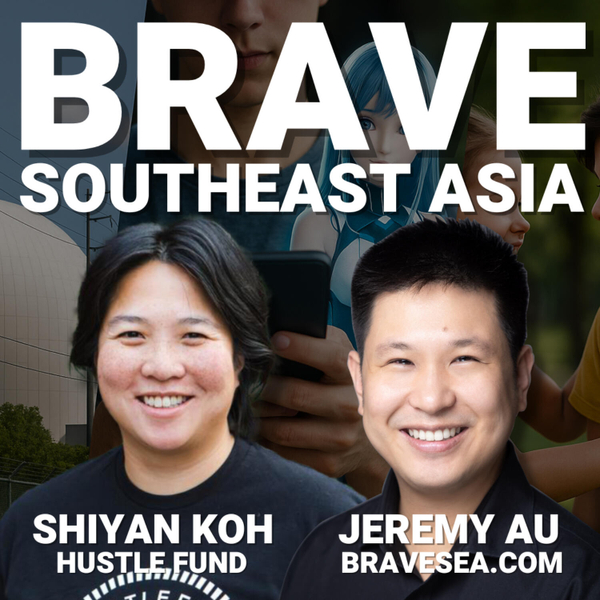
Shiyan Koh: Singapore Studies Nuclear Energy, SEA Startup Pessimism & AI Waifus – E608

Shiyan Koh: Singapore Studies Nuclear Energy, SEA Startup Pessimism & AI Waifus – E608

"Gen Zs were probably the first to be digitally native, right? Because we actually remember life before the internet. My entire secondary school life was looking out the window because we didn't have phones. I think the pendulum will swing the other way, because now all of us are more conscious about not giving our kids phones too early and trying to help them focus and not turn into zombies. Gen Zs are unfortunate in that they were the first—like experiments—if you think about when Facebook and the phone all came online. I have some hope that we can swing the other way." - Shiyan Koh, Managing Partner at Hustle Fund


"VCs have to be optimists, otherwise they cannot be VCs. If you're a pessimist, you should be a distressed debt investor. It's part of the job—you have to be an optimist. Sometimes people ask me, what do you need to see to invest? And I always ask the question back, what do you need to see? Because you're the one investing your time and effort into this. You have opportunity cost as well. It's less about what the investor needs to see and more about what you need to believe for this to be a business you want to spend your time on. Investor validation is one part of it, but at the end of the day, it's customer validation that really makes a business work." - Shiyan Koh, Managing Partner at Hustle Fund


"The internet is the best distribution system ever invented, so imagine all the businesses today that wouldn't have been possible without it. Think about that same kind of sea change now—there's going to be a bunch of businesses that were not possible without AI. That's a really exciting thing to be in, an exciting period to be alive. As a founder, you need to go find a problem that people want to pay you to solve. You can only control yourself; you can't count on other people to validate you." - Shiyan Koh, Managing Partner at Hustle Fund

Shiyan Koh, Managing Partner at Hustle Fund, joins Jeremy Au to explore Singapore’s exploration of nuclear energy, the Southeast Asia startup downturn, and how AI is changing both business and social behavior. They discuss how the government seeds long-term energy strategy, what optimism looks like in a bear market, and why human interaction must remain a priority as digital tools evolve. Together, they reflect on resilience, founder mindset, and parenting in an increasingly AI-driven world.

02:15 Singapore is quietly exploring nuclear power as an energy source: In 2024, Singapore signed a civil nuclear cooperation "123 Agreement" with America and launched the Singapore Nuclear Research and Safety Initiative (targeted ~100 researcher lab) at the National University of Singapore (NUS).

03:46 Hitting carbon net zero may require nuclear energy: International Atomic Energy Agency (IAEA) director-general Rafael Grossi: “When it comes to decarbonising, what are your options? Here, there is no hydropower. You have renewables, but you don’t have much territory... It’s a small country, so you cannot have wind parks for kilometres on end... In my opinion... Singapore could rightly (be) the most perfect example of a country that needs nuclear energy."

06:28 Nuclear acceptance may follow the NEWater playbook: They compare it to the early skepticism around NEWater, which underwent societal education, trial balloons, and gradual integration. Hurdles include nuclear safety, exploration of small modular reactor designs and concerns collaborations with neighboring countries.

13:59 Southeast Asia’s startup mood has soured post-boom: After years of hype and capital, many founders now face disillusionment. Shiyan calls it a hangover from the zero-interest era but also notes new AI-driven opportunities are emerging.

15:36 Founders can now build global-first with AI: Southeast Asia’s fragmented markets make regional scaling hard. Shiyan explains that founders can now launch globally from day one using AI tools, bypassing local limitations.

19:32 AI changes what’s possible, but customers, not VCs, decide: Even with better tools, Shiyan reminds founders that most startups still fail. What matters is whether customers are willing to pay, not just whether investors believe.

23:00 Real connection still beats AI companionship: They explore whether AI waifus can help people practice social skills or just create more isolation. Shiyan argues nothing replaces shared quirks, jokes, and emotional presence in real life.

Jeremy Au (01:12)

Shiyan, how's life?

Shiyan Koh (01:14)

Life is good. I just chugged a cup of coffee, so I'm feeling great.

Jeremy Au (01:18)

Yeah, because you just got off a flight. What time you woke up? Where were you? ⁓

Shiyan Koh (01:21)

I woke up at 5 a.m. I was in Tokyo. I just finished a week of pitching.

Jeremy Au (01:26)

Alright the LP fundraise. I did see actually the Instagram stories of you and Eric and I mean the other GPs of Hustle Fund I guess and all of you were wearing the shirts the Hustle Fund Shirts. You always pitch in it? What is exactly the word to get on the shirts?

Shiyan Koh (01:44)

We always pitch in the shirts. Depends. We have lots of shirts. You may be confused. We could be a t-shirt company or we could be a venture fund.

Jeremy Au (01:56)

Check out this swag link and It was just like this.

Shiyan Koh (01:59)

store.hustlefund.vc for all of along at home. Now we've got one that's like, it's a vibe. It's like got the hippo. I'm wearing a Camp Hustle shirt. We have like the standard Hustle Fund shirts. You know, we're kind of on brand. We're not suits, essentially.

Jeremy Au (02:14)

We're not suits, that's what you're saying. Fantastic. So we wanted to talk about, because we saw some interesting news. I think the two things that we want to talk about was, one was Singapore going nuclear, question mark. And there's one. And then obviously the implications of that. And what's the context of it. And then of course, the second thing is, I think there's a sense of, I think pessimism or cynicism about ecosystem. I think that we both noticed in Q & As and various groups.

I think those are interesting topics to talk about. But let's talk about Singapore going nuclear question

Shiyan Koh (02:43)

Yeah, well, I think you shared a fun article over the weekend, and it was, Singapore could be the most perfect example of a country that needs nuclear energy, IAEA chief. And I think we've talked about this on a prior episode when there were other trial balloon types of news articles, but there's some really choice quotes here. "Singapore give me the most perfect example.

Jeremy Au (02:54)

Yeah.

Shiyan Koh (03:06)

Territorial limitations, energy requirements, technological base, and institutional maturity," said Director General of the International Atomic Energy Agency, Rafael Grossi on Friday. He was here visiting under the S.R. Nathan Fellowship. In my opinion, and in the opinion of many experts in terms of options, perhaps Singapore could rightly figure as the most perfect example of a country that needs nuclear energy, because with a very small nuclear power plant, you can have a level of energy density and production that you cannot match with anything else.

Keynotes that the country cannot produce hydropower and lacks territory to produce enough wind or solar to meet its energy needs.

Jeremy Au (03:39)

So, I think there's lots of reasons for why nuclear energy makes sense. I think let's dive into that. But I think I just find it interesting because he was saying this as a visiting scholar at NUS, which is a giant think tank. That's one.


And then two is this article was published by Channel News Asia and all the various local newspapers. And three, of course, is everything he says, something like this, would have been cleared through the local Singapore government. We assume. But I just find it quite difficult for me to imagine that he didn't say it without clearing.


Shiyan Koh (04:13)

Well, I guess you can wait for backlash. There's more stuff about like, oh, you know, it will be done under the auspices of ASEAN. They can collaborate with other countries. They provide some examples of Slovenia and Croatia collaborating on similar types of energy projects. But yeah, I mean, I think if you think about global warming and everything that people are doing, like the math doesn't work without nuclear.


Jeremy Au (04:35)

the math works as long as you don't worry about carbon emissions, right? Because Singapore is an oil and gas hub, there's lots of oil and gas. Oh, the math of global warming. The math of Singapore trying to hit net carbon zero also doesn't work at a country level unless you go nuclear. Because there's not enough renewables. I think solar is doable.


Shiyan Koh (04:43)

No, I mean the math on global warming.


Exactly.


And our aircon is on all the time.


Jeremy Au (04:58)

Yeah, but I think basically, we have high carbon expenditure currently, but because we have high energy expenditure, similar to a developed world country, and we don't have a space for solar farms, we don't have space for hydropower, we barely have apparently geothermal power, perhaps they're trying to explore geothermal power, and wind power obviously there's no space for that either. So, I think the tricky part that the government is facing is if you promise


carbon net zero, how you gonna get there? So, unless you buy electricity from somebody else, nuclear is probably a big component of it. So yeah, so either you like break a pledge on carbon net zero or you go nuclear question mark, right? I mean, so I think that's the question I think.


Shiyan Koh (05:40)

Yeah, but I mean think nuclear has just been


in the doghouse, right? For the last few decades, right? So I think everyone has in their mind like Chernobyl or Fukushima. And there have been all these big efforts in the West to kind of shut down nuclear, existing nuclear and to block new nuclear from being built. But I think, a lot of advances in the small nuclear reactors offer hope for ways that people could build in a much more safe and contained way. I mean, I do have a question, right? Like, this is a very big country, like, where would you


put it? And if there were an accident like are you all screwed?


Jeremy Au (06:15)

Well, yeah.


Shiyan Koh (06:16)

Would it be offshore? Would you


be able to like tow it out really, really far as quickly as possible if something went south? I mean, I don't know, right? I think there's like a lot of questions that would have to be answered. And there's public opinion too.


Jeremy Au (06:28)

Yeah, and I think it's interesting because the trial balloon has gone up, right? And I think we flagged that up almost a year ago. I think I felt very contrarian saying it, but I was looking at the newspaper and I was like, like, you know, Singapore signed the Civilian Nuclear Energy Act with the Biden administration.


Shiyan Koh (06:42)

They do like joint R & D.


Jeremy Au (06:44)

Yeah, they now joined the


R&D project. Singapore committed to training nuclear safety engineers and create university majors on it. So to me, it's like this is part of the industrial and educational policy to start building out that capability. So to me, seems like, I'm not saying that there's an official decision, yes and no, but it feels like all the laying ground blocks are there.


And I said, think a big part of the fear is actually about public opinion, I think, in Singapore and also regionally as well, right? Because I think within Singapore, obviously, everyone's going to be like, where do you put it? Is it next to me? Is it going to be Tanjong Pagar? I mean, as an example, right? Because when you think of nuclear weapons, it's like Chernobyl, which is the HBO series.


So I


think that's the safety component. And of course, from a neighbor component, there's no ASEAN country has gone nuclear yet.


Shiyan Koh (07:36)

It's like a more intense version of, do you remember NEWater?


Jeremy Au (07:40)

Yeah, NEWater you're talking about the part where they recycle urine into drinking water and everybody laughs at Singapore for drinking their own urine. Yeah, it's normal now.


Shiyan Koh (07:48)

But now everyone's like, yeah. Now


it's normal, right? It's like part of the system. But remember they made a big push. Do you remember they gave it out during NDP? Yeah. And they're like, look, it's totally drinkable. Everyone's like, there all these jokes about Jamba Juice and everything. It was a long time ago.


Jeremy Au (07:59)

Yeah, yeah, yeah, yeah, yeah.


This


is like a deep cut into Singapore.


Shiyan Koh (08:09)

that's the pattern, right? It's like you need to socialize ideas. You need to get public opinion on board in order to get some of these ideas across the line.


Jeremy Au (08:18)

Yeah, and I always remember the funny part with NEWater is that they take obviously sewage water, they purify it and it's super pure and then put it into the reservoir, which is less pure and then they purify it. It's like yeah, a little storm water, canal flavor, a little fishy fishy, you know. Yeah, so I mean, I think there was like a concession being made to make it more palatable. It's like, oh, we didn't give it to you straight, you know.


Shiyan Koh (08:30)

like the natural flavors.


But I remember that period very clearly, there was like all of that socialization and everyone was like, there was like some outrage, right? Cause I was kind of like a bit grossed out.


Jeremy Au (08:53)

But okay, I mean, let's talk about the way why it makes sense. And we'll talk about like the risks or the consequences. I mean, like I said, it makes sense if you say you believe in a world of net carbon zero, the way you get there using nuclear energy. Singapore has a good engineering base and talent pool and this is high safety orientation. No natural disasters yet, touch wood, you know, in terms of like...


Shiyan Koh (09:09)

Safety orientation.


I think it's also like


national security strategic type of question too, right? Which is like energy consumption probably only goes up on a per capita basis, especially given, right? Like we had to put a moratorium on data centers because of energy and water demands, right?


Jeremy Au (09:29)

And I think there was a big kind of debate that we've had, right? Because exactly that, is, I think when Singapore put moratorium on data centers in Singapore, they all went to Johor or Vietnam.


Shiyan Koh (09:40)

So, you're kind of like


throttling certain growth prospects.


Jeremy Au (09:43)

Correct. And I think obviously, Singapore government, a lot of them look at data centers, it's like, okay, maybe it's not super high value, blah, blah. But then you kind of like, well, you know, that's literally like billions of dollars of foreign direct investment into, you know, servers, maintenance. But so I think if we remove energy as a constraint, then, you know, these data farms can continue being built, right?


Shiyan Koh (10:06)

Yeah. But also I think you just want to like be in control of your energy. Right. Just like, you know, you want to be in control of your water, right? Like, why do we spend all that money doing desalination or new water? It's because you don't want, right? It's always a threat. I'm going to cut off your water, right? Like, I mean, like food security, right? All of these things are, I think, elements of national security that,


Jeremy Au (10:27)

yeah.


Shiyan Koh (10:28)

But actually on this national security topic, I was at a meet the people session a couple of weeks ago and someone asked a question, a kid asked a question, what can we do as children to support national defense? And I thought the minister actually had a pretty good answer. The defense minister, you know, Minister Chan Chun Sing.


Jeremy Au (10:45)

Which minister and what did you say?


Shiyan Koh (10:50)

He said, one, you need to be internet savvy. You need to be able to discern fact or fiction, right? Because there's so much information out there. He said, two, don't be a picky eater. Because from a food security perspective, it's better if we have a diverse diet, because it allows us to have a more varied set of suppliers. But I think maybe also playing to the parents in the crowd, because it was answered to a kid. A kid asked him.


Jeremy Au (11:07)

Alright.


Yeah, all the


parents are like, you know, if you, you know, I mean, it's a dual approval system right there.


Shiyan Koh (11:18)

But then third, he said, you know, like, stay physically fit. Like, don't watch your phone more than two hours a day. But like, I actually thought that was like quite a good answer. Like, you know, if you want your population to be like part of, you know, national defense,


being fit, right? Having a diverse diet, and being able to discern fact or fiction online, where you think about how much warfare today is actually information warfare. I thought that was a really solid answer.


Jeremy Au (11:43)

That is a solid answer. And I mean, talking about national security, think I thought that Billahari, our retired diplomat, actually has been writing quite a lot of provocative articles over the past few years. He's all over Facebook, and everybody likes to send his articles around. But I thought what was interesting was that his point of view was that as the world goes more multipolar, more countries will see nuclear civilian and


dual use capability over time to ensure public safety, right?


And I think he was looking at, for example, like Korea and Japan as examples that have the civilian nuclear knowledge base necessary to do something and might see the need for dual use to able to guarantee their own national security if they don't have a US nuclear safety umbrella. And I think that's also talking about the context of Europe, Ukraine, and this whole NATO alliance thing. And I think that's something that I'm sure,


I think if you're looking at the neighbor's perspective, I think that's where some of the fear is going to kick in, right? We're just like, OK, you have Singapore. Singapore is going nuclear, right, civilian-wise.


So, I'm sure that from a neighbor perspective, I think that's something they're going to be thinking about one, right? Is one is like, okay, if there's a nuclear neighbor, one is, we also go nuclear.


Shiyan Koh (12:55)

But I think


that's why he, the IAEA chief was proposing doing it under the auspices of ASEAN, like regional collaboration. So there's, I mean think there's a question of like, how much regional alliances become more important in a multipolar world, right?


Jeremy Au (13:11)

Yeah, I can imagine that some set of diplomats thinking about how to make this because again, the biggest concern for every neighbor is it going to be like, Singapore goes nuclear, should we go nuclear? And then if Singapore has a nuclear disaster, like Fukushima, right? Then how is that going to impact us as neighboring countries? Right? So I think there's going to be that local domestic opinion in each of these countries as well, as the policymaker.


decision making. I felt like that paragraph was actually quite key because to me, I think there's a, you know, like a test balloon to be like, maybe we'll make this like what a Singapore, Malaysia, Indonesia, shared power grid, nuclear energy, where we, you know, have observers maybe from I think it's implied, right? Based on the example to be there to be trained there, you know.


So, it's an interesting thing where you're like, oh, maybe like our kids jobs be nuclear engineers. Like there's a major that's going to come up now. I mean, it is now a new major in our local universities.


Shiyan Koh (14:09)

My father-in-law is a retired physicist and he worked on fusion for his whole career.


Jeremy Au (14:14)

Fusion. Wow! Well fusion is kind of coming?


Shiyan Koh (14:18)

I mean, he spent decades working on solutions. He's like always, coming.


Jeremy Au (14:21)

It's only decades. It's always coming.


It's a science fiction nerd has like nuclear fusion is the way the future it's clean blah blah blah. So I think that's the nuclear side and I think that's interesting because weirdly I'm kind of optimistic about it because I like I don't know,


find nuclear energy cool. Yeah, it was cool for us. I mean, let's see how it turned out.


Shiyan Koh (14:45)

If we could get through


the political sort of public opinion stuff, it could be a pretty interesting option. And you know, I think we all need more positivity these days.


Jeremy Au (14:50)

Yeah.


Yeah, because I think one of the issues that you flagged up was that this, yeah, so Q &A, Southeast Asia, tech ecosystem is doomed, bad policy, bad VCs, bad founders. I mean, that's kind of like the words I'm hearing. So I'm just kind of curious, how you think about it?


Shiyan Koh (15:11)

Yeah, I mean, I think it's weird, right? Because on the one hand, you see all the AI advances happening literally every day, right? Like new models, new apps, things that are getting pushed. People are doing super cool stuff. So I feel like this amazing energy and optimism.


But then on the other hand, when I'm on a panel or I'm in some groups, there's a lot of pessimism about the local or regional ecosystem. And so I think those things are very stark contrast in my mind. So I think the way that I think about it is like,


over the last 10 years, let's say 2014 until now, there was a huge run up in the Southeast Asia ecosystem. Tons of capital poured in. This is zero interest rate period, right? And soft banks out there, rent checks, and everyone's super pumped. We've had some unicorns emerge out of that era. But I think


A lot of people feel like we're kind of in this hangover period now, right? Like now things have crashed, a lot of things didn't turn out the way they had hoped. It feels like funding has dried up. And so people feel like pessimistic. But


I think like the AI era actually offers more opportunity for Southeast Asian entrepreneurs to go global from day one than ever before. Right? Because I think one of the lessons of the last 10 years is


Southeast Asia isn't one market, right? And we say this a lot, but I think sometimes people always like want to conflate it because that's part of the narrative, right? So Southeast Asia is not one market and winning Malaysia doesn't necessarily give you an edge at winning Indonesia or Vietnam, right? You kind of have to go win all those things anew. And so the question is like, well, if you had to be in multiple markets,


at the end of the day to build a scaled company, are those the markets you would have picked in to go first? And I think there's questions about that, right? On the consumer side is like, well, would I really go pick a market that like has pretty low per capita GDP? Right? Or on the B2B side, you're like, do I want to pick a market where labor costs are low so the costs, like the cost benefit of software is not as compelling. Or do I say, 'hey,


I'm going to be global from day one, which means I can serve anyone in the world.' And my edge is going to be, I have like a pretty low cost basis, but I'm like quick and nimble and have ideas about problems to solve. And I think when you see like,


a bunch of these companies coming up, whether it's like a cursor or a lovable or any of these AI tools, like they're not saying I'm only going to serve people in Estonia or London or France or wherever, right? They're like, anyone who's writing code can use this and that's global, right? So I don't think there's any reason why a Southeast Asian founder can't do that. And so we shouldn't feel pessimistic, I guess. I think we should see sort of this era as like,


a lot of opportunity actually. Because people are adopting at all these new tools, they need tools that match that. And you actually have the opportunity to not just build a better SaaS version of the next thing, but really actually change how people do business in certain sectors. I think that's kind of exciting. So I guess I'm more optimistic in some sense.


But I do think that we kind of have to wrestle with the realities of the market.


Jeremy Au (18:21)

Yeah, I think.


This reminds me of Buddhism. When people are very happy, have equanimity. You have to be a little bit more chill. This too shall pass. The happiness shall pass. When things are bad, you still have the equanimity. This too shall pass. I mean, there's always these giant market cycles that we're part of. And I think that right now,


we're definitely in a bear cycle right now for Southeast Asia, I would say. But I think now I think the opinion has gone way more bearish, I think, than actual reality from my perspective. But I think if I was like looking at it from somebody who's just kind of like reading the news and just being part of the everyday, you know, dynamic, it does feel like three things would stand out for me, right? First of all, it's like,


one is, all these people that are saying that it should be better and it shouldn't be so gloomy, right? They were the ones that were also at the top of the market cycle also. They were not saying, it's a bit bearish. I think there's a sense that,


I think VCs were big boosters and always index on optimism during the top of the market cycle. And at the bottom of the market cycle, now they're saying be less gloomy.


Shiyan Koh (19:27)

VCs have to be optimists, otherwise they cannot be VCs. No, I'm serious, right? If you're a pessimist, you should be a distressed debt investor. I think it's sort of part of the job, you kind of have to be an optimist. But I guess I would say like...


Sometimes people ask me, what do you need to see to invest? And I always ask the question back, what do you need to see? Because you're the one who's investing your time and effort onto this, right? You have opportunity cost as well. So I think it's less about what the investor needs to see and it's more like, what do you need to believe for this to be a business that you want to spend your time on, right?


Investor validation is one part of it. But at the end of the day, it's customer validation that's really the thing that makes a business work. And so I'm not saying, hey, every business idea is going to work. That's not what the venture model is at all. Actually, I would say most things don't work if you're trying to do a VC sized outcome. And I feel like I've been pretty consistent in saying that.


But, but I think my optimism from this period is just that like the tools are so much better and it makes things so much easier. It's, it's like the dawn of the internet. The is like the best distribution system ever invented. And so imagine if like all the businesses you think about today that would not have been possible without the internet as a distribution mechanism. So, think about that similar sea change now, which is like, there's going to be a bunch of businesses that were not possible without AI.


Jeremy Au (20:44)

Right.


Shiyan Koh (20:45)

And that's a really exciting thing to be in. That's an exciting period to be alive in and to say like, oh yeah, I can actually transform how something can be. Yeah. So I think as a founder, you need to go find a problem that people want to pay you to solve. And maybe it's VC back home, maybe it's not, but I don't know. I think


Jeremy Au (20:53)

Yeah.


Yeah.


Shiyan Koh (21:06)

you can't count on other people. You can only control yourself, right? You can't count on other people to like validate you.


Jeremy Au (21:10)

You know, I think what that reminds me of is I think what people would have liked is like, you know, when at the top of the market cycle, there was, you know, I think they would like to have heard somebody who was like, okay, you know, this is way too good. This is a bull market. We need to watch out for this. And then that person who now has the credibility of calling the top of the market cycle, you know, gets to say today at the bottom of market cycle, the things are Yes. I think, I think.


Shiyan Koh (21:33)

People did say stuff. People


do say things like, hey, these valuations seem kind of out of whack, or this seems to be a little bit ahead of progress. People say stuff like that.


Jeremy Au (21:43)

Privately I would say. I don't think too many people said it publicly in Southeast Asia.


Shiyan Koh (21:49)

I think this is an interesting question, right, which is like, you always want to, I think, encourage people who are doing hard things, right? So like running around shitting on people generally is not a good look.


Jeremy Au (21:59)

Yeah.


Yeah, you don't want to the guy walking around saying, the market's gonna crack.


Shiyan Koh (22:04)

Yeah,


the market's gonna crash, this sucks or whatever it is, right? But I think you can see what people's behavior is, right? Whether they choose to participate in the deal or not. And also I think there's the reality is like everybody talks their own book. If you're a momentum investor, your incentive is to talk up the momentum. investor, your incentive is to say everything is shit. So I think there is an element of like, we also have to be like, practical and realistic about what people's incentives are.


But yeah, I don't know. Maybe we should just turn to Buddhism and be like, it's never as bad as you think and it's never as good as you think.


Jeremy Au (22:34)

Well, yeah, over like, you know, a century, you know, like, the world economy grows at what, 5 % or something like that every year or something like that, you know, but obviously, that big swings that up and down, bull versus recessions. I would say maybe one more element that I think that's interesting as well. I think that's also a bit different from this flavor compared to one to three years ago,


was adding one to three years ago, the whole global market was bad. And I think this year now, the flavor is like, there's a bit of comparison with the American market, there's like Planet AI. So, Planet AI is going for like billion dollar valuations at pre-seed, seed, things like that.


Shiyan Koh (23:14)

I mean, that's a


very handful of people, right? That's like, you know, Murati comes out of open AI and like starts her company and it's like a pre-seed valuation or seed valuation of Rebellion, right? But like, I think this is also like what we tell founders as well, which is just like


there are a handful of founders who have no trouble raising regardless of the market cycle. And they're the ones who are going to get covered and have like lots of crazy press. But for everyone else, fundraising is a slog. Like that's reality. So even if you want to be like, you know, the US is like a crazy place. That's only true for a subset of American founders. Everyone else is slogging. And I would say that like, I saw, you know, we have a


Jeremy Au (23:47)

Yeah, I agree.


Shiyan Koh (23:52)

like, acquaintance who lives in the Midwest said, am I the only person who hasn't tried chatGPT yet? So I think there's also a lot of variation, right? I think in San Francisco proper, probably everyone is using it and experimenting and trying. But there's, lots of people who haven't adopted yet, and that stuff all takes time as well, right? So I think there's also, like, you have to think about, like, well, what's the media you're consuming, and are you in your own sort of bubble about, like, what's actually happening? ⁓


Jeremy Au (24:16)

Yeah.


Shiyan Koh (24:17)

So yeah, I think that's, I don't know. Back to like discerning reality online.


Jeremy Au (24:25)

Well, talking about everybody using AI, I think you and I were swapping notes about the Grok avatar.


Yeah, so what is this avatar?


Shiyan Koh (24:35)

Well, I think you sent me the job description, right? Yeah. It was like a job description for engineers to work on like, AI waifus. Yeah. Yeah. Which is, you know, interesting.


I don't know, I think there were a bunch of Stanford researchers in town last week and they were trying to paint a more positive perspective on like, can you make human centered AI? So rather than the dystopian notion that everyone's just gonna be talking to their AI girlfriend or boyfriend and descending into like a weird, like virtual world, like can we use some of these tools to actually make people more pro-social, right? Like if you're


awkward or anxious or nervous like there's actually opportunities for you to practice get feedback in the privacy of your home so that when you actually do go out into the world you know you're more confident yeah got more reps and you know it can make you more successful socially do you buy it? Like I hear the words you're saying but I don't think I agree


Jeremy Au (25:12)

Right.


Yeah.


You know, it reminds me of like, remember like when online dating was suddenly become a thing and people were like, oh, it's good because you people who couldn't find dates can now find each other more online. No. You were on the New York Times wedding session as well.


Shiyan Koh (25:50)

Do you read the New York Times wedding section? I love the New York Times wedding section. ⁓


I read it and an incredibly high percentage of people say they met online.


Jeremy Au (26:04)

Yeah. So I think it's an interesting dynamic where I think a lot of people met online. I was at a friend's place recently and they also met on Hinge. And so, you know, like there's, I think the apps that obviously are doing a good job matching people. I think that's one. But two, of course, there's all these components where it's like for a lot of people are complaining about how online dating is like a hell hole from their perspective. From just like


the dating behaviors, how to talk to each other, having to create a funnel of lots of leads, and then you filter your way down and the mechanization of that process. I think there's a piece where as online dating goes and becomes that space for dating, then the acceptability of dating


and meeting people in other venues becomes less acceptable, right? So for example, a lot of people used to meet at work, right? People meet online in person because they asked to each other out. And I was becoming less and less susceptible to those places.


Shiyan Koh (27:00)

Just like less like comfortable like yeah you're like it's easier to do this than to like work up the courage to ask somebody out


Jeremy Au (27:08)

Yeah, well, the


end effect is the same, which is there's a displacement effect where, you know, these spaces are becoming more migrate to the online space where it becomes the social norm, right? In that sense.


Shiyan Koh (27:19)

Just feeling all this stuff like takes practice, right? Like the first time you ever ask someone out it's like super awkward and you like overthink the whole thing right and then the more practice you have it the easier it becomes because you're like okay this isn't life and death like what's the worst thing that's gonna happen they're gonna say no, you know, it's like anything it just becomes easier with practice and I think like when you're bad at something you feel anxious about it.


Jeremy Au (27:39)

I agree with you 100%. I guess thinking about it from a psychology of it is like, you know, the joke about online dating economics, the problem is that if they succeed in letting you meet somebody who is a long-term partner, you stop becoming a user, you stop being a subscriber.


Shiyan Koh (27:53)

That is cynical.


Hinge's tagline is the app designed to be deleted.


Jeremy Au (27:58)

Correct. I think that's the only one because it implies that all the other apps are not meant to be deleted. But I think that's the, I think the big push, right? Which is that there's a gamification of the dating process and the levers, there's a variable reward component. There's the lucky component, you know, like, so I think there's a part where, you know, like to some extent, interesting dynamic is that most dating apps are


you know, the economics of it, I'm just saying is you should buy a subscription for as long as possible. And so there's some, you know, dynamic, which is a bit different. I always think of myself as always interesting. I remember, but there was an Indian. Someone has to fact check me on this because I heard that there was an Indian app. There's a wedding app and they make most of the money on the wedding, but they offer a dating feature. Anyway, so I thought that was.


Shiyan Koh (28:43)

Okay, that's demonstration of alignment.


Jeremy Au (28:46)

Yeah,


exactly. It's like our job is to get you to a wedding where you got to buy the whole shebang, you know, I don't know, a five day wedding. And so I was like, okay, that's an alignment of incentives there, right? Anyway, so I think going back to the waifu's component, I think my concern I have is like, yeah, I think the positive spin is that people are going to be trained and practice on AI avatars before they do it in person. I think there's going to be some effect of that. But also I feel like that


economic incentive structure would be like, the waifu guy wants to keep your, you know, daily active users up and they want to keep you talking forever. You're like, at some point, I think like, you know 20 years down the road, you're like, wow, my waifu is way more interesting than my spouse, you know, pays attention to me, is available to me to talk at 3am in the morning about the most random nerdy, they'll be like, hey, did you know that the African swallow travels at a certain velocity per...


hour and then the waifu is gonna be like haha Jeremy I totally understand there's a Monty Python reference you are so charming and amazing for knowing this reference you know and everyone's gonna be like


Shiyan Koh (29:50)

I have a couple thoughts on this.


Jeremy Au (29:52)

What the Monty Python revelation?


Shiyan Koh (29:54)

No,


no, I got the reference. And then what is it like? I already had somebody tell me, my God, ChatGPT is so great. My wife now asks it questions so I don't have to answer it.


Jeremy Au (30:03)

Oof. And I was


Shiyan Koh (30:05)

thinking, on one hand, maybe it's good, like, you know, your wife is empowered and like doing other things and like you're not. But on the other hand, you're like, well, I mean, part of being partnered, I think, is that you guys help each other out. And, you know, there's that kind of, I don't know, shared


work that you do together, right? But to the swallow comment, right, is that like, you know, every couple has like inside jokes, right? And you like, you know, chat about them. And that's like part of what builds that history between two people. And that, you know, that they are charmed rather than annoyed by your weird


Jeremy Au (30:37)

interests.


Shiyan Koh (30:42)

I mean, I tell


my wife a bunch of weird sports stats that she probably, I'm like, my God, most amazing game. Guess what happened? Blah, blah. And she's like, okay. Or Q4, you know, amazing comeback.


Jeremy Au (30:56)

Yeah, I can't imagine I'm presenting a wife like I can't deal with American football stats. I'm just like


Shiyan Koh (31:01)

She'll be like, okay sweetheart.


I agree with you. I don't tell her 90% of the stats that I consume. I only share the 10% that I feel are really interesting.


Jeremy Au (31:12)

Yeah,


but now you have a waifu. I'm just saying now you have a waifu, right? There's a whole engineering team. There's this design to just find that 100%.


Shiyan Koh (31:23)

But


people have always had different interests from their spouses, right? Like I have friends that I'll watch sports with or I'll talk about sports with, right? And like my wife has book clubs that she's part of. So it's just like another yeah, yeah, you're not gonna do 100 % of things together, right? So, just sort of like well, what what's the percentage right? Which is like, you know


I think I'm more concerned about like, instead of having like friends that I had a fantasy football league, I only had like AI avatars that I had a fantasy football league.


That's just like the decline of social interaction altogether, which I think is a profound societal problem.


Jeremy Au (31:58)

Well, it's, you know, the social, this parasocial and this, I don't know, digi-social. I mean, you know, like socials, you and me hanging out, but talking about it, parasocial is me listening to Huberman Labs about, you know, like longevity. And I'm just saying, like, I know this guy. I'm not a Huberman bro. Thank God. But I do find his, look, I'm not trying to be a, he's not my role model. I'm just saying that it's


Shiyan Koh (32:15)

You're a Hoover.


Jeremy Au (32:23)

nice to listen to somebody talk about dopamine and sounds interesting. Anyway, fine, you're not a fan. That's okay. I don't know. It's like we agree to disagree. You like your football and I like listening to Huberman Lab. Okay, fine. This is Parasocial and this is Digital Social, right? Which is like you're playing a role playing game, a Japanese RPG, like Final Fantasy. This world full of you know, NPCs, right?


Non-playable characters who have a storyline review that's super fascinating review. I was watching some people do a play through of like Death Stranding 2, which is a new game. And they have some really compelling characters and they, you know, digital scan, the actresses and the actors entirely, including all their feet. And then they made it a I don't know, there's a huge joke about it because there's a cut scene where there's this, I mean,


Anyway, it's Quentin Tarantino is just there for some reason. Anyway, the point I'm just saying was that there was this, I mean, I'm just saying like, you know, if I look at that migration, you know, I kind of look at it maybe same thing from like dating to online dating, right? Maybe I'll say like, okay, social, human social, did we define social as becoming parasocial and now to digital.


Shiyan Koh (33:32)

The goal of also


saving is to eventually find someone that you exist with in real life.


Jeremy Au (33:36)

So imagine, okay, here's the startup pitch, I'm just very starving here, imagine a hinge, but all the people on the other side are bots.


Shiyan Koh (33:43)

And what's the goal? Like what's success event? Yeah, like Hanzo's trying to


Jeremy Au (33:45)

I don't know, but what? It's success. Success is a


nine dollar subscription every month.


Shiyan Koh (33:52)

But what do I get as a user? What am I trying to like? Is it entertainment that I pay for?


Jeremy Au (33:58)

I mean, I just feel horrible about myself because I do feel like I just brainstormed a real company, which is a hidden style interface for meeting people online. And then, you know, some of them...


Shiyan Koh (34:11)

Yeah.


Jeremy Au (34:11)

Yeah, I mean I'm just saying like, I'm just trying say here is you know, you're like, why do all the hard stuff afterwards? I'm actually taking somebody on a date, getting rejected, etc.


Shiyan Koh (34:18)

Because I think not everything should be about ease, right? Because something is hard, like, it doesn't mean you should not do it, right? I know a lot of capitalism is about easing things.


Jeremy Au (34:28)

Yeah,


I mean my bubble compound, taking my bubble, way more car, my bubble headquarters. Exactly.


Shiyan Koh (34:38)

I think like,


I don't think that's what, I don't know, like life is, right? I think life is like, there is friction, there's stuff happening and you're like interacting and I be human with people. I think that's what makes like life interesting and textured.


Jeremy Au (34:51)

I agree with you. I'm just mindful that maybe we sound like old people when we say that because for example, like there's a gen Z stare, right? heard of that? Stare. Stare. That's what this is a term that's it describes, I think there's a bunch of gen Z's and they're kind of like in a meeting or whatever, but just staring, but they're not like clocked into you. If that makes sense.


Shiyan Koh (35:00)

See?


Jeremy Au (35:13)

So I think a good example would be like you're in a meeting with them and just looking at the computer the entire time. They're not in the meeting, if that makes sense. It's just, you know, like.


Shiyan Koh (35:21)

Is this a meeting that should have been an email? Okay, wow! Because I also have sympathy for that, right? Sometimes you're in a meeting and like, why are we all here? This is a giant waste of time. This should have been an email.


Jeremy Au (35:32)

I agree. I'm just saying that I've noticed that, you know, as when I teach in university, there's a bit of a, I do think there's this thing about Gen Z's stare. And I think also my old professors also complained about it. Some of it was because COVID, so COVID broke the socialization dynamic for a lot of folks because they ended up going online on Zoom for their trainings. So, they kind of broke their social skills, the training side.


But I think the component of the gen Z stare that I kind of agree with is like, I think when we're in person or, let's just say, I think the boomer generation. Boomers. I'm just saying for the boomer generation, would be like, if we meet, we're 100% offline and we don't use our phones, right? I think for millennials, it's like, okay, we're like...


Shiyan Koh (36:08)

We're not boomers, okay?


Jeremy Au (36:22)

We're in person and 80% were checked in in person and 20% was just checking our phone from time to time for some notification. Does it make sense? And I think the complaint and where I would describe it is I think 80% zoned into either the phone or a little bit more checked out and then 20% is in in person with you, right? I think there's a sense that we're present with each other, right?


Shiyan Koh (36:32)

These are higher percentage.


I think we're gonna


swing back. Because I think the Gen Zs were probably the first were digitally native, right? Because we're a bit like, we actually remember life before the internet.


Jeremy Au (36:53)

Yeah, like there was a time when I was on a bus and I was meditating the entire way because I had no phone. So, I would literally just look out of the window.


Shiyan Koh (37:05)

This is my entire


secondary school life was looking out the window at because we didn't have phones. I think the pendulum will swing to the other way because now the kids, like our kids age, all of us are quite conscious about not giving our kids phones too early and trying to help them focus and not turn into zombies and things like that. So I think the pendulum will swing. I think Gen Zs are unfortunate in that they were the first like, they're like experiments, right? COVID didn't.


Jeremy Au (37:28)

Yeah, and COVID didn't help. They didn't


have a socialization.


Shiyan Koh (37:31)

They grew


up in social media, right? Like if you think about when Facebook and the phone, all those things together came online. So, I don't know, I have some hope that we can swing like the other way. But yeah, I mean, I actually think like a major part of like back to this like national defense idea is that we actually need to all interact with real human beings.


No, because it's harder to believe conspiracy theories if you know real human beings.


Jeremy Au (37:54)

Yeah, I mean, it was like that, we talked about that Chinese teenager in Singapore who became a white supremacist. You know, and he wanted to commit terrorist attacks in America. And I was like,


Shiyan Koh (38:05)

Not many friends to talk to to be like this sounds crazy like what are you talking about like that's actually literally like you're just like what are you talking about this doesn't make any sense right so I think like we need all that human interaction and it's really important to have it right it's like go out and like connect with people and talk about it


Jeremy Au (38:12)

He has said that out loud to his friends.


Shiyan Koh (38:28)

So, it's like, I know it's like, oh, I hate talking to my grab driver. I just want to be quiet. And there's just silent option. I was like, no, you should talk to your grab driver. Like you should talk to as many people who are like, you know, out and about in your life because everyone needs that human okay, I was picking up my luggage at Changi and the scoot staff were so cute. They all picked up their luggage, you know, the, the crew. And then they all like impromptu saying happy birthday to one of their crew members, like right there by the baggage.


What? I was so charmed. I was like, look, human connections! They're not just like, oh, they're looking at their phones, like trying to get home, wandering off, whatever. They're like, like, he was, yeah, he was like very touched and you know, it was cute. And they've just gotten off like a seven hour flight. They were probably tired too. Oh, that's so sweet. Yeah. So I think like, I don't know, I just feel like we all need to like have more human connection moments.


Jeremy Au (38:56)

Yeah.


Shiyan Koh (39:19)

We should just try to encourage that as much as possible.


Jeremy Au (39:22)

No, I'm saying like imagine it's like orange juice, right? You know, it's like, you know, there's a time when everybody was drinking, everybody had oranges, and everybody thought orange juice was fantastic. And then now it's like, everyone's like, oh no, juice is bad. know, but I'm just saying like,


in the supermarket right and now it's like they have this you know like the the juice packet down say you know it says 100% I don't know fresh or 100% not from concentrate so now I feel like you're just making this like I don't know stickers like 100% human yeah like this podcast debate is 100% human because we're totally fucking around half of us are discussing this like there's a mosquito in here


Shiyan Koh (40:02)

This is not AI, guys.


There's a mosquito in here!


Jeremy Au (40:06)

I'm


trying to get in while we're talking.


Shiyan Koh (40:09)

Yeah, I mean, I don't know. Like, look, it's probably an occupational defect, but I'm an optimist. I have to be, otherwise I can't do my job. But also, you know, I'm not a blind optimist, right? Like, stuff takes effort. It isn't frictionless. And like, all of us need to make effort to like make our communities like the kinds of places we want to live in. And I think in a period of rapid technological change, like,


Jeremy Au (40:29)

Yeah.


Shiyan Koh (40:34)

I'm happy we're having these conversations, right? Because we're like, man, this stuff is happening. What does it mean, right? How does that translate to how we interact with each other, with our kids, our families, our friends, things like that? ⁓


Jeremy Au (40:45)

Yeah,


I think all of the saying is, I think the Gen Z stare, or at this kind of like debate about it, I think it's going to be Generation Alpha, which is our kids age. It's going be Generation Alpha Waifus. And that's all I'm saying is, I don't know how prevalent, but if you ask me, that's my bet right now is our kids generation, I'm going to say


1% of our population is going to be like 100% into waifus.


Shiyan Koh (41:10)

They're not gonna procreate I guess.


Jeremy Au (41:13)

Well, I'm sure it'll be a startup too.


Shiyan Koh (41:16)

Well, through


to their waifus, they won't be like into the effort that having kids and procreation


Jeremy Au (41:22)

I mean, that's okay. It's like Pokemon, right?


Shiyan Koh (41:25)

They're not going take up resources, you're not going to transmit your genes.


Jeremy Au (41:29)

But I mean, there's processing power. It takes data processing upkeep.


Shiyan Koh (41:33)

This conversation is really taking a turn here, guys.


Jeremy Au (41:36)

I mean I just think that like we used to laugh at you know the Japanese for those you know shut in otakus, know hikomori who would just spend their entire lives in a room with online.


And everything was intermediated with the screen, right? Like their friends were through a screen, they're playing games, relationships were through the games they were playing. You know, we talk about Yoshiko Mori, and we used to laugh at that. I think it was just like the cannery and the coal mine a little bit.


I just think that that behavior, i don't know whether we're to use the word hikomori, we're going to use some other term for it. But you know, I just think that, yeah, you know, it just a little bit different. think, you know, people still walk around and we totally shut it. But what's going to happen is, you know, they are


going to be at home and they're going to be talking primarily to their companion or equivalent of it. They're going to be on a driverless car or even if they're on a Grab or Uber car with a human, they're not talking to the driver anymore.


Shiyan Koh (42:30)

But I mean, think that's part of what we need to do in early childhood, right? Is we need to socialize our kids. We can't outsource to screens, basically, right?


Jeremy Au (42:41)

It's so much


easier to outsource.


Shiyan Koh (42:43)

I mean, I know, man.


I'm in a constant battle about screen time.


Jeremy Au (42:47)

Oh my God, I can get them to do anything with screen. If I promise them an hour of screen time, I could get them to do anything.


Shiyan Koh (42:53)

No, but you have to get them to like, actually, my son had a playdate today and my wife was like, man, I found how we can not fight about screens. Invite one friend over and they'll just play. And then we don't have to talk about screens and she's like, and I can still do my own work while the kids are playing. perfect. Right? And so, I think we just need to make the effort to socialize them more.


Jeremy Au (43:07)

That's great,


Yeah,


Shiyan Koh (43:18)

They're young so that they don't default to that.


Jeremy Au (43:20)

Yeah, I agree I think that's the way forward for us millennials, for parents. But I guess that's the.


Shiyan Koh (43:25)

Also I think to help each other


out, right? Which is to like say like, hey, like I'll have a few kids over at my house. You guys go run your errands, do your thing, right? Take turns.


Jeremy Au (43:32)

Like like a child, or like


just being neighbors it's important, right? Yeah, it's important. On that note, ⁓


Shiyan Koh (43:42)

That was pretty optimistic, right? Don't you think so? We have like an action plan. Everyone can take control.

Jeremy Au (43:47)

And if you feel powerless, go talk to your waifu and they will cheer you up. I'm just saying, I'm just saying there's a huge engineering team that is working very hard to make sure that, All the time. You never feel lonely from now on. You never be bored from now on. You never be lonely from now on. And you never feel rejected from now on. Isn't that great?

Shiyan Koh (43:52)

Thanks Jeremy! I feel great. You feel great? All the time. That's what leads to delusion.

Jeremy Au (44:10)

On that note, let's wrap things up.

Hosted by

Related episodes