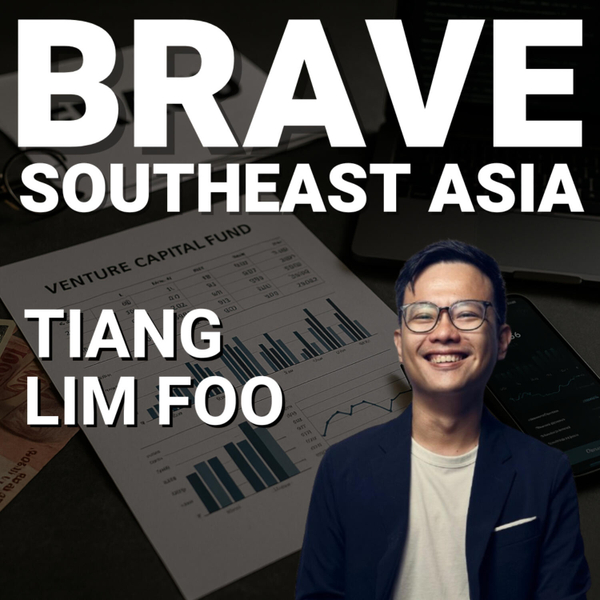
"Ultimately optimistic about the long-term viability of Southeast Asia as an ecosystem. I do think innovation and the pace of technology doesn't change; it will still be a positive force for the region. There's a lot of work to be done collectively as an ecosystem, whether it's founders, investors, you and I, and the wider capital markets. I'm still pretty optimistic." - Tiang Lim Foo, General Partner at Forge Ventures
Tiang Lim Foo, General Partner at Forge Ventures, and Jeremy Au discussed how Southeast Asia’s tech and venture capital landscape is evolving through cycles of hype, correction, and AI-driven transformation. They unpack the eFishery scandal as a clearing event, reframe expectations around exits, and debate whether venture capital remains viable in a region where only one unicorn appears every four years. They explore the split between local and global-first startups, how AI is reviving SaaS through productivity gains, and why only a few VC funds will likely outperform. Tiang also shares how fatherhood shaped his leadership style and how delayed gratification builds better founders and better kids.
02:43 eFishery was a clearing event that exposed systemic gaps: The scandal’s late-stage exposure revealed weaknesses in due diligence from seed to growth rounds. Tiang and Jeremy discuss how this singular event damaged investor confidence and might risk Southeast Asia facing a “lost decade” unless the ecosystem regains trust and transparency through police investigations.
08:20 Power law math must shift for Southeast Asia: Tiang explains why assuming a unicorn every year is flawed. With only one home run in Southeast Asia every four years, only two to four VC funds will hit top-tier returns in the region. He outlines how funds must underwrite exits between $100 million to $500 million and reverse-engineer ownership, dilution, and ticket size accordingly.
14:32 The ecosystem is splitting into two startup types: Baskit is an example of a hyper-local play focused on Indonesia’s supply chain, while Mito Health began in Singapore and now earns more revenue in the US. Tiang shares how these two paths local capital efficiency versus global market scale require different underwriting logic and founder support.
21:04 AI is reviving SaaS by changing productivity math: SEA companies previously avoided SaaS due to low labor costs. Now, AI-powered tools like Vercel enable 10x productivity, allowing startups to reduce headcount and speed up delivery cycles. Boards and management are pushing AI pilots across conglomerates and tech companies.
26:08 ChatGPT’s viral growth unlocked new software models: Tiang highlights how its intuitive UI and cross-language support made it usable with zero training. Unlike older tools like Evernote that required localization, ChatGPT’s frictionless adoption signals a shift in how enterprise software scales globally.
29:03 AI is widening the power law: Some lean teams hit 15K to 20K MRR without fundraising. Others build toward massive ARR and attract large rounds. Tiang explains how AI-native startups either stay bootstrapped or scale explosively, polarizing outcomes and reshaping venture expectations.
37:47 Parenthood reshaped Tiang’s leadership and time discipline: With two kids and a hard stop at 5:30 p.m. daily, Tiang structures board meetings around decisions, ensures clear agendas, and enforces pre-reading. He also draws parallels between parenting and investing both require influence, not control.
Jeremy Au (00:00)
Hey, Tiang! How are you?
Tiang Lim Foo (00:02)
Good! Been quite of, intense, interesting few years.
Jeremy Au (00:06)
Yeah, our last episode was episode 287, which was quite a few years ago. So definitely check out that episode to learn about your background and I think your experience becoming a VC and some those learnings along the way. I think we wanted to catch up because one of the causes is now we get to do this in person. There's a big difference.
Tiang Lim Foo (00:23)
Yeah, that's right. I think the last episode was in 2021, 22. Yeah, exactly.
Jeremy Au (00:28)
And then I think the second part was, we know, the Southeast Asia landscape has changed quite a bit as well during this time frame between like, eFishery fraud to kind of like the state of exits versus interest rates. So, I think a lot of things have changed along the way. The most important thing, the best investment of all.
Tiang Lim Foo (00:44)
In between I had another kid.
I don't know what the DCF on that looks.
Jeremy Au (00:54)
It's a cash outlay
of half a million dollars over the next 20 And maybe my kid will take care of me when I'm old.
Tiang Lim Foo (00:59)
Yeah.
Yeah, the expected value there is, you know.
Jeremy Au (01:06)
just saying like if you want to do a discounted cash flow then I think you got to take that into account. So, I think that's interesting. So, all of that is I think a question mark for all of us. So, yeah, why don't you tell me what's been going on in your life?
Tiang Lim Foo (01:17)
Yeah, so like I said, Hanana, a kid, he's 11 months old now, so proud father of two boys. That keeps me pretty busy, right? And since we last chatted, well, just maybe a quick reminder, I co-founded Forge Ventures in 2021. We ended up raising just under $25,24 million. And between then and now, we've made up
around 18 investments across the region. It's a generalist technology fund, that's the strategy, and with a concentrated portfolio approach, we've done a few investments in consumer, in Fintech, software, enterprise. Lately, we've made a few more investments in climate and energy.
And it's across Singapore, Indonesia, Philippines and Vietnam. So, we definitely have a bit of a view sitting headquartered here in Singapore, but looking at the region and getting a sense and powers of what's been happening in the past few years. I suppose you and I will read the same headlines. It's funny because I bumped into Willis the other day. Willis is the founder of Tech in Asia. He was like, how's it going?
You write the headlines, I read them, you tell me. And yeah, it's been a pretty dynamic and challenging and some might say intense couple years. You mentioned eFishery, right? It's probably the biggest headliner symptomatic of what's going on in Indonesia and the wider ecosystem. But at the same time, you know, we also see opportunities and green shoots within the portfolio. So, yeah.
Jeremy Au (02:43)
So yeah, I think definitely a lot of change happening. I agree with you, think eFishery was a big one, right? It's a big scandal, a lot of fraud. I think definitely,
I don't, like I say it's symptomatic but also end up being like a milestone that I think probably will set the chapter. Yeah, it's a clearing event. And I think we all had known that Indonesia had, everybody had knew that Indonesia had issues with accounting and it's allowed due diligence that's being done beforehand to make sure that people don't want the bad deals. There was also some controls that have been done.
Tiang Lim Foo (02:57)
It's a clearing event.
Jeremy Au (03:16)
But I think what was interesting about eFishery was the scale of it, the sophistication of it, and also the fact that he got to such a late stage before he was caught. So, all the various auditors that signed up for the books, but also the due diligence that had been done by seed rounds, Series A, Series B, Series C, all of it failed to catch it. So I think it caused a lot of pain because the late stage investor can't
survive such an event.
Tiang Lim Foo (03:44)
Yeah,
I mean, reputational damage aside, financial losses aside, I think one way to look at it is there's a pessimistic view to this, I think, right? Which is, would this precipitate a lost decade for Southeast Asia? It's something I catch myself thinking about.
Because sometimes when there is a loss in invested confidence, the sentiment and narrative sets in and that becomes a reality, right? Which is something that,
is that there's a non-zero possibility of it happening, which would be a shame actually, right? Because intellectually, you know that for every eFishery, there are other companies that genuinely are creating value, are building real businesses, are trying to innovate against that backdrop, right? So,
I do worry if that pains in the global investment community's mind a broad stroke of what Southeast Asia represents. But on the other hand, I think if you take a more optimistic view of this, this is not a forerian or a surprise for any growing ecosystem.
Silicon Valley has its own version of a Theranos and FTX, you know, and the scale is probably 10 times, no debt of efficiency, maybe 100 times, right? Because I've second-handed all the effects. China, no shortage of such stories, right, in the ecosystem. India, there's Biju's and what have you, you know, in recent memory. So, you know, I'm not saying that this is the right thing to do.
But it's a sign of a growing ecosystem, right? And it comes with a job description, right? If you're a venture investor, your job is to take the highest possible risk that you can underwrite, because the flip side of that is the highest possible return, right? And it comes with the territory, you know? Many literature has been written around
founder archetypes, what kind of founders and personalities would drive what kind of outcomes. And what we all tend to notice then is that exceptional founders come sometimes with interesting personalities. It's just, it's just part of the business, right? You know, and a non-zero percentage of that spectrum of founders would be people who are really good at telling a story, putting up a front
but might not be doing the right thing, right? And we just have to know how do we manage that, you know? So, I'm ultimately optimistic about the long-term viability of Southeast Asia as an ecosystem. And I do think that innovation and the pace of technology doesn't change, right? It will still be a positive force for
the region. Obviously, there's a lot of work to be done collectively as an ecosystem, whether it's founders, it's investors, you and I, right? And the wider ecosystem capital markets, we can talk about that. But net-net, I'm still pretty optimistic.
Jeremy Au (06:43)
I think I'm also optimistic about the talent in Southeast Asia. I think there's good talent across the region and there's strong like macro drivers, right? I mean, there's still
population growth, there's still middle-class growth. I think the playbook of what needs to be built is known, right? I mean, for example, you know, I think Singapore and Malaysia's GDP per capita is like, you know, five to 10 times. And then Malaysia to Indonesia's GDP is about, you know, kind of like three times, right? So, we kind of like, you know that Indonesia as it grows richer, look more like Malaysia. One thing I think about is like, you know, every coffee stall in Malaysia seems to be like air conditioned
Tiang Lim Foo (06:57)
Yeah.
Jeremy Au (07:20)
right? You know, because it's so hot, right? So for me, I look at Indonesia and Malaysia, I'll be like, the big difference between Indonesia and Malaysia is all your restaurants become aircon and more, right? So, I think there's a big shift that's going to happen and it's going to happen eventually over the next, you know, 10 years. So I think there's this dimension that I think there's tailwind. I think the tricky part that I'm struggling with is like,
that people are debating is venture capital that asset class that shows up, right? Because even an aircon story, you know, maybe there's a private equity you know kind of playbook that you're doing, maybe it's like traditional small- medium enterprise lending yeah and you know, so those are things that are more clear and previously, you and i have discussed like there's about
one unicorn being minted every two to four years, right? I mean last ye,ar we said every two years, now, we're saying looks like this Lal looks like every four years and that home run is so critical for the asset class or venture capital to play out, yeah
Tiang Lim Foo (08:20)
No, I think those are very good thoughts. Maybe one way to think about is this, right? Taking a step back and really looking at the state of play today and looking at reality. So what's the reality? The reality is that if you compare Southeast Asia to a global ecosystems, DPI has been pretty lackluster. It's just a fact.
From a value creation standpoint therefore you know one would ask whether all the companies are marked to the right mark yeah right in the ecosystem you know what else a lot of companies that are are regional but most are still pretty localized so there's a question of time, how big can they get,
and fund sizes, right? It's also a commentary on, if I had raised a billion dollar fund in Southeast Asia, how many checks should I write to enhance the probability of me returning the fund at least, if not genuinely producing profits for investors, right? Those are all questions that we have to contend with, I think. And I think that's independent of whether...
you're in Singapore, Indonesia, Malaysia, Vietnam, right? One thing I always think about and have, you know, and I have a bit of a debate with people on it's kind of what you alluded to which is does the power law exist, right? In Southeast Asia? If you really think about it,
Jeremy Au (09:37)
Mm.
Tiang Lim Foo (09:40)
the definition of power law means that a few investments drive the majority of the returns of a fund, and if you zoom back out the entire ecosystem, right? I think it doesn't go away. But the difference in Southeast Asia, I think it's the assumption of there's a unicorn every year might fundamentally be wrong.
So maybe, the outcome that you underwrite to it's a $500 million company, 250 maybe, maybe even a hundred. And if that's the outcome that you, you underwrite towards, right? The rest are just math as a 10 million seed fund or 20 million seed fund. How many, how much you need to own for each outcome? Cause that's the expected value. And if you work backwards, if that's the case, then
here's the entry valuation based on relative to the ticket size that I could write to invest in, right? And you kind of do the math that way, right? And really hold that discipline. I think that's something that we would need to be very clear-eyed on. Instead of saying, this is the TAM, right? And it's really going back to first principles to see,
hey, these are the companies that we invest in. These are the sectors. Here's the potential term. These are the outcome we're underwriting. Ticket size, ownership, and then there you go.
Jeremy Au (10:57)
I love to double click into this because I think this is actually a really big piece, right? Because I think when we talk about the Star Wars stuff is actually we talk about the macro piece but I think the crux of it is what's the power law? I would say the third dimension is whether you as a fan are good at picking those power law pieces, right? And obviously for this third chunk you know the two strategies like you said one is your strategy which is concentrated picking which is like some people call it zero hero
And then of course, there is the kind of like spray and pray, the index fund, which is doing 40 or 50 investments. This would be a bit looks a bit more closer to like iterative. I would say East Ventures as well, right? So I think that different picks. I think the part that people are very comfortable competing is that, okay, I can pick better or index fund is better.
I think you said something before the podcast was very true, which is right now there's about one unicorn every two years, maybe now one every four years. Being publicly listed has that outcome. And what that implies is that...
if it's one unicorn every four years, then only two VC funds deserve to exist because only that's only one home run every four years. Each VC fund is only two years. And people can either invest either at the pre-seed and the other one is the series A stage. So it's only two bites of the apple before it goes to the US.
Tiang Lim Foo (12:17)
Yeah, before it goes to US.
Jeremy Au (12:19)
So
in this scenario again, if it's one every four years, then only two VC funds will have DPI and IRR. And if it's one every two years, then there'll be about four VC funds that will have that VC level return that's comparable to a US or a fund. So I was just kind of curious about that because this is actually your insight as well. So I'm just kind of curious about how you think about that.
Tiang Lim Foo (12:42)
Yeah, so look, what we ultimately realized as a seed fund is that, again, if we do the math really quickly, right? Back on the neck, and let's say we're just under 25 million for one, right, so let's say about 20, right, to return the fund, assume you hold 10 % of the company at the eventual exit, right? That implies you need to create a collective enterprise value of 200 million.
And if you assume half of the portfolio companies would die, that assumes your expected value should be four to five hundred million. Yeah. Collective EV, right? And if you assume that from first bite to exit, you are suffering about five to 10 percent dilution, your first investment ticket should be around 15 percent plus minus. So that's the way we kind of do the math.
I think what's more nuanced than this, it's really understanding and spending time to your point selection. Selection comes in two dimensions, I think, right? Besides selecting obviously the best founders we can find, it's the sectors and markets that you underwrite towards. So one thing we're noticing in our portfolio companies right now is
it's bifurcating into a bi-model distribution. On the one hand, we have companies like Basket, based in Indonesia, pretty localized model in that they create technology and platform for distributors, for the supply chain in categories like FMCG, consumer electronics, right? It's really hard to regionalize and definitely harder to globalize.
Still a huge problem in Indonesia, still very valuable, arguably a large market, because it's not a 10 billion or trillion dollar market size. So working backwards through that then, what's the outcome you're underwriting and subsequently design the entry point versus like the other modality right now we're noticing. I think a great example is a company called Mito Health, M-I-T-O.
Jeremy Au (14:25)
Yeah.
Tiang Lim Foo (14:32)
I invested in Mito Health maybe two years ago when Kenneth showed up with an idea. So and subsequently they launched in Singapore going to Y combinator last year. Now they're available US nationwide. But if you rethink about the time then, right? It started from Singapore, such a small market. Our original hypothesis was can this be developed Asia?
Developed Asia play? Because price points, demand, level of quality of service that you provide seems more like a developed Asia play, right? But they, the founder's credit, found a path and way to the US, which is 100 times larger in terms of market size than what we could see here in Asia. And the latest numbers have shown that within six months of them launching in the US, they've far surpassed their revenue in
Singapore over the past two years. So there's a bit of a, hey, can we build from here, start from here? Let's build a path towards a larger market. And obviously in that go-to-market motion, then the outcome we're underwriting, it's definitely much higher than a very localized play. So a lot of lessons learned in that pattern.
And really it's about selecting, coming back to selection here. Besides, obviously the baseline, the bottom line is we need to work with very good founders, exceptional founders, but also be very clear on what's the execution, what's the outcome we're underwriting and working backwards from exits. And that's how we think.
Jeremy Au (16:01)
Right. You know, I think that is really good because what comes up for me is that even though I think we're saying that there's maybe only two to four slots of good VC funds that can do well in Southeast Asia currently,
the glass half full version of that is there are two to four slots. So the question is, can you become good enough to be one of those two to four? And I think what's interesting is that, I know both those founders that can start ups, right? We are both investors in Basket. So that's one. And then also both of them, both Yen and Basket and Kenneth and Mito have also been on the podcast as well.
And think I agree with you that actually I see that split as well, which is that I think that the old thesis of original story like Grab or like a logistics player, that story seems to be, I mean, still available as a play for the right player.
But it feels like the very deeply localized capital efficient route, maybe even a local listing, is a path. And then the path, like you said, is the Singaporeans who understand South America and have that corridor as well.
So yeah, I think it really boils down to that ability to pick as well. Are you good enough to be the... I guess now it's the squid games, The Southeast Asia. Previously, everybody thought that every fund was going to do well. And now, if you're focusing on Southeast Asia only.
Tiang Lim Foo (17:17)
But you also know that's not going to be true, It's not going to be every funds going to do well. I think such is the nature of market cycles, right? In the upmarket, everyone's a genius, right? In a negative market, that's where you really see more intensity and stress in the ecosystem, right? But you always know that if you take a step back, it's always going to be a normal distribution curve, right? Some will do well, some will do okay, some will do exceptionally well, right?
And we spoke about power law. That's why it is an incredibly hard industry. The power law means that maybe one or two of companies within the fund will drive majority of the returns in to fund, but it also implies that industry-wide, only one or two or two or three funds across an entire industry of maybe 50 or even 100 potentially, right? Drive majority of the profits of the industry, right?
I think there's a report from Silicon Valley that came out recently. It's even more concentrated than ever. The entire industry in terms of LP dollars concentrated maybe top three to five names. Majority of profits concentrated in the top three to five percent of the funds in a given vintage. But look, I also know that the world's changing really quickly.
I'm pretty proud that we're 30 minutes in, we haven't even talked about AI. The world is changing really quickly. Geopolitics, local regulators and market makers are trying to figure out the capital market problem. It's not that we're not aware of the gaps to be plucked and the problems to be solved. And the pace of technology has also forced everyone to...
rethink company building, product building, and value creation. GPT, I think it's really a huge clearing event in that regard. Going back to first principles to rethink from the ground up, what it really means. One example that I keep, or one thought I keep working on these days is if you look at the past,
10 years, lot of investments in Southeast Asia is really driven towards investing behind consumption, right? And some of the biggest assumptions are young population, growing middle class, higher spending power, higher GDP per capita, to your point. And that's done pretty well for a lot of people. But I think the next 10 years might not be a hundred percent consumption. Again, given
what we know now about GPT, right? Could it be a mixture of consumption, but also productivity gains, right? People always think that, next year enterprises are going to start adopting SaaS, cloud, whatever. And that next year never comes somehow, right? Which is astounding to me because if you look at
some of the biggest enterprises in Asia, South Asia alone, right? Not everyone's on cloud yet, you know, so the SaaS stories do not play it out. And if you add AI to that, I think there's still a lot of room for growth in my view, right? For the next 10 years, especially now that a lot of the individual employees, contributors, younger generation are more and more adept and open-minded to technology and using
new ways to create value using generative AI. I'm pretty willing to make a good bet on the next 10 years that Southeast Asia is not just a consumption investment pattern. It could also be a productivity driven one. And we're already seeing some green shoots in that, especially in Singapore. So Michael, obviously a good example, we're really
investing behind the trend that people care more about their health. There's also a B2B play behind, can we make, labs more efficient? Can we make doctors more efficient, right? Basket for instance, right? Not, not a consumption play, right? There's consumer consumption trends driving that, but ultimately it's a productivity story. And we're seeing more and more, examples of that coming out here.
Jeremy Au (21:04)
Yeah, I think that the SaaS story is interesting because it's a tired story. But it's interesting for you to bring it back. So the reason why it was super hot five years ago in the 2021 book for SaaS. I think Peng and Meng Xiao has been a big
Tiang Lim Foo (21:13)
This is a story.
Jeremy Au (21:26)
component, which is saying it's effective of GDP per capita, which is that if humans are cheaper than SaaS, then it's hard to buy, right? Oh, now we're saying it is, if the job that you're trying to place is one American with SaaS, you get a higher one less American, is going to cost you $100,000 USD. And the software is going to cost you $1,000. Then in a year,
because it's a hundred dollars times the 12 months, then it's a hundred X return straight away for year one, right? So that's why people have to switch. But if your labor in Southeast Asia is costs $5,000 per person, then you could hire 20 people, right? And then your software is there. Does it really...
you know, have the same ROI, nonsense.
Tiang Lim Foo (22:13)
Yeah, I get that. think obviously these are anecdotal examples, right? We have a portfolio company, just at the most recent board meeting told me that they axed 20% % of their headcount. It's not because of, well, it's cost cutting for sure, but cost cutting to a productivity and because they discovered that,
instead of saying, I need one more engineer to write 100 lines more of code, right? I just paid 20 bucks per month for Vercel, everyone's on, it's 10 times more productivity, right? And it's noticeable compression of the journey from idea to production. And it's a very real 20 % cost reduction.
Quite a few portfolio companies that I have in Vietnam, Philippines, Indonesia, okay, maybe not Vietnam, but more Philippines and Indonesia They're having trouble hiring engineers that are high quality so they almost always end up hiring in Singapore, India, Vietnam, right, some parts of Malaysia But now if they do manage to find a good one in Indonesia, I would
turn that 10X engineer into 100X because now they have access to Vercel, to whatever, right? And these are the next generation of companies being built in our economies today. I'm also seeing evidence of that happening in local conglomerates, telcos. And the attitude shift from,
should I adopt SaaS? I think AI is an important thing. Everyone's at least willing to try a POC on AI. And these are directives coming down from the board, coming down from management. We need to figure out AI.
It's super interesting. The attitude change of, this is another software, to this is AI, right? I mean, it's still software, but AI, right? Just gives everyone more air cover to experiment and take a little bit more risk, right?
Jeremy Au (24:14)
Yeah, I mean, I agree with you because I think AI has changed that story again, which is why we bring it back. Because one is, I think it lowers the cost of SaaS technically for the same amount of SaaS. Technically, I think you drive the cost 10x lower for the same functionality, right? So I think
that cost bar that we just talked about, the ROI. I think AI really kind of like drives that cost basis down. But I think it's not going to show up as low cost test. I think it's going to show up as, like you said, more power, right? More power. And I think the more power parts of AI is actually the areas that Southeast Asia companies kind of struggle with, right? So it's like English writing, you know, like, you know, marketing, code writing. Like this is what AI is good at. And these are skills that are just difficult to hire. You can't hire 20 Indonesians versus one American
to get the copywriting or co-writing. Whereas I think the traditional version of SaaS was very much like a process checkpoint of finance approvals. Then that was something that 20 Indonesians could have been seen as a serviceable baseline that you just want to keep because they're
Tiang Lim Foo (25:22)
Yeah, so
it's no longer just about if you really think about the atomic unit of jobs to be done, the biggest difference that I see when it comes to software, it's the paradigm of SaaS is about automation and it's very defined workflows. To now, a lot of the promises of Gen.AI, some of them realize, to your point, marketing, sales,
coding, user interface requires zero training. It's astounding to, I was just listening to a podcast, I can't remember where I heard it from, but ChatGPT went from zero tokens processed per day to close to a trillion per month, something like that. And it's astounding because this is probably one of the most viral software products ever.
Jeremy Au (25:50)
Right.
Tiang Lim Foo (26:08)
And it's not even social. you know, unlike Facebook, unlike Google, where inherently there's virality to the product. ChatGPT is not social, but the rate of adoption is like this, right? And I think that's a lot to do with the ease of use. And they've also solved the... When I was at Evernote, thank you,
Jeremy Au (26:28)
I never use buying and paying forever.
Tiang Lim Foo (26:31)
brings a tear to my eye. We have a department that focuses exclusively on localization. And we need to think about, how does the software look in English, in Japanese, in Russian? Obviously, it's built into the product, but also impacts sales and marketing, and impacts the way we think about user experience from the user point of view in different languages. ChatGPT has none of that.
Today you can, and even within the same sentence, can interact with ChatGPT. English, Chinese, Malay at the same time. No problem. So I think it's a lot to do with that aspect of today, the software products of today. And it's only going to get better, I think.
Jeremy Au (27:10)
Yeah, I think that's the crux of it, which is that ChatGPT is good and it's only going to get better, right? So I think that's where I feel like founders today should take that approach, which is if ChatGPT continues to get better.
But as it linearly continues to improve, I think there's a lot of opportunities that this opened up as a result.
Tiang Lim Foo (27:31)
I think so. But also means that more importantly than ever, you really need to have the low hanging fruits of, okay, this is a manual process that I automate. Those go away very quickly, right? In terms of a new company to be built. More importantly than ever, it's really about your insight in a certain industry, whether you really, really understand customer pain points,
and point your solution towards that, rather than a, let me collapse step zero to step 10, from step zero to step 10 to zero to five, right? And I charge you based on the cost, say, from 5 to 10. I think we really have to rethink what that means, especially also, and also especially in business model terms, right? To your point, right?
Before we understood as cost savings as on a per human basis. But today I think it's less clear. It's also about on a per human basis, how much more I can get out of a person. And it's not, it's no longer per head, per seat, per month. It's really about quantifying, the value that my product brings to you, you know, and how do I capture some part of that.
Jeremy Au (28:43)
So let's talk about that piece of value and now we're getting into AI I guess. What do you think that means, right? Do you think that means that the green shoots plus AI means VC is going to be back in two years? I'm just kind of curious because ...
Tiang Lim Foo (28:48)
Hahaha!
Jeremy Au (29:00)
the joke is, everyone's all waiting for power law, it never happens anyway.
Tiang Lim Foo (29:03)
The power law could be more extreme. I think one potential way to think about this is the power laws could be more extreme. I'm sure you've met quite a few, well I've met quite a few teams where two people, they fight code a product and it's a good 5, 10, 15, 20k MRR,
sustainable, I don't need VC funding and there more more examples of that and it gets very very niche. I heard an example that day that someone created a messaging app but just for LinkedIn that's it 15k MRR, two people I'm never gonna fundraise good for you or like an image generator for FNB just FNB 10-15k MRR,
not going to fundraise, right? Good for you. So I think I suspect we'll see a lot more examples of that where, you know, you have a problem, you know how to build for that problem, you solve it. Is this a business? Sure, right? Could this be a venture backed company? Big maybe, right? And the other extreme then would be
something like a livable oversell, right? That just catching lightning in a bottle. You scale that way. You develop for a large market. and the outcome is very extreme. You know, a 16 Z just publish, what it means to build for in the AI era recently, right? At least in the US they're seeing if you're a seed company, AI native, you're getting to,
something like a three to five million ARR in 12 months. And that's just median, you know, and if that's median, I don't know what the exceptional one looks like. So maybe the power law becomes more extreme, you know, I think coming back to Southeast Asia here, I, my excitement really comes from not, hey, am I building the next AI product for Indonesia in this market? Although
Jeremy Au (30:41)
Yeah.
Tiang Lim Foo (30:53)
there's a non-zero possibility that that happens. But I think the shift in mentality of like postGPT because we already established that open AI will get better over time. How can we build companies more efficiently? You know, it's no longer about raising gobs of venture dollars to hire teams of
coders, programmers or product managers. It's really about, if I can use this technology to solve a problem cheaper, faster, better, and it's still a big problem, i.e. venture backable idea, I think there's a lot more interesting company building happening here. And it probably is going to be more efficient too.
Jeremy Au (31:28)
Yeah, I think what's interesting is that, you know, we were talking about America and one of the concerns that's coming up is that there is a suction effect away from Southeast Asia into America as asset class, right? So we saw about the power law might become more extreme. Well, a lot of the AI that's being driven, innovation is being done out of America. So that's where the first gains are. Yeah. I think that
during the pandemic everyone was like Silicon Valley is over. It's about the rest of the world and now there's a little bit of a suction effect where Silicon Valley is back and people are moving to Silicon Valley and so you see like a lot of VC funds even Southeast Asia kind of like focus much more on the US say diaspora I think is one and our group is like you said are focusing on Australia, New Zealand, are focusing on India, some of them are focusing on China.
And I think there's very little of that echo in the other direction, so I was just kind of curious about how you feel about that.
Tiang Lim Foo (32:21)
Yeah, unfortunately, I think speaking purely in capital market terms, right? Whenever market downturn happens, when liquidity goes out, the Southeast Asia pool is inherently very thin, right? When liquidity goes out, less risk taking, less risk capital, and that's just a reality that we have to contend with.
Today we're also seeing a lot more polarization in the world stage. US is getting more and more protectionist, or collectively the West seems to be a lot more protectionist. And then there's China. India seems to be having its moment in the sun, which is awesome. And then there's Southeast Asia. The liquidity pool is very thin. I was listening to...
I'm sure you know the acquired. Awesome, right? The most recent episode is an episode on Google. People always forget that Google had only ever raised one VC round. It's mind boggling, right? They raised an angel round, 10 mil post, right? And then they raised a venture round, series A, profitable, and then that's it.
Jeremy Au (33:05)
Yeah, yeah, yeah, of course.
you
Tiang Lim Foo (33:27)
And the reason why they did not raise another venture round was because they're profitable. And the reason they're profitable is because they kind of fundraise because right after series A it was the dot combust, right? And enforced a lot of discipline on company building, on really thinking about a business model, really thinking about how do we become a higher quality company, right?
And I see a lot of similarities in today's environment. There's a lot more emphasis on path to sustainability at least. If not, is this profitable? How do we have a discipline to build towards that outcome? Netnet, I think, is going to be a healthy forcing function for Southeast Asia, especially
acknowledging the fact that the liquidity pool in the region is already quite thin in the capital markets. But that doesn't mean that there's no business to be done here in Southeast Asia. To your point earlier, macro in Southeast Asia is sound. GDP growth rates across the region are still in the
5 to 6 % range, thereabouts, still healthy. So there is business to be done. It's just how do do it? How do you capture that value and grow alongside with the region? I always feel like as investors, as participants of the capital markets, whether you're private or public, VC or PE, we live in a little bit of a parallel world to the real economy.
There's always the difference between Wall Street and Main Street. Wall Street lives in a different market mechanism than Main Street. I think Main Street Southeast Asia is still pretty robust. Is this limited? It's all doom and gloom.
Jeremy Au (35:09)
I think I love what you just said, which is Main Street is doing well in Southeast Asia, business is still going on, people are still eating their noodles, eating their beef rice bowl.
Tiang Lim Foo (35:19)
Yeah,
yeah, yeah, I just walked past the Labubu store and the Pop Mart store it's like, business is boring.
Jeremy Au (35:25)
Business is here for these cheap dolls that could have been Doraemon, could have been Ultraman, could have been whatever now is a Chinese brand. So I think a lot of gains for example Chinese brands expanding to Southeast Asia, franchise operator, fundamental mainstream.
Tiang Lim Foo (35:42)
Because clearly they see opportunity here. I think that's my message to founders, which is, before times of reading tech in Asia, TechCrunch, someone reads another series A about web valuation, not that it's a sign of success, then...
I think it's more so it shouldn't be a sign of success today. It shouldn't be a sign of validation that your business is working. Your business is working when you're profitable. And then you have a business.
Jeremy Au (35:58)
Yeah, exactly.
Makes sense. On that note, I love to kind of like slowly kind of like transition into, kind of like your own personal side. So you also have some changes as well. You've become even more of a dad.
Tiang Lim Foo (36:15)
That plus, that square.
Jeremy Au (36:18)
Because
you already were a dad last time we chatted. But now you're at a second kid. You grow your portfolio so diversification. You're like, ah, this first one is another home run, number two, you know.
Tiang Lim Foo (36:22)
I've grown my portfolio.
If it doesn't work out.
It's been a pretty rewarding journey and it sounds corny but I do learn a lot of I draw a lot of parallels and I did learn a lot of lessons by being a parent and the parallels between being a parent and being an investor. What struck me as the most important point to really,
as a point of growth for myself, it's recognizing the fact that how much you just cannot control. And it works both in the living room and the boardroom, right? You can influence, you can advise, you can put in place guardrails, but ultimately the decision to do something is in the hands of the child and it's in the hands of the startup founder, you know.
And I think that observation just reinforces each other. So boy one is like seven years old now, definitely a lot of independent thoughts these days. And it kind of reinforces both day job and that life. But yeah, I think I'm all the more better for it.
Also a maturation of my ongoing maturation of an investor and being, you know, hopefully a leader in the boardroom.
Jeremy Au (37:42)
How have you changed as the leader in the boardroom because of becoming a dead square?
Tiang Lim Foo (37:47)
Being that to two boys means it's a forcing function of I really need to be more productive and efficient with my time. And one example of that would be setting very clear expectations of why are we even sitting down to have a meeting, for example, out of many things.
And being very clear on if we're having this board meeting, let's have an expectation of are you looking to make certain decisions, which requires everyone's input, right? Be more disciplined on sending materials beforehand so that everyone can be very efficient about consuming information and contributing to the conversation.
And really have very clear expectations of if a decision needs to be made today or do we have more questions and all that, and we just really have a cadence of those things. That's one example and there many many such examples because really, you know, by 5:30 I really need to leave my office to pick my kid up.
Jeremy Au (38:47)
Wasn't leave the
kid at school.
Tiang Lim Foo (38:48)
No,
no, I cannot be like, it's okay, I'm running 20 minutes late, why don't you play 20 minutes more? There's no such thing, right? It's a positive function.
Jeremy Au (38:58)
Yeah, yeah. Making me remember all the times when I was like at school and I'll be waiting at the school steps.
Tiang Lim Foo (39:04)
Yeah, I'm like, yeah, literally the image in my head, It's he's twiddling his thumbs sitting by the canteen and I can't even text him because he doesn't have a phone, right? So yeah, it's really that enforced discipline.
Jeremy Au (39:19)
What's your philosophy on technology for kids?
Tiang Lim Foo (39:22)
We delay screen time, me and my wife, we've decided very early on that we want to delay screen time as far out as possible. Obviously, many research has been done on the attention deficit, starting from our generation and younger, and a lot of that contributing factor comes from screens. It's an established fact and we want to be very disciplined on that.
Jeremy Au (39:41)
Yeah.
Tiang Lim Foo (39:45)
between 0 to 5, at least for boy 1, he had minimal to no screen time. He doesn't have an iPad, definitely not a phone. These days we're a little bit more loose because one interesting observation that we had made was because he had zero screen time,
at one point he didn't know what Paw Patrol is, he didn't know what, you know. And his friends start telling him about Sonic and Paw Patrol and whatever and he's missing out on, he can't engage and he's missing out on conversations, right? And it's impacting his social life. So we have to solve that, so now we let him watch Paw Patrol. He no longer watch Paw Patrol, but you get the point, right?
Jeremy Au (40:18)
loser.
Tiang Lim Foo (40:29)
We let him watch some Netflix so that he can engage in dialogue. But it's regimented, 30 minutes per day, maybe an hour during the weekends, but not before you finish your homework. So there's some kind of routine to it. I think the intention there really is about helping him build good habits that he can keep over his lifetime.
Because I can't tell him in 20 years, should you be an AI researcher or a doctor? But I know for sure that to be good at either, you have to have good habits. And that starts from home.
Jeremy Au (41:02)
Yeah, I just want to say like, you know, when I went to America to study, one of the biggest things I realized was that so much of the conversation then was always about TV shows. Yes, because it was always like, have you watched Game of Thrones? Yeah, have you watched Star Wars? Nobody watched Star Trek. you get away without that one. So and I always remember like, you know, as a
Tiang Lim Foo (41:12)
Yeah
Jeremy Au (41:25)
international student back then it was very much like okay I gotta watch this stuff as just research ⁓ I gotta watch this stuff
Tiang Lim Foo (41:30)
Cultural immersion. Cultural immersion.
But it's very true right, I think part of it is about, a large part of it is participating in the cultural zeitgeist of the moment. In a more atomic unit it's about engaging with, you know, socially and being very culturally sensitive to the happenings of the world, right. If the way that you achieve that is by watching some TV shows, then go for it.
Sometimes I think about this, we're millennials, we grow up watching TV and we're fine, remember at one point, were like, if you watch TV 24/7 you can be dumb. Yeah, I think we turned out fine.
Jeremy Au (42:07)
yeah,
And reading Harry Potter is satanic. And it's gonna corrupt your boroughs.
Tiang Lim Foo (42:13)
Yeah,
right. But we turned out fine. So what's the anxiety and difference between then and today if I give the kid an iPad? My conclusion is that the screens of today are fundamentally different from the screens of yesterday years. For one, it's interactive. Obviously, when we're growing up, when we touch the TV, we get scolded because it's HDTV, whatever.
Jeremy Au (42:33)
You spoil it with your fingers, your busy fingers.
Tiang Lim Foo (42:36)
But
now the intuition for a kid is, why is this broken? So I think interactivity is a huge difference. I think more important than that is the on-demand aspect of screens today. Remember last time when we were watching programs on TV, we have to wait. If it goes away, it goes away. If you missed it, you missed it.
And you always hold your pee until the next advertisement. And then you try to rush back again. No, no such thing today, right? If I want to pause, I pause. If I want to watch it now, it happens now, you know, so I have to explain to my son that, uh, no, if you miss Doraemon on on 9 AM so today you missed it, right? It's not streaming. It's not on demand, you know, and I think that's shock sick It's something in the brain where
you expect instant gratification, there's no delayed gratification. It doesn't help you understand anticipation and patience. It takes away some aspect and element of surprise sometimes, which is pretty much the definition of life. And I think that kids today, because of that, they lose some aspect of that.
Just the ability to be patient, to sit in uncertainty for a bit, to anticipate, to work through frustration and having that ability to just concentrate. That's I think the biggest difference.
Jeremy Au (43:54)
Yeah. On that note, any parting words of advice that you would give to founders or to executives today? Yeah. at Southeast Asia.
Tiang Lim Foo (44:02)
Patience, I think the same act, the same,
the same point, right? More so than ever, instant gratification is mostly never a good thing. All of the best founders I've worked with, they have this ability to delay gratification, right? And really think, thinking in terms of the bigger picture, the longer term, rather than the next round and the next valuation, you know, and
the ability to really sit in uncertainty and frustration and just work through it. I think it's what's gonna differentiate you and the rest of your competitors or other founders. ⁓ First principle thinking, I think it's quite important. Going back to first principles to really think about why are you building this business in the first place?
Jeremy Au (44:37)
Yeah.
Tiang Lim Foo (44:49)
How do I make this a business and not just a product, not just a concept, right? Going back to fundamentals, you know, especially in times like this, I think it's important. Yeah.
Jeremy Au (45:01)
Yeah. On that note, thank you so much for sharing.
Tiang Lim Foo (45:03)
Thanks for having me